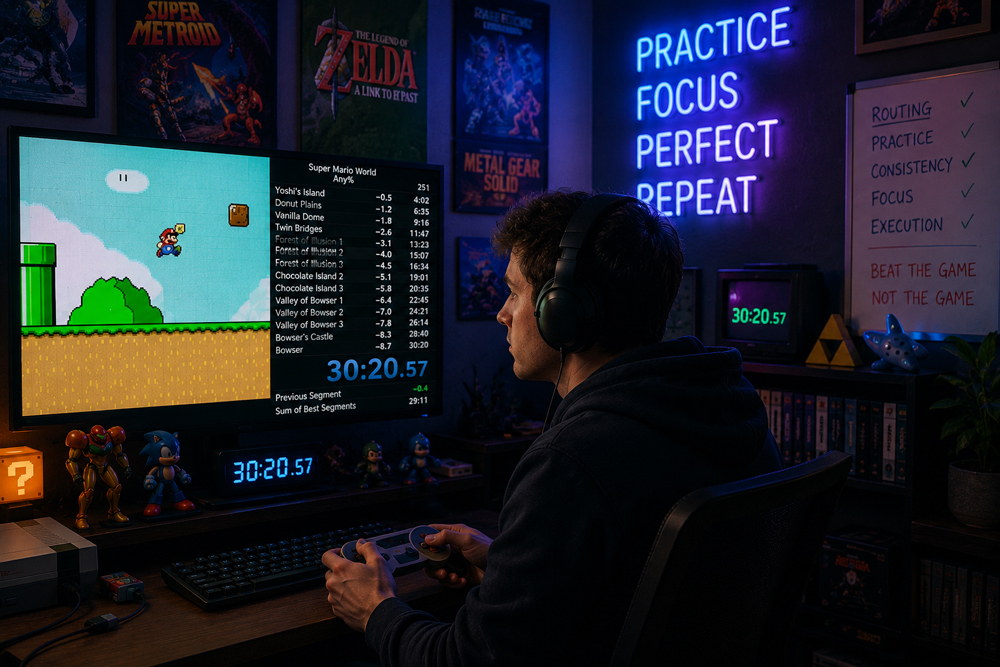
Speedrunning strips a game down to its bones — no cutscenes, no lore, no hand-holding. Just a player, a timer, and the question of how fast the whole thing can be broken.
In an age where gaming continues to evolve, the question arises: Is speedrunning the purest form of gaming left, or is it merely a different kind of performance? This debate draws attention not only to the competitive aspects of gaming but also to its artistic and community-driven narratives.
Speedrunning, the practice of completing video games in the shortest amount of time possible, has gained significant traction over the past decade. With the rise of platforms like Twitch and events like Games Done Quick, speedrunning has transitioned from niche subculture to a mainstream phenomenon. As traditional gaming evolves with complicated mechanics and narratives, speedrunning might offer a profoundly different experience, grounded in skill, precision, and community engagement.
Derek Yu, celebrated game developer and creator of Spelunky, argues that speedrunning epitomizes what gaming should be about: skill mastery and personal achievement. For Yu, speedrunning allows players to engage intimately with game mechanics, revealing layers of design that often go unnoticed during regular playthroughs. "When you speedrun a game, you're not just playing; you're dissecting it, finding gaps in the design, and learning how to execute flawlessly. It becomes a dance between the player and the game."
Dr. Jane McGonigal, game designer and author, shares this sentiment, describing speedrunning as an avenue for gamers to experience a sense of accomplishment. "The thrill of completing a game in record time speaks to a fundamental human drive for mastery and competence. Speedrunning also fosters community, as players gather to share strategies and support each other's progress. It's a collective journey toward excellence."
In contrast, Twitch Poarch, a professional speedrunner and streamer, offers a critical take. He posits that, while speedrunning certainly showcases incredible skill and technique, it inevitably leans more towards performance than gameplay. "When you're speedrunning, you're putting on a show. It's about entertainment and engagement with the audience, which can often shift the focus away from the essence of the game itself. The pressure to produce content and maintain a viewer base can alter how players experience the game and their motivations for speedrunning."
Poarch's observation raises a sharper question about authenticity in gaming. Are speedrunners truly playing for the enjoyment of the game, or are they primarily motivated by audience approval? This perspective sheds light on a critical tension within the speedrunning community — the balance between competition and performance.
All experts agree that speedrunning requires an exceptional level of skill and dedication. The sense of community created through shared experiences and mutual support is widely acknowledged as one of its greatest strengths. Both Yu and McGonigal also support the idea that speedrunning provides a more profound interaction with game design, revealing hidden layers of complexity that casual play never reaches.
Where they split is fundamental: Yu and McGonigal view speedrunning as a means for genuine engagement with the medium, while Poarch emphasizes its performance aspect — suggesting that audience-driven goals may quietly replace intrinsic motivation. Is the runner playing the game, or playing to the crowd? The answer, according to Poarch, is increasingly both — and that matters.
As the gaming industry progresses, understanding the implications of speedrunning on the community and gaming experience becomes crucial. It forces gamers and developers alike to re-evaluate what gaming means in a digital age — whether it's about mastering a game or engaging in a shared performance narrative.
What does it mean to play a game at breakneck speed, and how does that affect our understanding of the medium? The answers are as varied as the games themselves — making this debate both timely and necessary for the evolution of gaming culture.
The Dance of Mastery and Community
In navigating the intricate debate surrounding speedrunning, it becomes clear that it embodies the very essence of gaming—intense skill, community interaction, and personal achievement. Speedrunning is less about the mere completion of a game and more about a dynamic relationship between player and design, where every glitch and optimization tells a story of dedication and finesse. The sheer exhilaration found in racing against time resonates with both individual achievement and collective passion, highlighting gaming’s fundamental drive for mastery. While some may argue that speedrunning is merely a performance art, it transcends this label by fostering a thriving community and showcasing the depth of game design in ways that standard gameplay often misses. Ultimately, speedrunning stands as a testament to the evolution of gaming, not just as entertainment but as a profound exploration of skill and artistry.

Derek Yu
Game Developer, Creator of Spelunky
"Speedrunning is the epitome of gaming as it showcases the skill and creativity of players pushing games to their limits. It exemplifies competition and community-driven enjoyment, celebrating games in their purest forms."
𝕏 Derek Yu in Derek Yu
Dr. Jane McGonigal
Game Designer & Author
"While speedrunning showcases incredible skill, it also raises questions about performance and the gaming experience. I believe it represents a new form of play that balances competition and artistry."
𝕏 Dr. Jane McGonigal in Dr. Jane McGonigalHow Does This Hit You?



No comments yet. Be the first to weigh in.