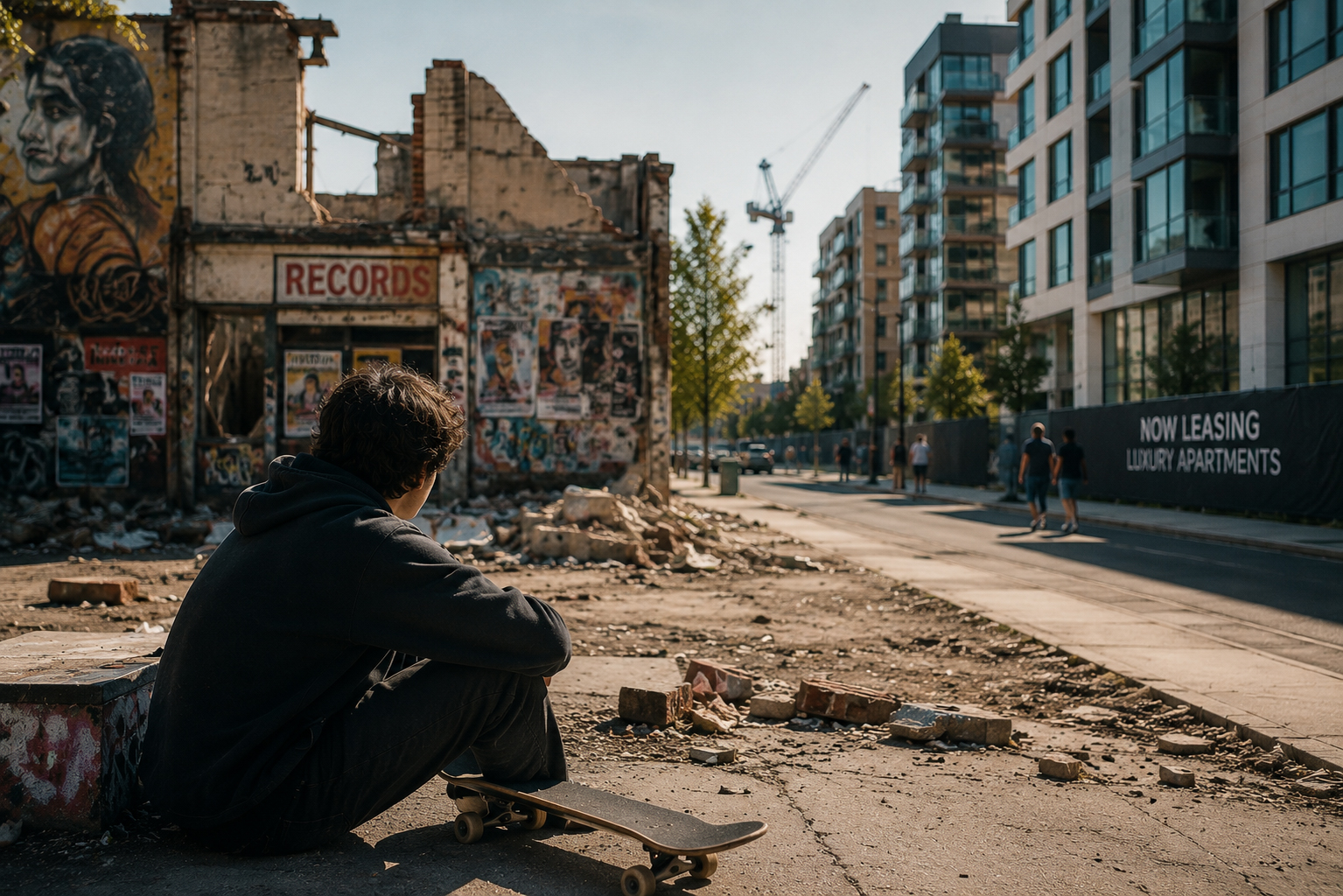
The skate spot is gone. So is the mural, the record store, and the dive bar. Gentrification keeps claiming cultural landmarks — and Richard Florida, David Harvey, and Jane Jacobs each have a very different explanation for why it keeps happening and who's really to blame.
As cities evolve, the specter of gentrification looms large, bringing with it both revitalization and the sad demise of cultural landmarks. Whether it's the recent closure of a beloved record store or the whitewashing of a community mural, the toll of urban transformation raises an implicit question: Is anyone genuinely surprised by the cultural casualties that accompany this phenomenon?
Context: Why This Matters Now
With urban centers experiencing a rapid influx of new residents and capital, discussions on gentrification have resurfaced with renewed urgency in light of a fluctuating economy and shifting demographic trends. Neighborhoods that once thrived as havens for artists, skaters, and independent businesses are increasingly becoming expensive enclaves for affluent newcomers. This tension raises critical questions about place, identity, and cultural heritage in our cities.
The outcry surrounding the erasure of traditional skate spots, street art, and local music venues underscores a broader struggle. Gentrification not only changes the physical landscape but also alters the social fabric of communities. It raises concerns about who has the right to define and control urban space and whose voices are amplified in the public arena.
Perspective: Richard Florida
Urban studies theorist Richard Florida argues that creative communities often serve as precursors to gentrification. He posits that vibrant neighborhoods attract talent and investment, which can lead to rising rents and property values. Florida notes that while this process may stimulate economic development, it often marginalizes existing residents and cultural institutions. "The creative class is drawn to areas rich in diversity and culture," he states, but as these neighborhoods become increasingly desirable, the original cultural markers — like skate spots and record stores — inevitably fall victim to a homogenizing economic model.
Perspective: David Harvey
Contrasting with Florida's somewhat optimistic view, geographer David Harvey offers a more critical perspective. He frames gentrification within a broader context of capitalism and class struggle. According to Harvey, gentrification is not simply a natural phase of urban development; it is a deliberate process of economic exploitation facilitated by policies favoring investment over community preservation. He argues that the destruction of local culture, including skate parks and mom-and-pop shops, is a symptom of a larger systemic injustice. "Gentrification is the restructuring of urban space to fit the needs of capital," he asserts, emphasizing the socio-political dimensions that often go overlooked in discussions about urban revitalization.
Perspective: Jane Jacobs
Urban activist and author Jane Jacobs, long celebrated for her advocacy of community-driven urban planning, presents a different angle on gentrification. Jacobs champions the value of mixed-use neighborhoods that foster robust local economies. She would argue that the right balance between development and preservation lies in community engagement. Jacobs' vision emphasizes the importance of retaining local culture — nurturing spaces like skate parks and local music venues. For Jacobs, the solution isn't merely slowing gentrification but encouraging a thoughtful approach that involves local voices in the planning process, ensuring that changes reflect community needs rather than purely economic interests.
Editorial Synthesis
Where Experts Agree
All three experts acknowledge that gentrification often leads to the erasure of local cultural markers, such as skate spots and community art. They recognize that economic investment can uplift neighborhoods but also heighten living costs. There is also a consensus that local perspectives need to be included in urban planning discussions.
Where Experts Disagree
Florida sees gentrification as a largely positive force for renewal, while Harvey views it as a detrimental process driven by capitalist exploitation. Jacobs promotes community-driven development as a safeguard against gentrification's adverse effects, differing from Florida's focus on market-driven solutions. Harvey might argue that planners are complicit in the gentrification process, while Florida may promote them as catalysts for positive change.
Why This Matters
The conversation surrounding gentrification is not just an academic exercise; it has real-world implications for communities seeking to retain their unique identities. The closure of a skate spot or a local record store signals a deeper loss than just a business — it represents the dismantling of shared history and collective experiences that were once interwoven with the fabric of the neighborhood.
Cities must grapple with the responsibility of balancing growth and preservation in increasingly polarized environments. If urban development continues to disregard the voices and needs of existing communities, more beloved cultural markers will likely fall victim to the relentless march of gentrification. Understanding this dynamic is crucial for forging urban futures that honor both economic vitality and cultural authenticity. In the face of rising rents and the erosion of local character, the question remains — will communities be empowered to preserve their unique identities, or will we witness a world where only the affluent have a stake in the city's future?
Preserving Cultural Identity Amid Urban Change
Gentrification is a double-edged sword, offering economic revitalization while often erasing the very cultural expressions that define neighborhoods. As beloved spaces like skate spots, murals, and record stores disappear, we must confront the uncomfortable truth that urban development frequently sidelines the voices and histories of marginalized communities. The growing discontent surrounding these changes isn't merely anecdotal; it reflects a deepened awareness of the importance of cultural preservation in our cities. Stakeholders must prioritize inclusive urban policies that balance growth with heritage, ensuring that new developments respect and incorporate local culture rather than erase it. The fight against gentrification shouldn’t spell the end of creativity and community—but rather inspire a new dialogue about coexistence and mutual respect. We cannot afford to be surprised by the cultural casualties any longer; instead, we need to demand better, more equitable urban futures that celebrate diversity rather than diminish it.

Richard Florida
Urban Studies Theorist
"Florida argues that gentrification can lead to revitalization of urban spaces, improving economic opportunities and cultural attractions. He believes that thoughtful planning can mitigate negative impacts on existing communities."
𝕏 Richard Florida in Richard Florida
David Harvey
Geographer and Social Theorist
"Harvey contends that gentrification displaces long-standing communities and erodes cultural heritage. He stresses the need for equitable development policies that prioritize the needs of existing residents over profit-driven interests."
𝕏 David Harvey in David HarveyJane Jacobs
Urban Activist and Author
"Jacobs emphasized the importance of vibrant neighborhoods and mixed-use developments but warned against top-down approaches that disregard community input. She advocates for a balanced approach that integrates both development and preservation."
in Jane JacobsHow Does This Hit You?


No comments yet. Be the first to weigh in.