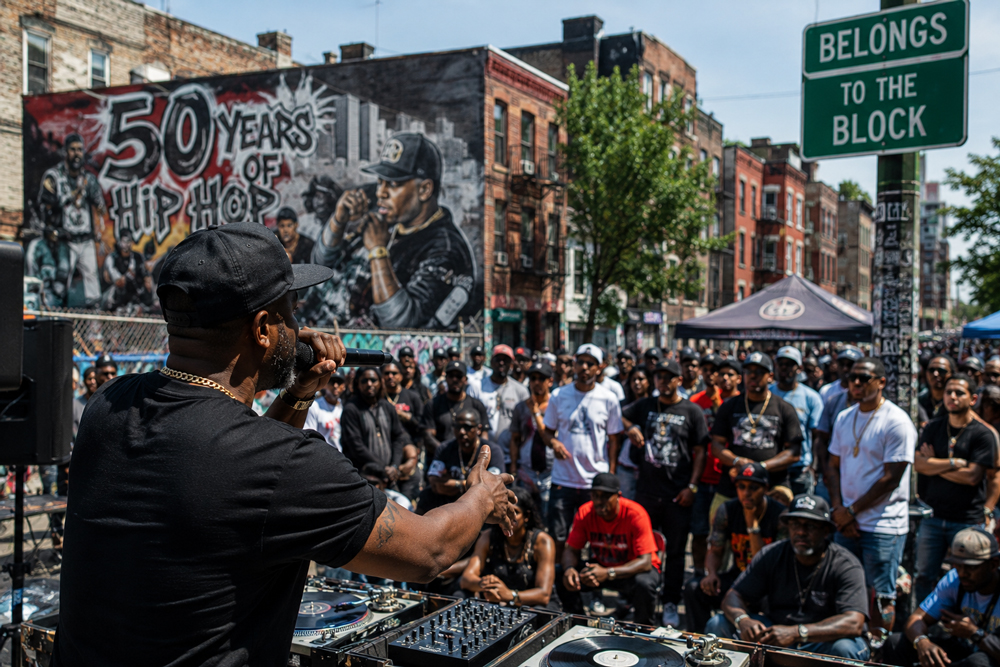
Excerpt: Hip-hop started on a block in the Bronx with a DJ, two turntables, and something to say. Fifty years later, it's a billion-dollar industry. The block is still there. The question is whether the music still is.
As hip-hop celebrates its 50th anniversary, a compelling question emerges: does the culture still belong to the block? The genre, which originated in the streets of the Bronx, has evolved into a global phenomenon, prompting heated debates about its roots, relevance, and cultural ownership.
The importance of this discussion cannot be overstated. As hip-hop enters middle age, it has transcended its original context, appearing in mainstream media, fashion, and even politics. This transformation raises critical questions about authenticity, cultural appropriation, and social responsibility. In a time when social issues, racial tensions, and economic disparities remain at the forefront, examining hip-hop's connection to its roots is more relevant than ever.
Michael Eric Dyson, a prominent sociologist and cultural critic, emphasizes that hip-hop remains a powerful voice for marginalized communities. According to Dyson, despite its commercialization, the core messages of resistance and resilience continue to resonate with the youth from whom it sprung. "Hip-hop is a language of the oppressed," he argues, asserting that the genre serves as a tool for social justice and empowerment.
Dyson posits that the genre's return to its roots can be seen in the resurgence of conscious rap. Artists like Kendrick Lamar and J. Cole echo the sentiments of previous generations, framing social issues within their lyrical narratives. This continuity suggests that hip-hop still "belongs to the block" in essence, even if the platforms have evolved.
Ben Shapiro offers a contrasting viewpoint, suggesting that hip-hop's commercialization has distanced it from its origins. He points to the genre's embrace of materialism, fame, and fortune, arguing that mainstream success has turned hip-hop into a commodity rather than a form of cultural expression. "In many ways, hip-hop has sold out, prioritizing profit over its initial community-centric ethos."
While acknowledging the genre's roots, Shapiro raises concerns over authenticity and representation. He questions whether artists can genuinely claim to speak for their communities when they operate within a multi-billion dollar industry. For Shapiro, this shift reflects a broader trend of cultural appropriation, whereby hip-hop is consumed by audiences who may lack an understanding of its historical significance.
Kareem Abdul-Jabbar blends the two perspectives. He argues that while hip-hop has indeed undergone a radical transformation, its foundational values are still intact. Abdul-Jabbar believes that the genre has a unique ability to adapt while preserving its core message. "Hip-hop has morphed, but at its heart, it still speaks to the struggles of those on the margins."
He points to how hip-hop's influence has extended beyond traditional boundaries, impacting politics and global conversations about social justice. Abdul-Jabbar suggests that rather than being overshadowed by commercialization, hip-hop has found new platforms, allowing it to reach even broader audiences while still championing the causes it has always supported.
All three experts agree that hip-hop continues to provide a voice for marginalized communities and addresses social issues. The genre has evolved, adapting to the changing cultural landscape, and there is a shared recognition that globalization and commercialization have fundamentally shifted the genre's dynamics — for better or worse.
Where they split is telling: Dyson and Abdul-Jabbar advocate for hip-hop's enduring connection to its roots, while Shapiro expresses deep skepticism. Shapiro emphasizes concerns regarding cultural appropriation that the others do not fully endorse — a fault line that runs through the entire debate.
The debates surrounding hip-hop's connection to its origins are critical not only for the genre but also for the communities it represents. The ability of hip-hop to adapt while remaining committed to its founding principles offers both challenges and opportunities. The voices in this debate highlight the tension between maintaining authenticity and embracing evolution — a dynamic that will continue to shape the cultural landscape for years to come.
The ongoing relevance of hip-hop serves not only as a mirror to society but also as a platform for change — reminding us that while the genre may evolve, its roots are irreplaceable.
Hip-Hop: A Dual Legacy of Roots and Reach
As we celebrate hip-hop's 50th anniversary, it's evident that the culture has grown beyond its street origins while still holding on to its core values. Although commercialization presents challenges to authenticity, voices in the genre, like those of Kendrick Lamar and J. Cole, remind us of hip-hop's foundational purpose: to amplify the stories of marginalized communities. The debates surrounding ownership and relevance highlight the ongoing struggle for cultural integrity in a rapidly changing landscape. Hip-hop remains a vital platform for social dialogue, but it is essential to navigate its evolution with an appreciation for its roots. Ultimately, hip-hop can simultaneously belong to the block and resonate globally, provided that artists and fans uphold the cultural commitment that birthed this transformative movement.

Michael Eric Dyson
Professor of Sociology, Georgetown University
"Dyson argues that Hip-Hop remains a vital expression of grassroots experiences and struggles, and it is essential that the culture stays connected to its origins in the community. He emphasizes the importance of local voices in shaping Hip-Hop's evolution, reflecting contemporary issues faced by marginalized populations."
𝕏 Michael Eric Dyson in Michael Eric Dyson
Ben Shapiro
Political Commentator and Author
"Shapiro posits that as Hip-Hop has become commercialized, it risks losing its authentic connection to the community and the struggles that birthed it. He believes it has transformed into a business rather than a cultural movement, leading to a disconnect between artists and the original community that nurtured Hip-Hop."
𝕏 Ben Shapiro in Ben Shapiro
Kareem Abdul-Jabbar
Cultural Critic and NBA Legend
"Abdul-Jabbar believes that while Hip-Hop's roots should always be acknowledged, the culture also has the potential to evolve with new influences. He advocates for a balance between respecting tradition and embracing innovation, ensuring the culture remains relevant in a changing society."
𝕏 Kareem Abdul-Jabbar in Kareem Abdul-JabbarHow Does This Hit You?


No comments yet. Be the first to weigh in.