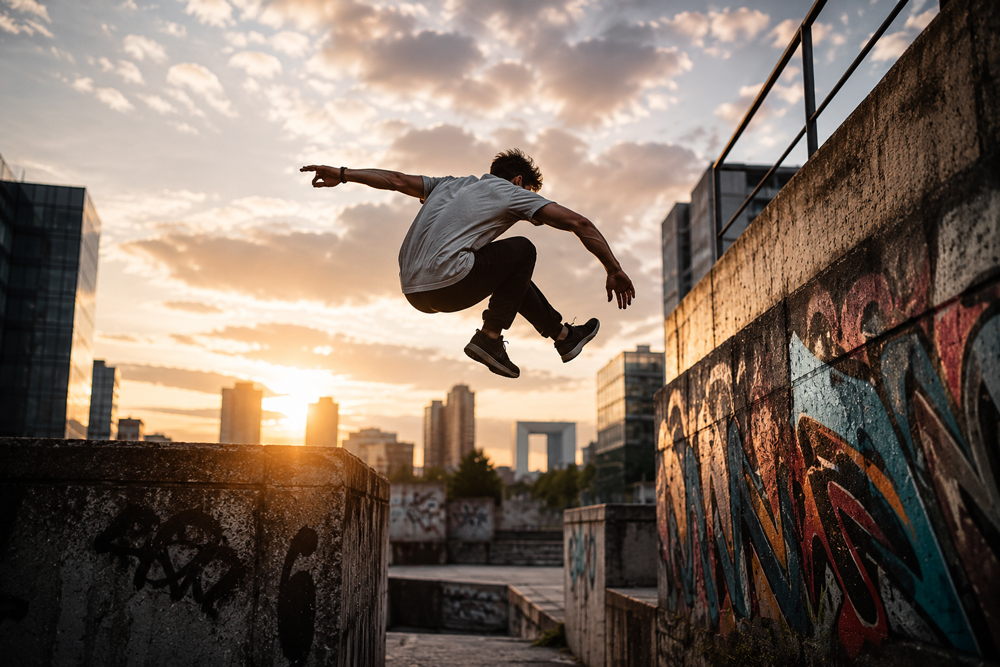
Parkour was born on the street, built on freedom, and defined by the idea that every wall is a door. The moment someone added a scoreboard, that idea got complicated.
The labeling of parkour as a sport has significant implications for its practice, culture, and future. Some believe that the moment we categorized parkour as a sport, we lost its essence.
As parkour gains more mainstream recognition, particularly with the prospect of inclusion in events like the X Games and other competitive arenas, this debate becomes increasingly critical. The way we categorize this practice can transform its impact and meaning, shaping its trajectory for future generations.
Jesse La Flair, a professional parkour athlete, asserts an unequivocal stance that parkour is, and should remain, a lifestyle rather than a sport. He emphasizes that the core of parkour lies in self-expression, creativity, and the freedom to move in one's environment without restrictions. "When you put parkour into a box labeled 'sport,' you diminish its essence and limit its potential for personal growth. It's about overcoming obstacles in life, not just physical challenges."
La Flair further illustrates his point by discussing the role of community in parkour. He argues that the focus should be on sharing experiences and learning through movement, rather than competing for trophies. In this light, parkour is less about athleticism and more about empowerment.
On the other side of the debate, Dr. Michael J. Johnson, a sports sociologist, presents an analytical viewpoint. He acknowledges that while parkour originated as an idiosyncratic form of movement, its evolution into a competitive realm is a natural progression. "All forms of expression, including parkour, undergo transformations. The question is whether these changes dilute or elevate the core values. In the case of parkour, competition can co-exist with its foundational principles if managed carefully."
Johnson believes that integrating parkour into a sporting context can offer greater opportunities for recognition and resources. This can lead to improved training facilities and athlete support, which in turn could enhance the community's overall well-being.
Toby Segar, a parkour coach and educator, expresses a more nuanced view that straddles the line between sport and art. He emphasizes the importance of education, safety, and community support in the practice of parkour. "While I respect Jesse's perspective, I think we can embrace parkour's competitive aspects while still honoring its roots. Safety is vital, and we can establish guidelines that preserve parkour's core identity while integrating elements that improve participants' experiences."
All three experts agree that the soul of parkour lies in self-expression and creativity. Community is a fundamental aspect of parkour's identity, and safety and education are critical for the growth of the practice — on that, nobody argues.
Where they diverge cuts deeper: whether competition enhances or detracts from parkour's essence, and what is truly lost — or gained — when freedom of movement meets structure and rules. La Flair sees categorization as a cage. Johnson sees it as a ladder. Segar is trying to build a door between the two.
The identity crisis surrounding parkour is about more than just labels — it delves into issues of authenticity, community, and the cultural significance of movement. As parkour becomes more recognized globally, it is crucial to reflect on what this evolution means for practitioners. Will the introduction of competitive elements enhance the community, or dilute its core values?
The essence of parkour — a blend of philosophy, artistry, and community — may prove resilient, regardless of how it is framed. But the debate will continue, because in parkour, as in life, how you move through the obstacle matters just as much as getting past it.
Finding Balance: The Dual Identity of Parkour
The debate surrounding parkour's identity as a sport or a lifestyle reveals a rich dichotomy that reflects broader societal tensions about authenticity and expression. While Jesse La Flair cogently argues for the preservation of parkour's roots in self-expression and community, Dr. Michael J. Johnson presents the inevitability of its evolution into a competitive sport. However, we argue that acknowledging parkour as both a sport and a lifestyle can enrich its culture rather than dilute it. Embracing this dual identity allows for the celebration of personal empowerment while also adapting to the changing dynamics of contemporary athletics. Ultimately, the future of parkour hinges on a community that values both its artistic essence and its potential for competitive growth. Let’s foster a space where creativity and competition coexist, ensuring that parkour continues to inspire and empower individuals in diverse ways.
Jesse La Flair
Professional Parkour Athlete
"Labeling parkour as a sport confines its essence to competition and regulation, undermining its true nature as a creative expression of movement and personal freedom."
𝕏 Jesse La Flair in Jesse La Flair
Dr. Michael J. Johnson
Sports Sociologist
"The classification of parkour as a sport sparks vital discussions about identity and community, yet it risks diluting the values of freedom and creativity that underpin the practice."
in Dr. Michael J. Johnson
Toby Segar
Parkour Coach and Educator
"Recognizing parkour as a sport can provide essential structure and support for practitioners, allowing for growth, safety, and organization within the community."
in Toby SegarHow Does This Hit You?

No comments yet. Be the first to weigh in.