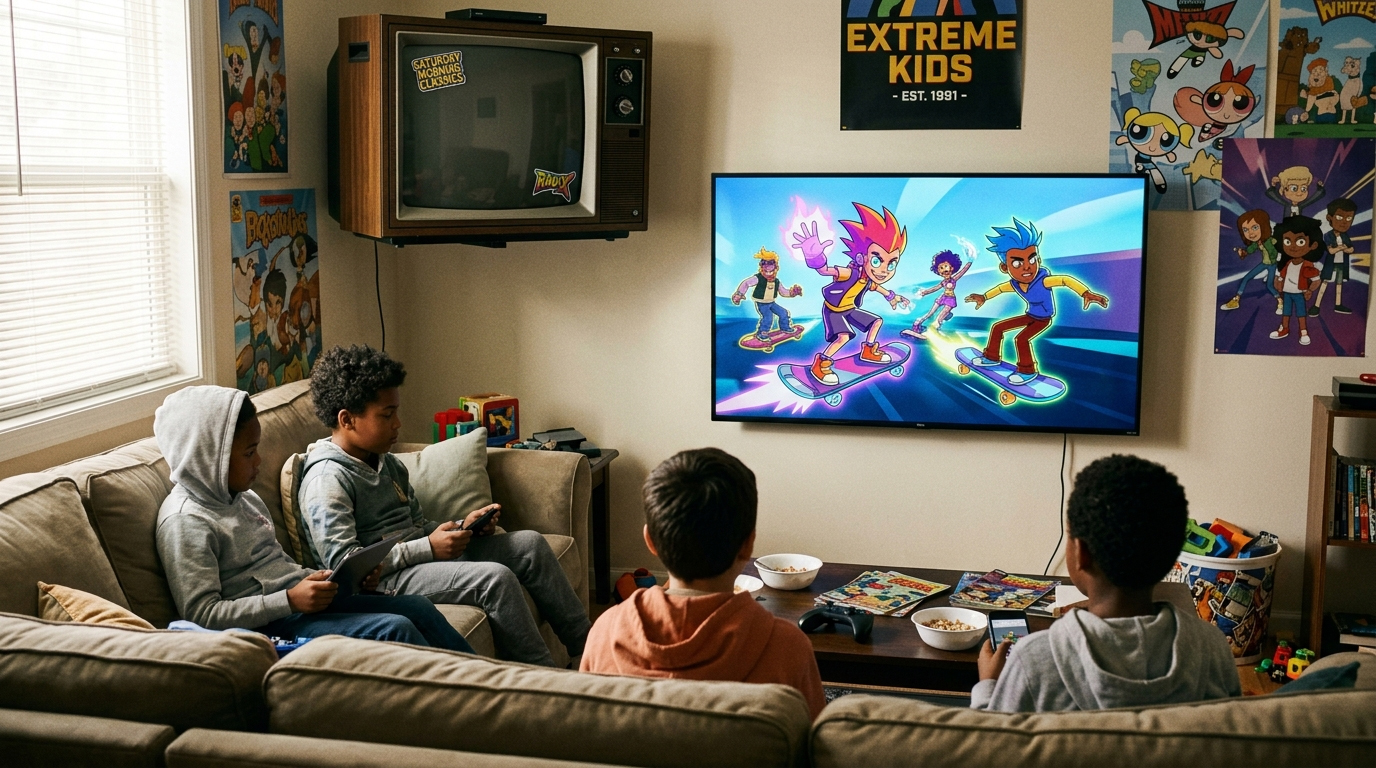
In an age defined by constant connectivity and digital distractions, one might wonder: will today's children grow into the same kind of adventurous spirits fueled by the bold, imaginative narratives of Saturday morning cartoons? These animated shows once served as the rite of passage for countless kids, delivering doses of chaos, creativity, and camaraderie. As we look ahead, questions loom large about who will be raising the next generation of extreme kids.
Context: Why This Matters Now
The cultural landscape has shifted significantly since the heyday of Saturday morning cartoons. In the '80s and '90s, programs like Animaniacs, DuckTales, and Teenage Mutant Ninja Turtles not only entertained but also influenced young minds. They offered a sense of exploration and risk that many believe is lacking in today's era of hyper-scheduled and ultra-protective parenting. As children now consume content through streaming platforms, how does this digital shift affect their exposure to the creativity and risk-taking that defined prior generations?
Perspective: The Role of Nostalgia and Influence
Robert Pondiscio, a Senior Fellow at the Thomas B. Fordham Institute, articulates a clear belief in the formative power of Saturday morning cartoons. He argues that these shows encouraged risk-taking behaviors and imaginative play, which were vital for child development. “These cartoons allowed children to explore boundaries in a safe yet stimulating manner,” he states. “They sparked creativity and inspired a certain recklessness that can be beneficial for growth.”
Danielle O'Neill, a child psychologist, reasons that the nostalgic framework holds merit as well. “When kids watched cartoons, they engaged with themes of friendship, adventure, and conflict resolution. These concepts are central to social development. The absence of similar narratives today means today’s kids might be missing out on important learning experiences.”
Perspective: The Digital Shift and Parental Control
On the other hand, Katherine O'Keefe, a cultural historian, highlights how the media landscape has transformed drastically. “While a linear model of watching cartoons allowed for collective experiences, today’s digital media consumption is far more individualistic. Children have tailored their viewing experiences, often opting for safer, algorithm-driven content.” She emphasizes, “This shift doesn’t just change what kids are exposed to; it alters the way they perceive risk and creativity.”
Perspective: The Protective Parenting Trend
O'Neill elaborates on the concept of overprotective parenting in contemporary society and its potential ramifications. She describes a parenting style characterized by excessive caution, which may hinder children from taking the kinds of creative risks that were once commonplace. “Children thrive when they are challenged,” she asserts. “But when parents eliminate risks from their lives, they also strip away the opportunities for learning through failure and experimentation.”
Conversely, Pondiscio considers whether today’s parenting culture is genuinely more protective or merely evolving. “Parental fears are often amplified by societal changes, but it doesn't mean kids won't find ways to push boundaries,” he remarks thoughtfully. “Today's extreme kids are just operating under a different set of rules.”
Editorial Synthesis
Where experts agree:
- Saturday morning cartoons played a significant role in shaping creative and adventurous behaviors in children.
- The themes of friendship and conflict resolution present in these cartoons are crucial for social development.
- Overprotective parenting may limit opportunities for risk-taking and creativity.
Where experts disagree:
- The extent to which today's digital landscape impoverishes children’s imaginative play.
- Whether modern parenting is inherently more protective than previous generations or simply adapting to new societal norms.
Why This Matters
As the debate unfolds, it becomes clear that the evolution of media consumption and parenting styles is crucial to understanding how the next generation will be shaped. Pondiscio, O'Neill, and O'Keefe each offer compelling viewpoints, yet all underscore the importance of fostering environments where creativity and risk-taking can flourish. The challenge lies not just in the media children consume, but in how parents and society at large guide them through this rapidly changing landscape. Ultimately, if we wish to nurture a generation of explorers, we must consider how to balance the protective instincts of modern parenting with the lessons of creativity and risk that echoed through the colorful frames of Saturday morning animations.
Let us ponder who is indeed raising the next generation of extreme kids, and reflect on whether they will have the same opportunities to venture beyond the limits of their imaginations.
Rediscovering Adventure in a Digital Age
As we navigate this era of screens and saturation, it's crucial to reflect on the formative experiences that shaped previous generations. Saturday morning cartoons provided children with opportunities to explore, take risks, and engage in imaginative play, essential components that are arguably being overshadowed by today's curated digital content. While streaming services offer an abundance of choices, the lack of spontaneous, chaotic narratives could stifle creativity and limit social development. To truly raise the next generation of extreme kids, we must foster environments that encourage exploration, withstand challenges, and engage with diverse forms of storytelling. It is a collective responsibility—parents, educators, and content creators alike—to ensure that today's children experience a rich fabric of imaginative play that inspires them to push boundaries and embrace both adventure and resilience.

Robert Pondiscio
Senior Fellow, Thomas B. Fordham Institute
"Pondiscio argues that Saturday morning cartoons offered a unique blend of creativity and moral lessons that shaped the values of a generation, fostering imagination and resilience in children. He believes that the way content is delivered today lacks the same cultural significance and narrative depth."
in Robert Pondiscio
Danielle O'Neill
Child Psychologist
"O'Neill contends that modern digital media, unlike classic Saturday morning cartoons, can lead to overstimulation and a disconnection from reality, urging caregivers to consider the impact of screen time on emotional and social development. She emphasizes the need for balanced media consumption that promotes healthy developmental outcomes."
in Danielle O'Neill
Katherine O'Keefe
Cultural Historian
"O'Keefe believes that both past and present media shape childhood experiences but highlights the need for thoughtful consideration of how these changes reflect broader societal values. She advocates for research into how contemporary children's programming can learn from the past while adapting to modern realities."
in Katherine O'KeefeHow Does This Hit You?


No comments yet. Be the first to weigh in.