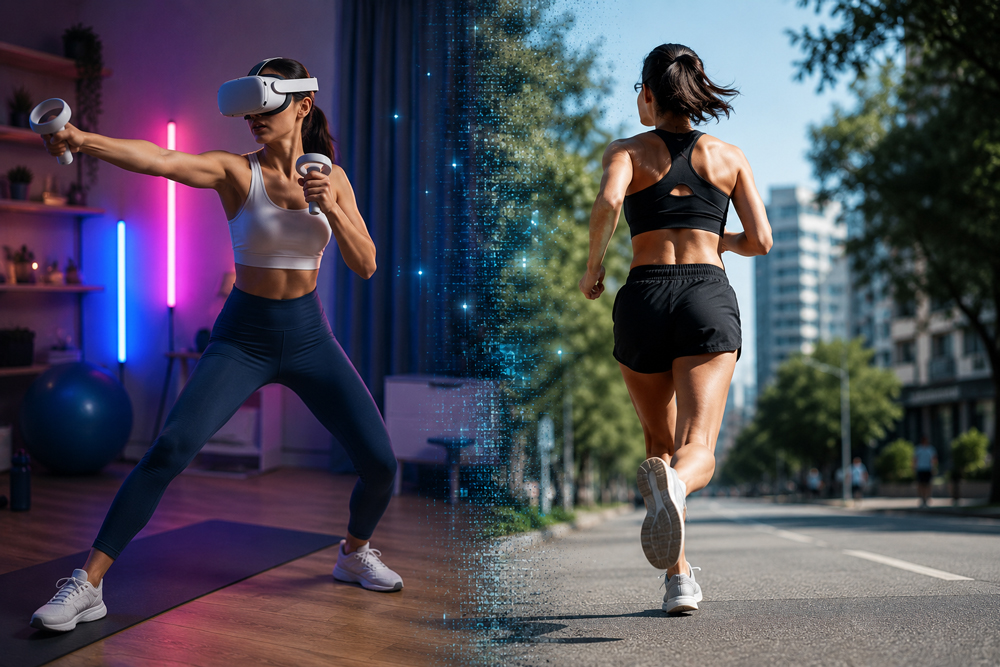
You can box in your living room, climb a virtual mountain, and never leave the house. The question is whether your body — and your mind — know the difference.
VR Fitness Is Booming. But Can a Headset Replace the Gym — or the Street?
As the virtual reality fitness market continues to expand, a significant question arises: Can a VR headset truly replace traditional gyms and outdoor workouts? Amidst rising concerns over sedentary lifestyles and the convenience of home workouts, the discussion around the efficacy and potential of VR fitness has never been more pertinent.
In recent years, particularly during the COVID-19 pandemic, many have turned to home-based fitness solutions. VR has emerged as a cutting-edge technology that offers immersive workout experiences. As fitness enthusiasts explore new ways to maintain their health, understanding whether VR can provide an adequate replacement for physical gyms and outdoor exercise becomes essential for consumers, fitness professionals, and technologists alike.
Dr. Elizabeth E. Krupinski, Director of the Arizona Telemedicine Program, emphasizes the psychological benefits of VR fitness. "In an age where isolation can lead to mental health issues, VR offers a sense of community and engagement that can sometimes be missed in traditional fitness settings. The gamified environment encourages individuals to push their limits, leading to improved motivation and adherence to workout regimens."
Mike S. K. Hwang, CEO of Fitness Tech Corp, supports this sentiment from a technological standpoint. "The advancements in VR technology have made it possible to deliver experiences that are not only fun but also highly effective. Users can engage in activities that are engaging and enjoyable, which can lead to more frequent and longer workouts. This indicates a shift in how we will approach fitness moving forward."
On the contrary, Dr. Jason L. Lee, a fitness research scientist, presents caution regarding the replacement of traditional fitness methods. He argues that while VR offers novel and appealing ways to exercise, it lacks the social and environmental aspects of gyms and outdoor activities. "Face-to-face interactions, the ability to access varied terrains, and an environment conducive to diverse workouts cannot be replicated by VR headsets. Physical gyms also provide valuable resources, including equipment and expert guidance, which can greatly enhance a person's fitness journey."
Hwang acknowledges these points but counters them with the potential for VR to adapt and evolve. "While it doesn't replace traditional fitness environments outright, VR can serve as an adjunct, helping to bridge the gap for those who are hesitant to step into a gym setting."
All experts agree that VR fitness can provide an engaging and enjoyable workout experience, and that advancements in technology will likely enhance the effectiveness of VR fitness programs over time. The psychological benefits of utilizing VR as a form of exercise are also widely acknowledged — particularly for those who struggle with motivation, access, or anxiety around traditional gym environments.
Where they diverge is telling: the extent to which VR can replace traditional gym experiences remains sharply contested. The importance of social interactions in fitness is emphasized by some experts but sidestepped by others. And the fundamental question of physical spaces versus virtual environments — of concrete and iron versus pixels and controllers — continues to prompt debate that no amount of processing power has yet resolved.
The conversation surrounding VR fitness touches on fundamental concerns about health and wellness in an increasingly digital world. The psychological engagement afforded by VR may help combat sedentary lifestyles. But Dr. Lee raises valid concerns regarding the depth and richness of fitness experiences that may be lost in a purely digital environment — the resistance of real weight, the texture of pavement, the presence of another human pushing alongside you.
Ultimately, VR fitness is on the rise, offering exciting possibilities for the future of exercise. Balancing the innovation of VR with the proven benefits of traditional methods may serve as the key to a comprehensive fitness approach that engages all communities. The fitness landscape is shifting — but whether VR can wholly replace the gym or the street remains an open, yet fascinating question.
Finding Balance: The Future of VR Fitness
As the excitement around VR fitness grows, we should embrace its potential while acknowledging its limitations. The immersive and engaging experiences offered by VR can indeed motivate individuals and provide an alternative to traditional workouts, especially during times when access to gyms is limited. However, it is essential to recognize that VR cannot replicate the social interactions, variety, and outdoor benefits of gym workouts and street exercise. Therefore, rather than viewing VR as a complete replacement, we should see it as a valuable complement to existing fitness routines. By integrating VR into a well-rounded fitness approach, enthusiasts can harness its unique advantages while still enjoying the holistic benefits of diverse physical activity environments.

Dr. Elizabeth E. Krupinski
Director, Arizona Telemedicine Program
"VR fitness can create immersive environments that enhance motivation and engagement, potentially making workouts more enjoyable and effective. As technology advances, it offers unique solutions to accessibility issues in traditional fitness settings."
in Dr. Elizabeth E. Krupinski
Mike S. K. Hwang
CEO, Fitness Tech Corp
"While VR fitness has its advantages, it cannot wholly replace the societal and psychological benefits of traditional gyms and outdoor exercise. A hybrid approach may be the future, blending the best of both worlds."
𝕏 Mike S. K. Hwang in Mike S. K. Hwang
Dr. Jason L. Lee
Fitness Research Scientist
"While VR can provide a novel workout experience, it lacks the essential components of social interaction and outdoor environments that traditional workouts offer. Long-term adherence to fitness routines may be compromised when relying solely on virtual experiences."
in Dr. Jason L. LeeHow Does This Hit You?



No comments yet. Be the first to weigh in.