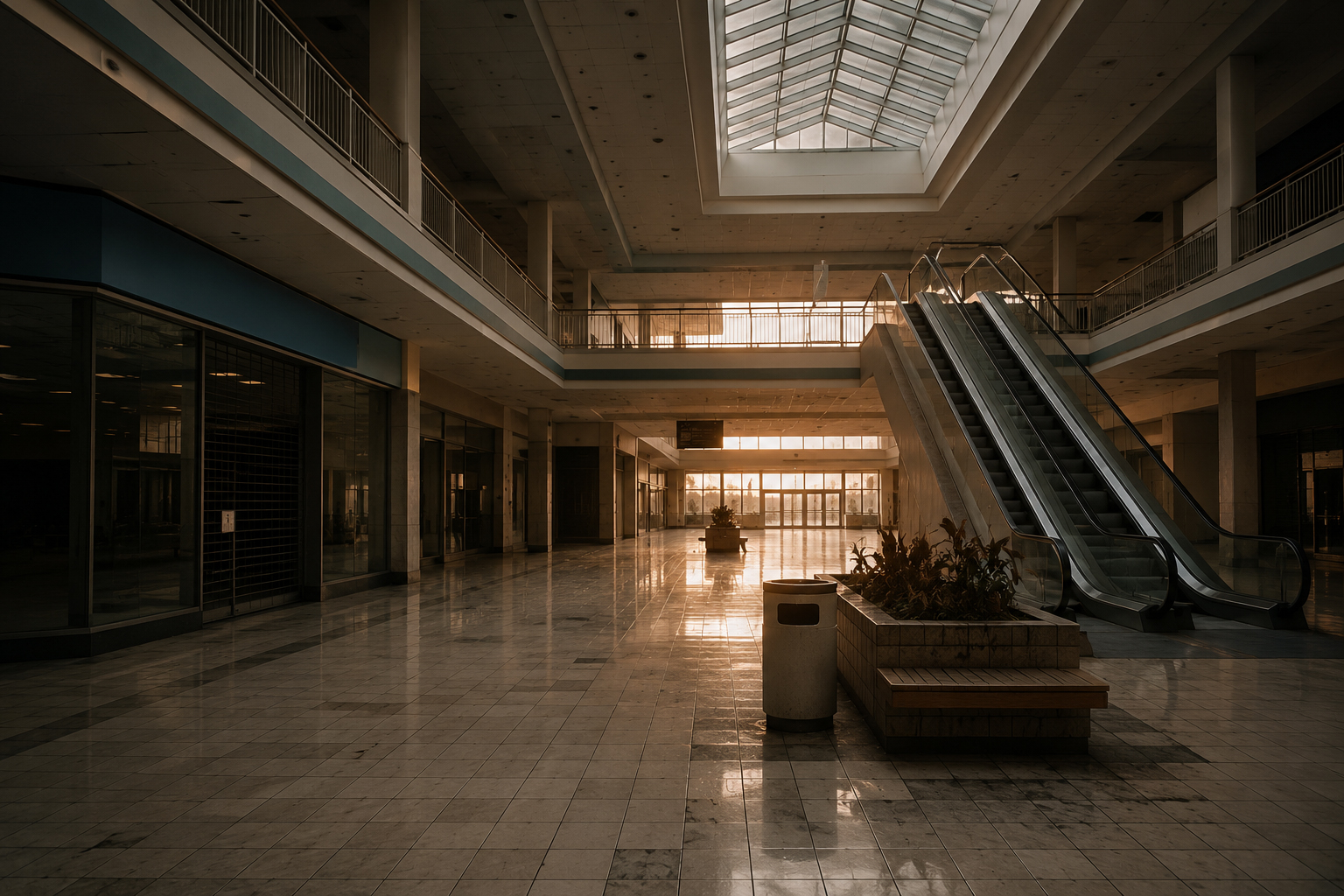
We abandoned the mall for Amazon and never looked back — until the parking lots went empty and something felt missing. Marcia Smith, David Spector, and Rebecca Jones explore what our sudden nostalgia for the shopping mall reveals about community, connection, and what we've lost in the digital age.
What happens when a cultural icon fades? The shopping mall, once a symbol of community, capitalism, and consumerism, has witnessed a significant decline over the past few years. This raises an essential question: What does our nostalgia for these once-bustling centers tell us about our current social fabric?
Context
As the world grapples with the repercussions of the COVID-19 pandemic, retail spaces have faced unprecedented challenges. Lockdowns and the acceleration of e-commerce resulted in many malls closing their doors for good. This shift has left behind empty structures that many once frequented for shopping, socializing, and entertainment. Today, lingering memories of the mall's vibrant atmosphere evoke a sense of longing, making its demise feel like more than just a loss of a physical space — it represents a broader societal transformation.
Perspective: Marcia M. Smith (Urban Sociologist)
Marcia M. Smith posits that the mall represented a social hub that transcended mere shopping. "Malls provided a space for social interaction, particularly for young people. They acted as a crucial site for forming identities and relationships," she explains. Smith argues that the decline of the mall is emblematic of a more significant shift in urban landscapes.
In examining trends in urban development, Smith highlights that cities have increasingly moved towards more fragmented, experiential environments. "We see a rise in pop-up stores, outdoor markets, and online shopping, yet these alternatives often fail to recreate the community atmosphere that malls inherently offered. People miss the congregation that malls facilitated," she asserts.
Perspective: David O. Spector (Retail Analyst)
Retail analyst David O. Spector brings a more commercial lens to the discussion, focusing on the economics that have plagued traditional malls. "The retail environment has fundamentally changed, driven by online shopping and changing consumer preferences," he states. While he acknowledges the nostalgic significance of malls, Spector emphasizes the need to adapt to new consumer behaviors.
Spector elaborates on a critical point: "Malls weren't just places to shop; they were designed as platforms for franchises to maximize profits in a highly competitive market. As consumer habits shifted, the business model became increasingly unsustainable, leading to the mall's downfall. It's not just about what we miss; it's about what no longer works in our economy."
Perspective: Rebecca T. Jones (Cultural Critic)
Cultural critic Rebecca T. Jones delves into the emotional and psychological implications of the mall's decline. She suggests that the nostalgia surrounding malls taps into deeper human emotions tied to community and belonging. "Malls were not just commercial spaces; they were also cultural landmarks that dictated social norms and trends," she notes.
Jones argues that the sense of loss is reflective of a broader existential crisis. "In an increasingly digital world, the mall symbolized a tangible experience that we yearn for. We miss the sense of belonging they provided — a place where one could shop, dine, and engage in entertainment under one roof. It's a metaphor for what we collectively feel we've lost during the pandemic: connection."
Editorial Synthesis
Where Experts Agree
Malls served as vital social and cultural spaces. The decline represents broader shifts in consumer behavior and urban development. Nostalgia reflects our longing for connection and community.
Where Experts Disagree
Experts differ on the degree to which the decline is economically driven versus culturally driven, and on the potential for new retail environments to replace what malls offered. The role of digital commerce in diminishing the social aspects of shopping also remains contested.
Why This Matters
Understanding the decline of the mall requires a nuanced analysis from various perspectives. It reveals not just changes in retail but shifts in how society values community. As we navigate an increasingly digital world, the longing for what was once a vibrant social hub becomes a lens through which to view our current anxieties.
The rise of online shopping and shifts toward experiential retail highlight the difficulties in recapturing the essence of what once was. Even as some attempt to transform these spaces into mixed-use environments, the question remains: Can they ever evoke the same sense of belonging?
The juxtaposition of loss and nostalgia compels society to reflect on its values and priorities. Perhaps in yearning for the community that malls fostered, we are grappling with larger questions of identity, connection, and the human experience. In this age of rapid change, it remains critical to find ways to recreate spaces that foster genuine human interaction and belonging.
Reviving Community Amidst Retail Transformation
The decline of the shopping mall embodies a cultural shift reflecting our changing social needs and economic realities. As Marcia M. Smith highlights, malls were more than just retail spaces; they served as vital community hubs where people gathered, formed identities, and built relationships. In contrast, David O. Spector emphasizes the pressing economic challenges that have driven retail trends away from traditional stores. Yet, nostalgia for the mall suggests a deep-seated yearning for the social interaction it facilitated. In a world increasingly dominated by online shopping and segmented experiences, there is an opportunity to reimagine these spaces. Urban planners and retailers alike must explore innovative ways to resurrect the communal essence of malls while merging them with current trends. By bridging the gap between nostalgia and modernity, we can redefine what community looks like in our urban centers, fostering connection in a fragmented landscape.

Marcia M. Smith
Urban Sociologist
"Smith argues that malls have traditionally served as communal spaces that foster social interactions and community ties. The decline of these spaces reflects a growing isolation in society that can have detrimental effects on community cohesion."
in Marcia M. Smith
David O. Spector
Retail Analyst
"Spector contends that nostalgia for malls often overlooks the systemic failures that led to their decline, including the rise of e-commerce and shifting consumer needs. He argues that this longing signals a desire for connection rather than for the mall itself, urging stakeholders to seek innovative alternatives."
in David O. Spector
Rebecca T. Jones
Cultural Critic
"Jones believes that the decline of malls represents a larger commentary on modern consumerism and societal relationships. Instead of merely mourning the loss of a physical space, she encourages a deeper reflection on what these changes say about our evolving identity and community structures."
in Rebecca T. JonesHow Does This Hit You?


No comments yet. Be the first to weigh in.