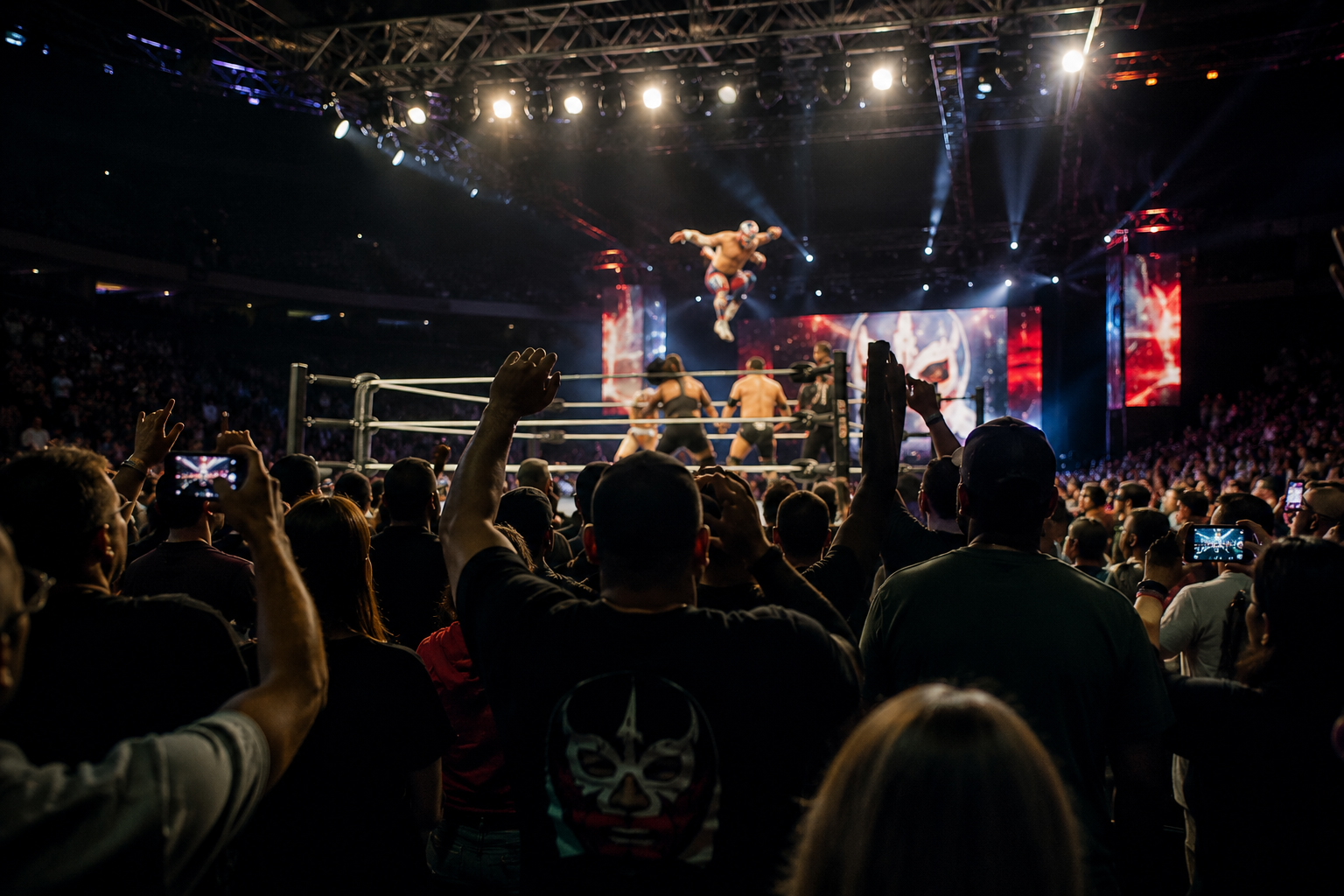
Professional wrestling is scripted, the outcomes are predetermined, and millions of fans have always known it — and loved it anyway. Dave Meltzer, Kurt Angle, and Julius McCoy unpack what our willingness to embrace the "fake" reveals about what we actually want from sports and storytelling.
Wrestling Was Fake and We Loved It Anyway. What Does That Say About What We Want From Sports?
What does it say about our relationship with sports when a significant portion of its audience willingly accepts the scripted nature of professional wrestling? While fans thrived on the theatrics and emotional storytelling, discussions around perceived authenticity continue to resonate, especially as sports evolve. This piece explores the complex interplay between reality, entertainment, and what we seek from sports in general.
Context: Why This Matters Now
In an era of skepticism about the authenticity of various facets of society — politics, entertainment, and even journalism — spectators are increasingly drawn to experiences that offer escapism, storytelling, and community. The popularity of professional wrestling sharply contradicts the rising demands for transparency and authenticity. Wrestling, defined by its predetermined outcomes, raises pertinent questions: Are fans more interested in real competition, or do they yearn for narrative-driven entertainment?
Perspective: Dave Meltzer (Wrestling Journalist, Founder of The Wrestling Observer)
Dave Meltzer argues that wrestling's appeal lies in its blend of drama and athleticism. "Fans understand that what they're witnessing isn't a legitimate contest. They're drawn to the stories, the emotional highs and lows, much like operatic performances. People want to connect on a deeper level, and wrestling delivers that through its unique narrative structure."
Meltzer emphasizes that wrestling thrives in its acknowledgment of being performative. This genre allows audiences to engage with larger-than-life personas and fantastical plots while experiencing the joys of athletic spectacle. He posits that wrestling has evolved to incorporate meta-narratives that capture viewers' imaginations and aspirations.
Perspective: Kurt Angle (Former Professional Wrestler, Olympic Gold Medalist)
Kurt Angle offers a more personal viewpoint, highlighting how wrestling's choreographed nature can serve as a gateway to real athletic skill. "While the outcomes are predetermined, the physical demands are very real. My Olympic training and wrestling career taught me the value of athleticism, technique, and discipline. For many fans, it's watching the culmination of hard work and dedication."
Angle stresses that the acceptance of wrestling as 'fake' does not diminish its artistic merits. Instead, he believes it enhances the spectacle, demonstrating how far athletes can push their bodies in pursuit of emotional expression. He urges fans to appreciate the sport through the lens of personal stories and human struggles — elements inherent in all sports but particularly pronounced in wrestling.
Perspective: Julius McCoy (Cultural Critic and Sports Analyst)
Cultural critic Julius McCoy approaches the conversation from a broader societal lens. He states, "Wrestling has become a mirror for contemporary society. It reflects our values, anxieties, and desires. Look at how wrestling has embraced diversity, social narratives, and sometimes controversial topics — this speaks to our need for representation and complex storytelling in sports."
McCoy points out that wrestling occupies a unique space where fantasy and reality blur, often confronting societal norms and issues. He suggests that audiences are drawn to this format not only for entertainment but also as a conduit for dialogue about real-world problems masked in hyperbole and dramatic flair — reflecting a desire for inclusivity, social criticism, and a platform through which broader themes can be explored.
Editorial Synthesis
Where Experts Agree
Wrestling's appeal lies in its intricate storytelling and character development. Fans appreciate the physicality and athletic effort involved, regardless of the scripted nature. Professional wrestling serves as a reflection of societal issues and collective values.
Where Experts Disagree
Meltzer focuses on entertainment value and narrative structures, while Angle emphasizes the purity of athletic competition as central to wrestling's appeal. McCoy advocates for wrestling as social commentary, while Meltzer prioritizes its escapist qualities.
Why This Matters
The ongoing discussion surrounding wrestling reflects larger themes within our cultural consumption of sports. It embodies a dichotomy: the tension between the longing for authenticity and the acceptance of scripted narratives. As sports continue to evolve, fans are seemingly more open to experiences that prioritize emotional resonance over strict realism.
This juxtaposition of embracing the 'fake' while celebrating the 'real' reveals profound insights into what audiences desire from sports: community, relatability, and narratives that go beyond simple competition. Perhaps the broader lesson isn't about the authenticity of competition but rather about what we, as fans, choose to value in our sports narratives. We might find that the intersection of reality and performance is where our true desires lie — not in the rigid confines of competition, but in the boundless creativity of storytelling.
Redefining Authenticity in Sports
As our societal norms shift, so too does our understanding of authenticity in sports. The enduring popularity of professional wrestling reveals that fans often prioritize emotional connection and storytelling over traditional notions of competition. The tension between scripted outcomes and genuine engagement speaks to a broader desire for community and shared experience in a fragmented world. As we gravitate towards narratives that resonate on a human level, we must reconsider the role of authenticity in sports. Wrestling, with its over-the-top characters and dramatic plots, offers a unique lens through which we can appreciate the complexities of fandom and entertainment. In this context, the lines between reality and performance blur, prompting us to ask: What do we truly seek from our sports experiences?
Dave Meltzer
Wrestling Journalist, Founder of The Wrestling Observer
"Dave believes that while wrestling may be scripted, its allure lies in the storytelling, athleticism, and emotional connection it creates with fans. He argues that this shows our desire for drama and narrative in sports rather than just competition."
𝕏 Dave Meltzer in Dave MeltzerKurt Angle
Former Professional Wrestler, Olympic Gold Medalist
"Kurt acknowledges the scripted nature of wrestling, yet emphasizes the incredible physical feats and athletic dedication required. He suggests that this dichotomy attracts fans who appreciate both the sport and the entertainment value."
in Kurt AngleJulius McCoy
Cultural Critic and Sports Analyst
"Julius argues that fans increasingly seek authenticity in sports and that wrestling's scripted nature can undermine trust in athletic competition. He believes this reflects a larger trend where audiences desire genuine experiences that resonate beyond choreographed entertainment."
in Julius McCoyHow Does This Hit You?


No comments yet. Be the first to weigh in.