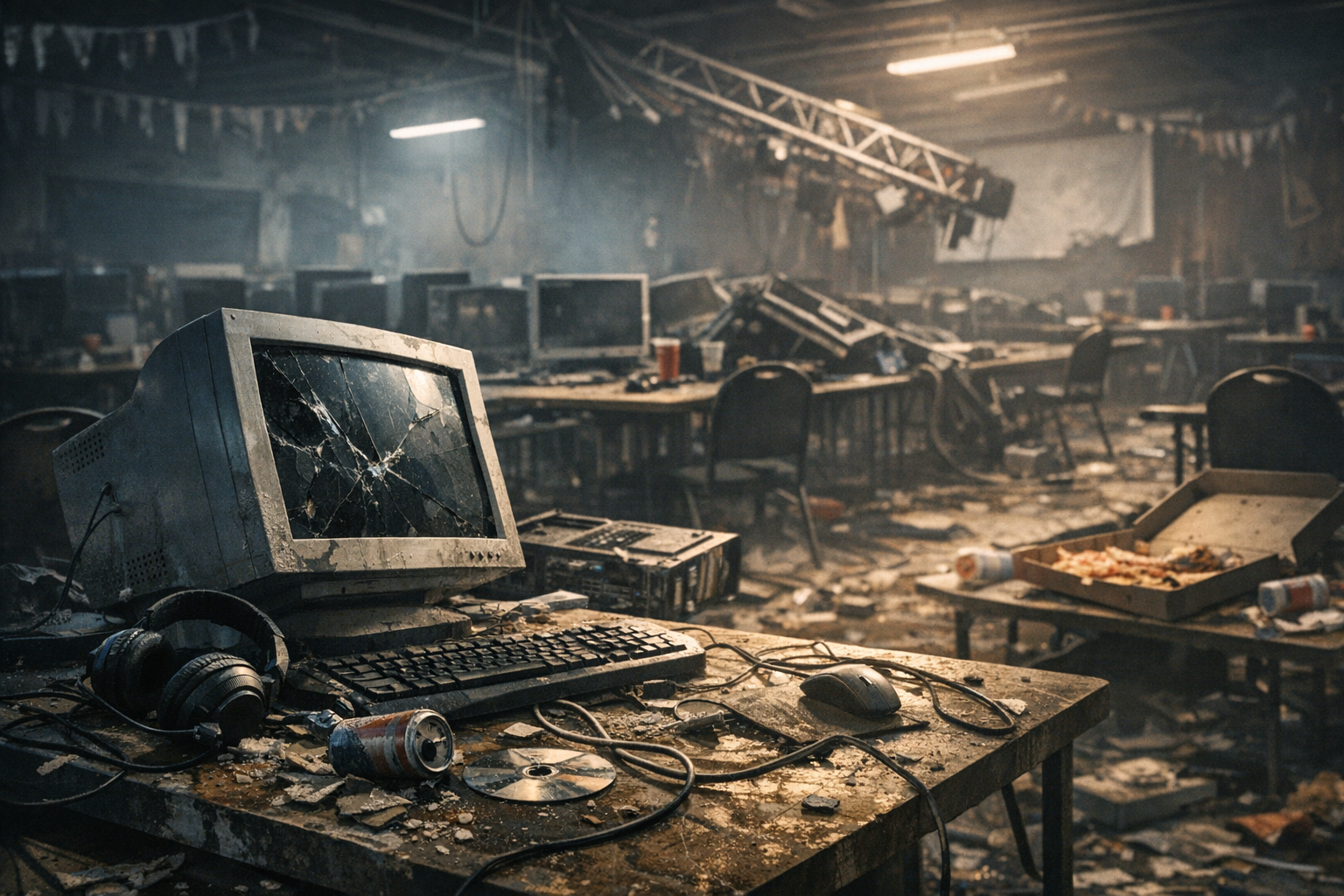
The Collapse of the LAN Party and What We Lost With It The evolution of gaming culture has seen countless transformations, yet few are as poignant as...
The evolution of gaming culture has seen countless transformations, yet few are as poignant as the decline of the LAN party. What was once a cornerstone of social gaming, where the click-clack of keyboards and the hum of machines filled basements and community centers, has dwindled with the rise of online gaming. This shift raises an essential question: In our rush towards convenience and digital connectivity, what have we lost?
Context
The decline of LAN parties is a reflection of broader trends in the gaming industry. According to a recent study, 73% of gamers now prefer online multiplayer experiences over local ones. This shift is particularly significant given that LAN parties once offered a unique blend of competition and camaraderie that online gaming struggles to replicate. With this transition, many wonder if the communal spirit of gaming is fading and what implications this has for player relationships, game development, and the gaming industry at large.
Perspective: Gabe Newell
Gabe Newell, co-founder of Valve Corporation, has deep insights into the gaming landscape. He argues that while online gaming has democratized access and allowed a global player base, it has come at the cost of local community building. "LAN parties foster an environment of innovation and collaboration that simply can't be replicated digitally," he notes. Newell recalls how the early days of LAN parties helped to create a bond between players and their communities, contributing to the development of classic titles like Counter-Strike and Dota 2.
“Technology has made it easier to connect from anywhere,” Newell continues, “but it has also led to a dilution of the rich, face-to-face interactions that made gaming special.” For him, the emotional connections forged during long nights of gameplay are irreplaceable and have been lost in a sea of online anonymity.
Perspective: Brett Sperry
Brett Sperry, a game developer and designer known for his work on Command & Conquer, echoes similar sentiments regarding the impact of LAN parties on game development. Sperry emphasizes that LAN events were breeding grounds for feedback loops between players and developers. “Direct player interaction gave us insights we wouldn’t have gotten otherwise. Watching players problem-solve together was a masterclass in game design,” he shares.
Sperry suggests that the collective environment of LAN parties encouraged diverse perspectives and an engaged player base that contributed to the iterative process of game development. In emphasizing the fun of collaborative play, Sperry believes that the decline of LAN parties has led to a loss of authentic player experiences, touching on the idea that the separation of players due to online gaming can create feedback gaps for developers.
Perspective: Katherine Ryan
Katherine Ryan, a gaming journalist, provides a different viewpoint centered on the evolution of technology and its effects on gaming culture. She suggests that while LAN parties were integral to early gaming communities, the online realm has entirely transformed the ecosystem of multiplayer gaming. “The shift allows for more diverse gaming communities and connections that transcend geographical boundaries,” Ryan argues.
However, Ryan acknowledges that this transition has its downsides. “The loss of in-person gatherings has altered the social fabric of gaming. The spontaneity and joy of gathering with friends are indeed diminished,” she admits. Still, she is optimistic that online platforms are evolving and can create new forms of community, even if they differ from the essence of the LAN party experience.
Editorial synthesis
Where experts agree
- Emotional connections: All three experts highlight that LAN parties fostered emotional bonding and community engagement among players.
- Impact on development: Both Newell and Sperry note the significance of player feedback in shaping game design during LAN events.
- Cultural significance: Each expert agrees that LAN parties played an essential role in the cultural landscape of gaming.
Where experts disagree
- Future of community: Ryan believes online platforms can evolve to recreate communal bonds, while Newell and Sperry emphasize that some aspects of in-person gatherings are irreplaceable.
- Accessibility vs. authenticity: Ryan points to the accessibility of online gaming, while Newell and Sperry argue that the depth of shared experiences at LAN parties cannot be matched.
Why this matters
As gaming continues to evolve, understanding the ramifications of the LAN party decline is critical not only for players but also for developers and industry stakeholders. The emotional connections that emerge from in-person interactions are essential for fostering a thriving gaming culture.
The challenge now lies in finding ways to merge the accessibility of online play with the community-building strengths of in-person gatherings. The loss of LAN parties is a testament to the changing landscape of gaming, but it also serves as a reminder of the intrinsic value of shared experiences. As we move forward, there is an opportunity to innovate and create new ways for gamers to connect that honors the spirit of LAN gatherings—a spirit that deserves to be preserved in this evolving industry.
Nostalgia Meets Modernity: A Call to Reconnect
The decline of LAN parties marks more than just a shift in gaming preferences; it signifies a loss of community and connection that online platforms often fail to replicate. As experts like Gabe Newell point out, the personal bonds forged over shared experiences in a physical space bring a richness that digital interactions cannot match. While we embrace the convenience of online gaming, we must also recognize the profound impact of these lost gatherings. Moving forward, it is essential for the gaming community and developers alike to find ways to reintegrate that communal spirit. Encouraging local events, hybrid formats, or even just rekindling the LAN concept in smaller settings could bridge this widening gap. In a world increasingly oriented towards online connectivity, fostering these real-world connections could reignite the passion and camaraderie that defined an era of gaming, reminding us that the joy of gaming is heightened not just by competition, but by community.
Gabe Newell
Co-founder, Valve Corporation
"Newell argues that the collapse of LAN parties has resulted in the loss of community engagement and social interactions that defined early gaming experiences. He emphasizes the value of face-to-face connections that foster lifelong friendships and memories."
𝕏 Gabe Newell in Gabe NewellBrett Sperry
Game Developer and Designer
"Sperry believes that while LAN parties provided unique social experiences, their decline is a natural evolution of gaming technology. He points out that online gaming platforms can offer new ways to connect, though they lack the physical presence."
in Brett SperryKatherine Ryan
Gaming Journalist
"Ryan argues that while the loss of LAN parties is regrettable, it has paved the way for more inclusive and accessible gaming spaces. She advocates for embracing digital community-building to create new forms of engagement."
𝕏 Katherine RyanHow Does This Hit You?



No comments yet. Be the first to weigh in.