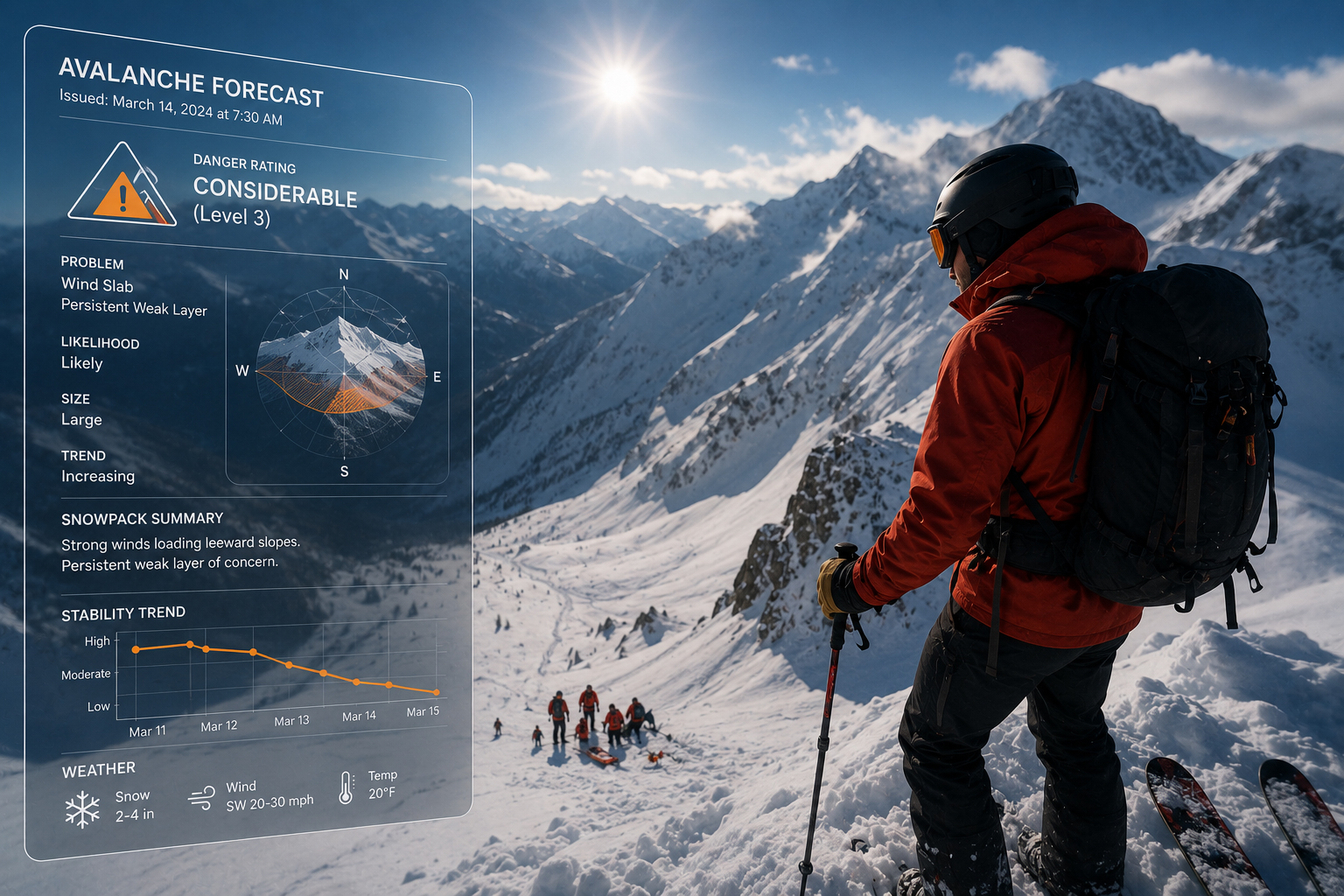
Avalanche forecasting has never been more precise — and backcountry skiers have never been dying in higher numbers. Doug Chabot, Dr. Christine McClung, and Dr. Thomas O'Rourke examine the troubling paradox: whether better data is making the backcountry safer or just giving people more confidence to take risks they shouldn't.
The paradox of increasing avalanche forecasting accuracy coinciding with rising fatality rates among backcountry skiers poses a troubling question: Is improved data luring adventurers into making greater risks?
Context
Advancements in snow science, data collection, and predictive algorithms have led to significant improvements in avalanche forecasting — including enhanced satellite imagery, remote sensing technologies, and ground-based observations. Yet this surge in predictability is juxtaposed by unsettling statistics: backcountry skiing fatalities have increased to alarming levels. Does knowing more about risks encourage riskier behavior?
Perspective: Doug Chabot
Doug Chabot, Director of the Gallatin National Forest Avalanche Center, argues that while avalanche forecasting has improved, it has also created a false sense of security. "When skiers interpret accurate data as a green light for riskier endeavors, the outcome can be fatal. There's a psychological element here — better information might be leading people to underestimate the inherent dangers of the backcountry."
Chabot highlights recent increases in backcountry traffic correlating with the rise in fatalities. Many skiers feel equipped to push deeper into remote terrains, sometimes disregarding their decision-making processes due to the comfort of precise forecasts.
Perspective: Dr. Christine McClung
Dr. Christine McClung, an avalanche researcher at Snowy Mountains Engineering Corp., vehemently supports the advancements in forecasting as a vital improvement for safety. "Better data equips users with essential information that can save lives," she argues. McClung believes that the responsibility ultimately lies with skiers to interpret forecasts wisely and practice prudent decision-making.
However, she acknowledges the darker side. "People may feel invincible with the right tools at their disposal, and that's where the tension lies. The skill of reading the backcountry environment has not significantly improved to match the leap in forecasting technology." In her view, risk awareness training should run concurrently with advancements in forecasting.
Perspective: Dr. Thomas O'Rourke
Dr. Thomas O'Rourke, a geophysicist and avalanche safety consultant, stresses the need to educate recreational users on the complexities of avalanche behavior. "Accurate forecasts can't replace experience or instinct. The two must work in tandem," he asserts.
Dr. O'Rourke believes the real challenge lies in what he describes as "information overload." With so many accessible data points, skiers may struggle to distill relevant information from the noise, leading to dangerous decisions based on incomplete assessments. "Every environment is unique, and a forecast must be treated as just one piece of the puzzle," he cautions.
Editorial Synthesis
Where Experts Agree
Increased forecasting accuracy has undoubtedly improved safety for backcountry practitioners. Many skiers are not fully grasping the limitations of refined data, potentially leading to riskier choices. There is a clear need for enhanced educational programs alongside technological advancements to foster better decision-making in the backcountry.
Where Experts Disagree
The degree to which improved forecasts enhance user confidence and risk-taking varies among experts. McClung prioritizes user responsibility in interpreting data, while Chabot emphasizes systemic industry-wide change focusing on risk perception. Dr. O'Rourke suggests that forecasting data should not replace traditional knowledge and experience.
Why This Matters
While enhancements in avalanche forecasting serve as an important tool for awareness and safety, they may also inadvertently encourage riskier behavior. It is crucial to strike a balance between advances in accurate forecasting and the necessary groundwork in education, training, and risk awareness.
By combining cutting-edge data with experiential learning and judgment, the backcountry community can cultivate a culture of safety while enjoying the exhilarating thrill of the wild slopes — a balance that could ultimately dictate the future of the sport and the safety of its participants.
Data Dilemma: The Double-Edged Sword of Avalanche Forecasting
As we stand at the intersection of enhanced avalanche forecasting and rising fatalities in backcountry skiing, it is clear that improved data presents both opportunities and challenges. The accuracy of avalanche predictions has indeed grown, but this very knowledge can create a perilous illusion of invulnerability among skiers. Doug Chabot’s insights remind us that better information does not equate to lower risk; instead, it can lead to overconfidence and reckless choices. Coupled with increased backcountry traffic, this paradox warrants a more nuanced understanding of risk-taking behavior in the sport. Educating skiers about the psychological impacts of data interpretation, along with encouraging a healthy respect for nature's unpredictability, is essential. Ultimately, we must not only celebrate our advancements in technology but also approach them with caution to ensure that lives are not sacrificed at the altar of progress.
Doug Chabot
Director, Gallatin National Forest Avalanche Center
"Doug believes that enhanced avalanche forecasting technology provides skiers with critical information to make safer decisions in the backcountry. Accurate data can serve as a vital tool in risk management, assuming users interpret information responsibly."
in Doug Chabot
Dr. Christine McClung
Avalanche Researcher, Snowy Mountains Engineering Corp.
"Christine argues that while data accuracy has improved, it may lead to complacency among backcountry skiers. The allure of precise forecasts can encourage riskier behavior, ultimately leading to more accidents."
in Dr. Christine McClungHow Does This Hit You?



No comments yet. Be the first to weigh in.