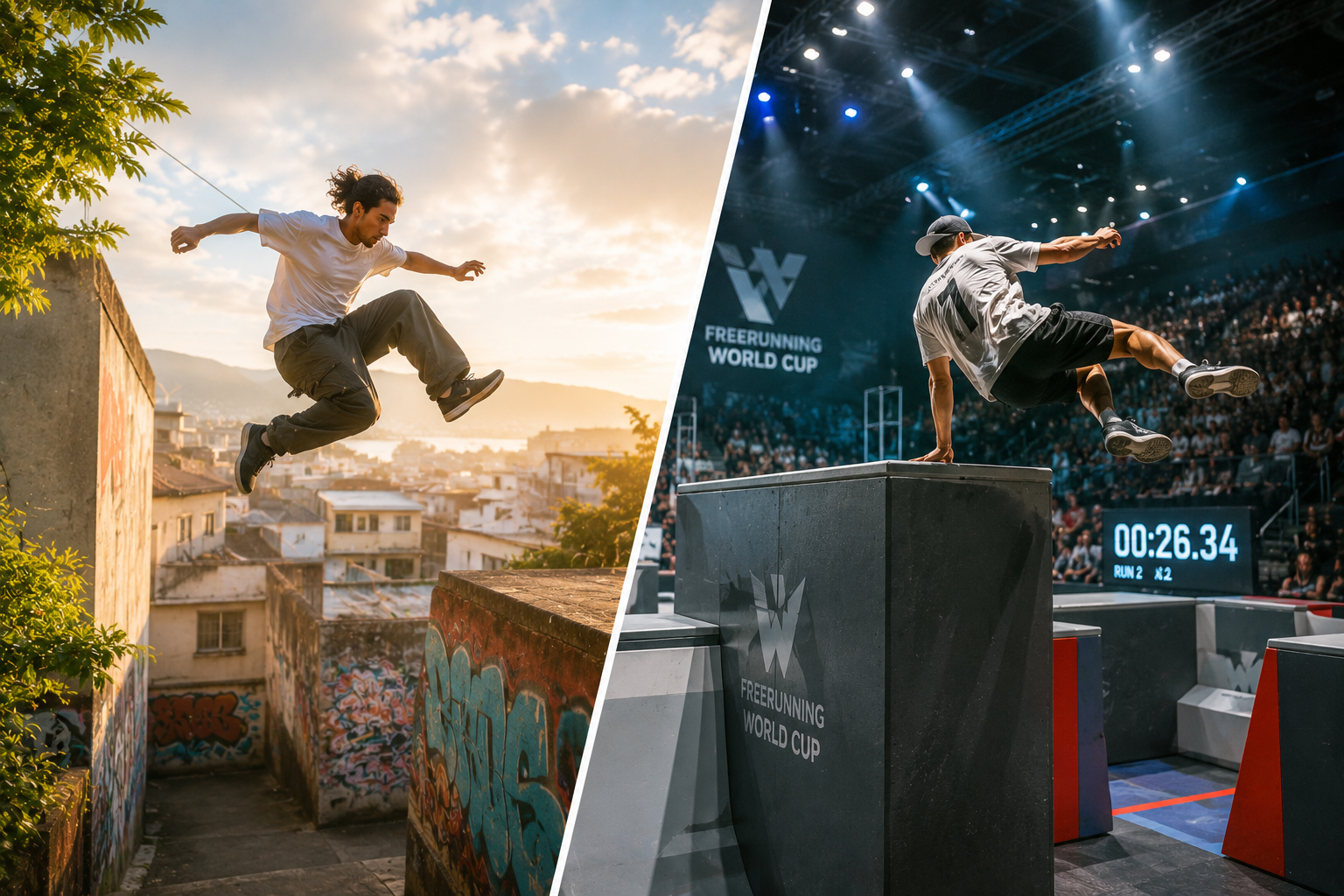
Free running began as a way to move through cities — fast, fluid, and entirely your own. Then competitions arrived with judges, scores, and routines. David Bell, Jesse La Flair, and Faraaz Khan debate whether the spirit of free running survived that transformation, or got lost somewhere between point A and the podium.
When free running emerged from the urban landscapes, it began as a utilitarian endeavor focused on efficiency and agility, with practitioners seeking to navigate their environments in the quickest way possible. However, the rise of competitive formats has transformed it into a display of routine and skills that often come with grading and judging. A critical question arises: has the original essence of free running — the primal need to move fluidly from point A to point B — been lost amid the spectacle of competition?
Context
As free running continues to gain popularity worldwide, shaping youth culture and urban experiences, the question of maintaining its foundational principles becomes pressing. The advent of competitions has brought media attention, sponsorship, and a broadened audience, yet it risks overshadowing the raw, self-expressive spirit at the heart of this discipline.
Perspective: David Bell (Co-founder, Parkour Generations)
David Bell, one of the pioneers of free running, asserts that the soul of the discipline resides in its original intent. He reflects on the early days when free running was not about scores or medals but focused on personal expression and a reaction to urban spaces. "While competitions have their place, they tend to shift focus from the creative and improvisational nature of free running," Bell states. He argues that in competitive settings, the risk of homogenization grows, with practitioners potentially watering down their creative expression to conform to judges' expectations.
Perspective: Jesse La Flair (Professional Freerunner & Influencer)
Conversely, Jesse La Flair, a prominent freerunner and social media influencer, offers a different angle. La Flair recognizes the artistry embedded in performance-based competition while acknowledging the concerns raised by Bell. "Competitions can elevate free running to a new level, showcasing our skills to a larger audience, which can, in turn, inspire and motivate young practitioners," he argues. La Flair suggests that while there may be an inherent tension between competition and creativity, the two can coexist in a way that fosters growth and innovation.
Perspective: Faraaz Khan (Parkour Coach & Advocate)
Faraaz Khan provides a balanced viewpoint, emphasizing the importance of both competition and creativity. As a coach and advocate, Khan insists that competitions can serve as a tool for progression without completely obfuscating the core principles. "The challenge is finding that balance. We should encourage competitors to excel, but not at the expense of their individuality," he explains. Khan believes that the evolution of free running can offer structure while still promoting personal journey and expression.
Editorial Synthesis
Where Experts Agree
Free running originated as a form of personal expression and movement, not competition. Competitions have transformed the landscape, presenting both opportunities and challenges for practitioners. There is potential for a hybrid model that blends the creative aspects of free running with the structure of competitive formats.
Where Experts Disagree
David Bell is cautious about competitions diluting the creative essence of free running, while Jesse La Flair believes competitions can enhance the art form. Faraaz Khan positions himself in between, advocating for a balance that embraces both elements without compromise.
Why This Matters
The conversation around free running and its evolution invites broader reflection on how sports and creative activities can coexist and enrich one another. As free running continues to integrate into mainstream culture, the discipline faces an identity crisis: Will it remain a sanctuary for individual expression, or will it overly conform to competitive frameworks?
These discussions also highlight the importance of mentorship and community in passing on the foundational principles of free running. As new entrants are drawn into the culture, they must be oriented not just towards performance metrics but towards the ethos that ignited the movement at its inception. The balance struck today may illuminate the path it will take tomorrow — ensuring free running's legacy embraces both creativity and competition, ultimately enriching its journey from point A to point B for all its practitioners.
Balancing Competition and Creativity in Free Running
The transformation of free running from a mode of personal and fluid expression to a structured competition raises significant concerns about the preservation of its original essence. While competitions can spark interest and draw new participants to the sport, they also risk standardizing practices and stifling innovation. As David Bell notes, the focus on scoring may lead to a homogenization of styles that detracts from the improvisational spirit that once defined free running. However, Jesse La Flair offers a counterpoint, suggesting that competition can elevate the discipline by pushing practitioners to hone their skills. Ultimately, the challenge lies in finding a balance, ensuring that free running retains its core identity even within the framework of competition. Emphasizing creativity, personal expression, and community engagement can allow free running to evolve without sacrificing its roots, nurturing both competitive spirit and the original ethos of moving freely through urban spaces.
David Bell
Co-founder, Parkour Generations
"Free running's original intent was about efficient movement and personal expression. While competitions have added structure, they risk diluting the core essence of the discipline, which celebrates creativity and spontaneity."
in David BellJesse La Flair
Professional Parkour Athlete
"Competitions provide a platform for athletes to showcase their skills, pushing the boundaries of what is possible within the discipline. While they introduce scoring, they also foster community and inspire new generations to engage with freerunning."
𝕏 Jesse La Flair in Jesse La FlairHow Does This Hit You?

No comments yet. Be the first to weigh in.