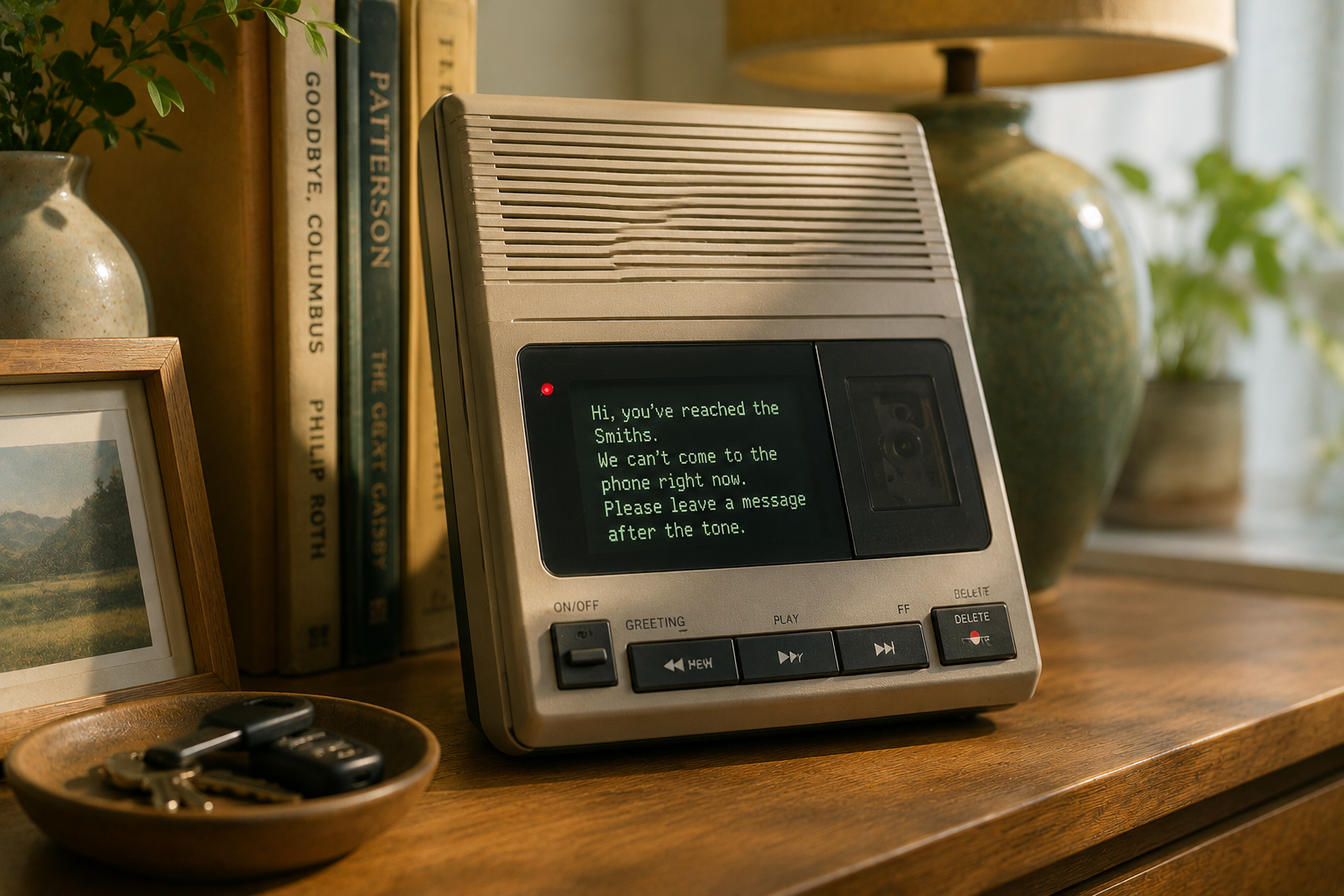
Before the social media bio, before the LinkedIn summary, there was the answering machine message — the first time most people ever had to decide in thirty seconds what they wanted the world to think of them. Sherry Turkle, Cal Newport, and Sara Hendren explore what the return of voice notes says about our hunger for intimacy, authenticity, and the lost art of being unreachable.
How did a simple recording device evolve from a quirky novelty into a profound tool for self-expression? The answering machine message may have been the first autobiographical piece many ever created — allowing individuals to present their own narratives, albeit in a limited format. Today, as voice notes return to the forefront of personal communication, one must consider whether this resurgence is a craving for traditional formats or a deeper yearning for the elusive feeling of being unreachable.
Current Relevance
As digital communication increasingly saturates our lives, the revival of voice notes signifies a broader cultural conversation on personal connections. Amidst an age characterized by constant availability, the weight of our voices — and the intentional absence of recorded responses — seems more relevant than ever.
Perspective: Sherry Turkle
Sherry Turkle, a Professor at MIT, argues that technologies have changed our modes of self-expression dramatically. According to Turkle, the answering machine revolutionized personal communication by allowing people to craft a narrative about themselves for the world to hear. Reflecting on the modern-day shift back to voice notes, she notes that these forms tap into a more authentic self-representation.
"Voice notes allow for spontaneity and a raw emotional connection that text simply cannot capture," she asserts. Turkle highlights that voice notes can create a sense of intimacy, evoking emotions long lost in mere text-based interactions.
Perspective: Cal Newport
On the contrary, Cal Newport, Professor at Georgetown University, is skeptical of the resurgence of voice notes. He posits that while these messages allow for individual expression, they also contribute to a culture of distraction and compulsive communication. "The perception of being unreachable, once a refuge, becomes a fleeting memory in the digital age," he argues.
Newport emphasizes the danger of voice notes surrendering one's time to the immediacy of others' needs. Instead of finding solace in solitude, individuals may feel pressured to respond immediately, thereby blurring the lines the original answering machine once provided.
Perspective: Sara Hendren
Artist and designer Sara Hendren offers a more nuanced view. She believes that while the original purpose of answering machines was to serve as a buffer between caller and recipient, today's voice notes can serve a dual purpose: conveying emotional content while simultaneously establishing boundaries.
"Nobody needs to respond instantly to a voice note; instead, you can listen and reply at your convenience," she points out. Hendren encourages embracing this balance — allowing individuals to express their individuality through recorded narratives without losing the sense of sanctuary unique to being unreachable.
Editorial Synthesis
Where Experts Agree
Voice notes evoke a sense of intimacy that text-based communication cannot achieve. The format allows individuals to craft personal narratives and express themselves more authentically. There exists a modern desire for a deeper emotional connection in communication.
Where Experts Disagree
The benefits of voice notes may be overshadowed by the potential for distraction and the pressures of immediate response. The longing for being unreachable may not be fully realized in a society that thrives on constant connectivity. Voice notes can either reinforce personal boundaries or blur them further, depending on individual usage and societal expectations.
Why This Matters
The resurgence of voice notes might not merely represent nostalgia but a fundamental need for authenticity and a more profound connection in a fast-paced digital environment. As individuals seek meaningful ways to express themselves while maintaining boundaries, the balance between being reachable and the allure of unavailability must be thoughtfully discussed.
The intimacy found in voice echoes the sentiments of earlier communication forms — a reminder that in our rush toward efficiency, something essential may have been left behind.
Rediscovering Connection in an Over-Connected World
The resurgence of voice notes and their parallels to answering machine messages represent a longing for deeper, more authentic connections in an age where communication can feel superficial. Sherry Turkle highlights the emotional intimacy these recordings evoke, tapping into a personal narrative that text often fails to convey. This speaks to a collective desire to feel both communicative and elusive—a balance that voice notes provide. Conversely, Cal Newport's skepticism reminds us of the efficiency we risk losing in our communications through such personal expressions. Ultimately, this debate underscores the importance of introspection in our digital dialogues and the necessity to create a space where we can truly connect with ourselves and others, even amidst the noise of constant connectivity.
Sherry Turkle
Professor of Social Studies of Science and Technology, MIT
"Turkle argues that voice notes reinstate a sense of presence and intimacy reminiscent of the answering machine era. She believes this format allows for a more personal connection, fostering emotional expression in ways text cannot."
𝕏 Sherry Turkle in Sherry Turkle
Cal Newport
Professor, Georgetown University
"Newport contends that while the format of voice notes can mimic the engaging aspects of answering machines, the overarching issue resides in our constant connectivity. He cautions against romanticizing the past, urging a balance between reaching out and valuing solitude."
𝕏 Cal Newport in Cal Newport
Sara Hendren
Artist and Designer
"Hendren believes that both the answering machine and voice notes highlight our desire for moments of being unreachable. She argues that these formats offer emotional nuance and evoke a nostalgia for the times when certain communications were slow and intentional."
in Sara HendrenHow Does This Hit You?



No comments yet. Be the first to weigh in.