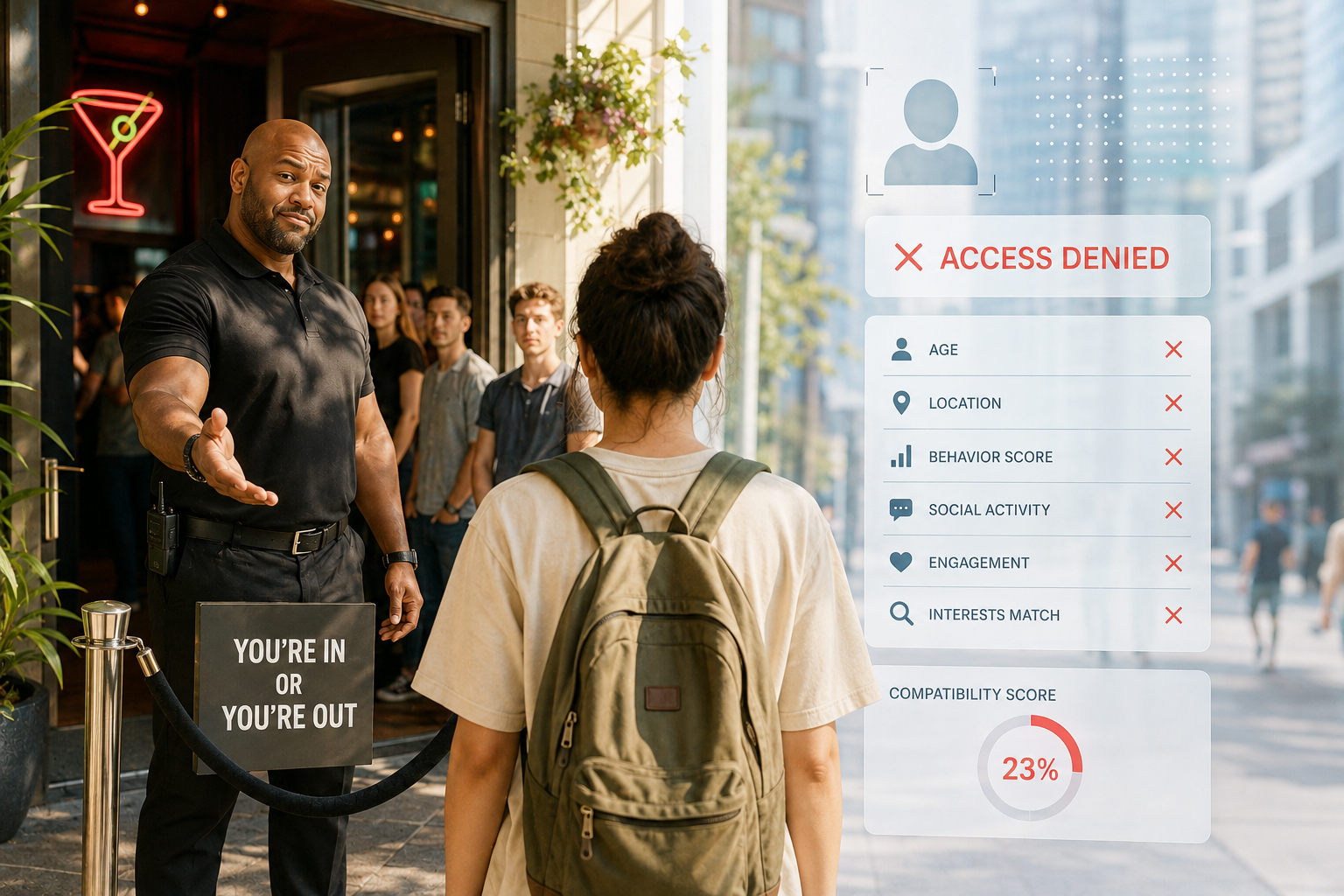
The bouncer kept people out based on gut feeling and bias — but at least you could argue with him. Now algorithms make the same calls at massive scale, invisibly. Kate Crawford, Zeynep Tufekci, and Evan Greer debate which gatekeeper is actually worse for society.
In an age where algorithms increasingly determine access to everything from job opportunities to social media platforms, one can't help but wonder: Is this digital gatekeeping more just than the subjective decisions made by a nightclub bouncer? As these seemingly impersonal systems take on the role of judge and jury, what are the implications for fairness, transparency, and societal inclusion?
Context
The rise of algorithms in decision-making processes is a byproduct of technological advancement and the growing emphasis on data-driven strategies. While algorithms promise efficiency, their lack of human intuition can introduce outdated biases and systemic inequalities. The transition from human gatekeepers to automated systems raises vital questions about who truly belongs and how decisions are made in a society dominated by technology.
Perspective: Algorithms as the New Gatekeepers
Kate Crawford, a Senior Principal Researcher at Microsoft Research, emphasizes the sheer scale and reach of algorithmic systems. "Oftentimes, these algorithms are built on data that reflects societal biases; they replicate and sometimes amplify these injustices," she states. Crawford argues that algorithms can be inherently problematic because they are trained on historical data that may contain entrenched prejudices. Just as bouncers might let in patrons based on subjective criteria, algorithms can inadvertently exclude marginalized groups based on skewed datasets.
Furthermore, Crawford highlights the lack of transparency in algorithmic processes. Consumers are rarely privy to how decisions are made, making it difficult to challenge or understand why one individual may be favored over another. This opacity raises ethical questions about accountability in the digital sphere.
Zeynep Tufekci, a sociologist and author, adds another layer to this discussion. She notes that algorithms often make decisions without taking nuanced human experience into account. "Bouncers may have their biases, but they also possess the capability to read social cues and make contextual decisions. Algorithms, on the other hand, lack this flexibility," Tufekci explains.
Perspective: Bouncers and the Human Element
Evan Greer, Deputy Director of Fight for the Future, shifts focus to the social dynamics of bouncers in decision-making environments. He argues that bouncers, despite their subjective biases, can sometimes allow for human connection and understanding that algorithms cannot replicate. "A bouncer might see someone struggling to get in and offer second chances; an algorithm indiscriminately sticks to predetermined rules," he says.
Greer also emphasizes the role of accountability in human decision-making. When a bouncer makes a poor choice, it can be publicly scrutinized and challenged. Unlike algorithms, which often operate within a 'black box' environment, individual decision-makers can be held responsible for their actions — giving communities a platform for advocacy and change.
Furthermore, Greer points out the value of human judgment as a form of social currency. In certain situations, people may rely on bouncers not just to determine who belongs but to cultivate a specific atmosphere or community. Algorithms generally lack the capability to understand context or emotion, which can create a sterile and isolating environment.
Editorial Synthesis
Where Experts Agree
Algorithms can replicate and amplify societal biases found in historical data. Human decision-making, while flawed, allows for contextual understanding and accountability. The opacity of algorithmic processes makes them difficult to challenge or understand.
Where Experts Disagree
The extent of bias in bouncers versus algorithms is contested — are algorithms generally worse? The ability of algorithms to adapt and learn compared to human intuition is also debated. Experts differ on the potential for reforming algorithmic systems versus the complexities involved in changing human behavior.
Why This Matters
The transition from human to algorithmic decision-making is not merely a technological upgrade; it represents a fundamental shift in how society determines 'belonging'. In a world dominated by data, the decisions of algorithms shape not only accessibility but also affect larger social constructs. For marginalized communities, the implications of automated exclusion can be dire.
Striking a balance between the data-driven efficiency of algorithms and the nuanced insight of human judgment holds the key to ensuring that future systems promote equity, transparency, and accountability. It is a responsibility that falls on both technologists and the broader community to question, educate, and advocate for a system that recognizes the complexities of human experience — both on the dance floor and in the digital space.
Algorithmic Gatekeeping: A Step Backwards?
The growing reliance on algorithms as decision-makers in crucial aspects of our lives raises significant concerns about fairness and transparency. While proponents argue that algorithms can optimize efficiency, they often perpetuate existing biases found in historical data. Unlike a bouncer, whose decisions, although subjective, can be challenged or questioned in real-time, algorithmic determinations are often opaque and unaccountable. This digital shift can deepen societal inequalities, particularly for marginalized communities, evoking a pressing need for regulatory measures. Thus, we must critically examine the implications of algorithmic governance and advocate for systems that prioritize inclusivity and fairness over mere efficiency. The human intuition that a bouncer brings, despite its flaws, sometimes offers a more nuanced understanding of belonging than our current digital gatekeepers.
Zeynep Tufekci
Sociologist and Author
"Tufekci argues that human bouncers, while flawed, can exercise judgment and nuance that algorithms cannot. She believes that algorithms often reinforce biases and lack the contextual understanding necessary for fair decision-making."
𝕏 Zeynep TufekciKate Crawford
Senior Principal Researcher at Microsoft Research
"Crawford contends that while human decision-making can be biased, algorithms have the potential to be designed transparently and measured to reduce bias effectively. She advocates for using algorithms to make consistent, data-driven decisions."
𝕏 Kate Crawford in Kate CrawfordEvan Greer
Deputy Director of Fight for the Future
"Greer emphasizes the need for both approaches to be critically examined. He believes that while algorithms can offer efficiency, it’s crucial to ensure they don’t perpetuate discrimination, advocating for accountability in both human and algorithmic decision-making."
𝕏 Evan GreerHow Does This Hit You?



No comments yet. Be the first to weigh in.