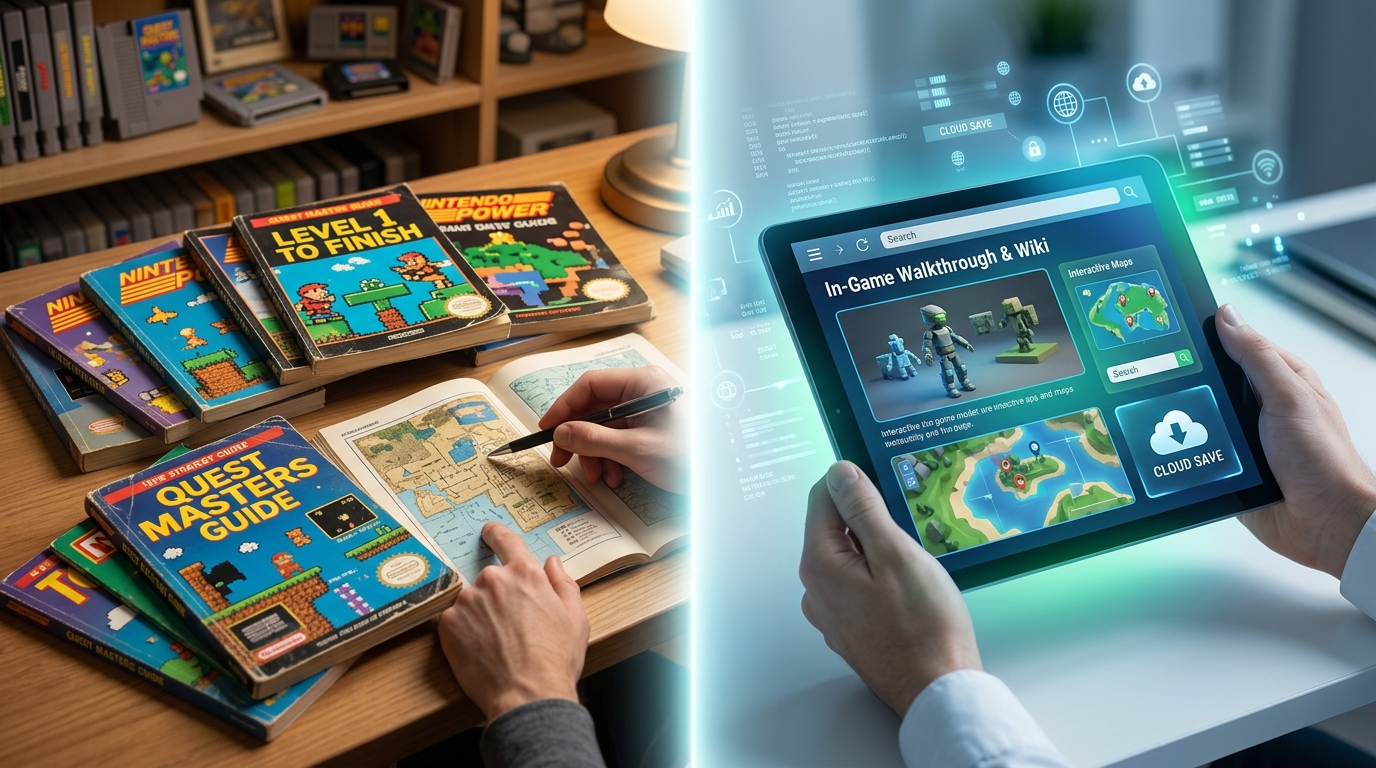
Before YouTube tutorials, gamers often relied on printed strategy guides that became prized companions—dog-eared, annotated, and passed between friends. These books didn't simply provide answers; they invited players to study maps, memorize mechanics, and slowly master a game's hidden systems. Today, video walkthroughs offer instant, visual solutions to nearly any challenge, making gaming more accessible than ever. But some technology critics argue that convenience has changed our relationship with knowledge itself, replacing ownership with on-demand access. The debate isn't about whether YouTube is more useful—it clearly is in many situations—but whether something valuable was lost when gaming knowledge stopped living on our shelves and started living in someone else's video.
There was a ritual to getting stuck in a video game.
You didn't immediately search online.
You reached for the strategy guide.
Its pages were worn.
Corners folded.
Maps highlighted.
Secrets circled in pencil.
Over time, the guide became as personal as the save file itself.
Today, most players solve those same problems differently.
A quick search.
A ten-minute walkthrough.
A boss guide at double speed.
Within minutes, the obstacle disappears.
The convenience is undeniable.
But it raises a deeper question:
When gaming knowledge became instantly accessible, did it also become something we stopped truly owning?
Why This Matters Now
Gaming has become one of the largest forms of entertainment in the world, and the way players learn games has evolved just as dramatically.
Printed strategy guides have largely disappeared.
In their place are YouTube creators, livestreams, wikis, Discord communities, and searchable databases that provide answers almost instantly.
The result is unprecedented accessibility.
Players no longer need to spend hours searching for hidden items or deciphering obscure puzzles.
Yet that convenience has subtly changed the learning process.
Instead of studying systems, many players simply follow instructions.
The shift reflects a broader cultural transition from possessing knowledge to accessing it whenever needed.
Expert Perspectives
Kevin Kelly: Knowledge Feels Different When You Can Hold It
WIRED co-founder Kevin Kelly believes physical strategy guides created a uniquely personal relationship with information.
"There's a kind of intimacy in marking up a book or guide that video doesn't replicate; it becomes a part of you."
Strategy guides accumulated history.
Margins filled with notes.
Favorite pages became worn.
Friends borrowed them and returned them with new discoveries.
The guide became more than a reference.
It became a shared artifact.
Kelly also recognizes why video walkthroughs became so popular.
Watching someone defeat a difficult boss often communicates techniques far more effectively than static images or written instructions.
"Sometimes, when you're stuck on a boss, the demo is more effective than any written guide could ever be."
Convenience has expanded access—but ownership creates a different kind of connection.
Nicholas Carr: Easy Access Can Weaken Deep Learning
Technology critic Nicholas Carr argues that digital media changes not only how people consume information but also how they retain it.
"YouTube walkthroughs create a reliance on external sources for knowledge."
According to Carr, the ease of instant answers can discourage sustained engagement with a game's mechanics.
Instead of experimenting, players often imitate.
Instead of remembering solutions, they remember where to find them.
That distinction matters.
Physical guides encouraged repeated reading, note-taking, and gradual mastery.
Videos often solve immediate problems but may leave less lasting understanding.
"Knowledge becomes ephemeral."
When information is always available elsewhere, there is less incentive to internalize it ourselves.
Howard Rheingold: Access and Ownership Can Coexist
Digital media scholar Howard Rheingold takes a more balanced view.
He believes each format serves different purposes.
Printed guides reward patience and deeper exploration.
Videos provide unmatched speed and accessibility.
"Each format has its place."
Rather than viewing one as superior, Rheingold argues that players benefit most by understanding when each tool is appropriate.
A walkthrough may solve an immediate obstacle.
A strategy guide—or its modern equivalent in written resources—may encourage broader understanding of the game's systems.
"Understanding how and when to use each type of support can enhance one's gaming experience."
The goal is not choosing between ownership and access, but combining the strengths of both.
Editorial Synthesis
Where Experts Agree
Although they differ in emphasis, the experts recognize several common themes:
- Digital platforms have made gaming knowledge dramatically more accessible.
- How players engage with information influences what they retain.
- Learning is shaped by the format through which knowledge is delivered.
- Community remains central to sharing gaming knowledge, even if the medium has changed.
Where Experts Disagree
Access or Ownership?
Kelly values the personal relationship created by physical guides.
Carr worries that constant digital access discourages deep learning.
Rheingold argues that the two approaches can complement one another.
Convenience vs. Retention
Carr believes instant answers can reduce long-term understanding.
Kelly accepts that videos are often the most effective teaching tool for complex gameplay.
What Does It Mean to Know a Game?
Earlier generations often learned games through repeated experimentation supported by printed references.
Modern players can rely on searchable, constantly updated resources, raising questions about whether knowing where to look is becoming as valuable as remembering the information itself.
Why This Matters
The disappearance of printed strategy guides mirrors a broader shift in how people interact with knowledge.
Across education, work, and entertainment, ownership has increasingly given way to access.
Music streams instead of sitting on shelves.
Books live in cloud libraries.
Maps are consulted rather than memorized.
Gaming has followed the same path.
That transition has made knowledge more democratic than ever before.
Anyone with an internet connection can learn advanced strategies that were once hidden behind expensive guides or community insiders.
Yet something subtle has changed.
Printed guides invited players to linger.
To reread.
To annotate.
To discover unexpected details while flipping through pages.
Video walkthroughs are extraordinarily efficient—but efficiency is not always the same as understanding.
Perhaps the real lesson is not that one format replaced the other, but that they encourage different relationships with knowledge.
One asks us to possess information.
The other asks us to retrieve it.
A strategy guide became part of your collection because you expected to return to it. A YouTube walkthrough becomes part of your history because you expect it will always be there. The difference isn't simply how we learn games—it's how we define knowing them in the first place.
Navigating the Shift: Ownership vs. Access in Gaming Knowledge
As we transition from the tactile experience of physical strategy guides to the immediate availability of YouTube walkthroughs, we face a nuanced dilemma about our relationship with knowledge. While digital platforms offer unmatched convenience and varied perspectives, they risk diluting the sense of ownership and engagement that comes from physically interacting with materials. The act of underlining and sharing a strategy guide created a communal bond among gamers, fostering deeper exploration and retention of knowledge. In contrast, the ephemeral nature of online videos encourages a rapid consumption of content that may lead to a superficial understanding. Ultimately, we must strive to cultivate a balance that honors the intimacy of ownership while embracing the accessibility of digital resources, ensuring that gamers continue to engage deeply with the content they love.

Kevin Kelly
Co-founder, Wired Magazine
"Kelly argues that physical objects like strategy guides foster a deeper connection and ownership of knowledge. He believes that the tactile experience of underlining and dog-earing enriches understanding, making the information more personal and retained."
in Kevin Kelly
Nicholas Carr
Author and Technology Critic
"Carr contends that access to knowledge has become the priority over ownership, with platforms like YouTube making information immediately available. He argues this shift democratizes learning and can enhance understanding through diverse perspectives."
in Nicholas CarrHoward Rheingold
Author and Digital Media Scholar
"Rheingold maintains that both ownership of knowledge through physical texts and access via digital media have their merits. He urges for a balanced approach where both forms coexist, fostering enriched learning experiences while embracing technological advancements."
𝕏 Howard Rheingold in Howard RheingoldHow Does This Hit You?



No comments yet. Be the first to weigh in.