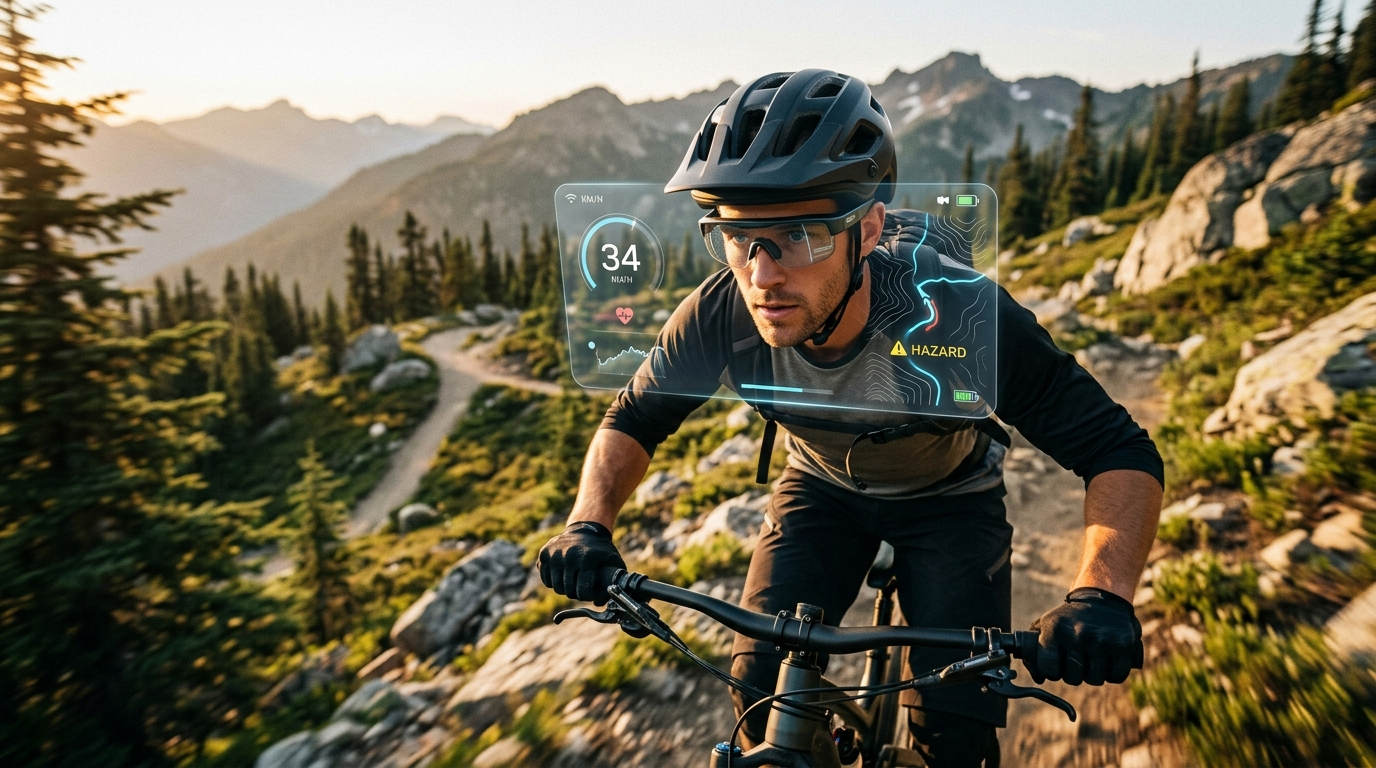
Augmented reality glasses are poised to transform action sports by placing live data directly in athletes' fields of vision. From wave conditions and trail navigation to performance metrics and safety alerts, AR promises a more informed sporting experience. Supporters believe this technology can improve performance, decision-making, and accessibility, while critics argue that constant digital overlays risk distracting athletes from the very moments they seek to experience. As AR devices move closer to mainstream adoption, the debate extends beyond innovation itself: can technology enhance action sports without replacing the instinct, presence, and freedom that have always defined them?
Imagine dropping into a skate bowl, paddling into a wave, or carving down a mountain trail while performance data floats effortlessly before your eyes.
Speed.
Heart rate.
Navigation.
Weather conditions.
Technique analysis.
With augmented reality (AR) glasses rapidly approaching mainstream adoption, this vision is becoming increasingly realistic.
But as digital information begins to overlay the physical world, an important question emerges:
When data becomes part of the experience, are you still fully experiencing the sport?
The debate isn't simply about technology.
It's about preserving the feeling that makes action sports worth doing in the first place.
Why This Matters Now
Major technology companies are investing billions of dollars into wearable AR devices.
At the same time, action sports continue to embrace performance analytics, GPS tracking, and connected equipment.
The combination appears inevitable.
Future athletes may have access to real-time information including:
- Speed and acceleration
- Wave and tide conditions
- Trail navigation
- Weather alerts
- Biometric data
- Performance analytics
The potential advantages are significant.
Yet so are the philosophical questions.
Action sports have always been rooted in instinct, flow, and immersion. Can those qualities survive constant streams of digital information?
Expert Perspectives
Kevin Kelly: Data as a Performance Tool
Technology writer and WIRED co-founder Kevin Kelly believes AR has enormous potential to improve action sports.
Real-time information could help athletes make better decisions while increasing both safety and performance.
"Imagine a surfer instantly accessing wave data and tide conditions while paddling out."
For Kelly, information enhances rather than replaces instinct.
Properly designed AR systems could help athletes:
- Read changing conditions
- Improve technique
- Avoid hazards
- Learn more efficiently
Technology becomes another piece of equipment, much like better boards, helmets, or protective gear.
However, Kelly also acknowledges an important limitation.
"The allure of seeing data in real-time can overshadow the intrinsic joy of the sport."
Useful information should support the experience—not dominate it.
Jaron Lanier: Protecting the Human Experience
Computer scientist and author Jaron Lanier approaches AR with greater caution.
He recognizes its potential benefits while questioning its long-term psychological effects.
"While data can enhance performance, it should not overpower the very essence of the sport."
For Lanier, action sports are fundamentally sensory experiences.
The feel of a board beneath your feet.
The sound of a breaking wave.
The cold air during a downhill ride.
These sensations cannot be replicated—or improved—by digital overlays.
"When our focus shifts from the physical world to a layer of digital information, are we still truly experiencing the moment?"
Lanier believes athletes should treat AR as an occasional aid rather than a permanent lens through which they experience nature.
The danger is not technology itself, but forgetting where the real experience exists.
Kara Swisher: When Performance Becomes Content
Technology journalist Kara Swisher expands the conversation beyond individual performance.
She explores how AR intersects with social media and online identity.
Real-time metrics could make sports more interactive and more shareable.
Athletes might instantly broadcast:
- Speed
- Jump height
- Route maps
- Performance statistics
- Environmental conditions
"In the age of social media, sharing your sport's metrics in real time can lead to community engagement and inspire others."
But Swisher also sees a downside.
If every ride, wave, or trick becomes content optimized around measurable performance, personal experiences may become increasingly performative.
"If you're constantly checking performance stats during a skate, are you really enjoying the ride?"
Technology designed to enrich experiences can quietly shift attention away from the experience itself.
Editorial Synthesis
Where Experts Agree
Despite their different perspectives, all three experts recognize several common themes:
- AR can improve safety and performance.
- Real-time data has legitimate value for athletes.
- Technology should support rather than replace human experience.
- Mindful use of AR will be essential as adoption grows.
Where Experts Disagree
Enhancement vs. Distraction
Kelly views AR primarily as a performance-enhancing tool.
Lanier worries that excessive digital overlays may interfere with presence and immersion.
Swisher believes the biggest challenge may be how social media changes the purpose of using that data.
How Much Technology Is Too Much?
Some experts envision AR becoming a standard part of athletic equipment.
Others argue that certain experiences should remain intentionally free from digital augmentation.
The Future of Action Sports
Supporters see smarter, safer, and more informed athletes.
Critics fear increasingly quantified experiences that prioritize measurable performance over personal enjoyment.
Why This Matters
The conversation surrounding AR glasses reflects a broader question facing modern technology.
Just because something can be measured, should it be?
Action sports have always been defined by qualities that resist easy measurement:
- Flow
- Freedom
- Creativity
- Intuition
- Presence
Those experiences often matter more than statistics.
At the same time, technology has consistently improved equipment, safety, and training.
AR may simply represent the next stage of that evolution.
The challenge lies in preventing useful tools from becoming constant distractions.
Because athletes don't pursue these sports solely to generate data.
They pursue them for moments that feel impossible to quantify.
The ideal future may not reject augmented reality.
It may simply recognize that there are moments when the best display is no display at all.
The most valuable information in action sports may never appear on a screen. Sometimes it's found in the feeling of the wave, the sound of the wheels, or the instinct that tells you exactly when to move.
Balancing Data and Experience in Action Sports
As augmented reality glasses begin to shape the landscapes of action sports, it's crucial to strike a balance between enhanced data access and the innate joy of the activity. While tools that provide real-time metrics can undoubtedly elevate performance and safety, they also pose the risk of overshadowing the visceral connection we have with our chosen sports. As athletes, it's essential to retain an awareness of our surroundings and the pure exhilaration that comes from engaging with nature and community. Embracing technology shouldn't come at the cost of diminishing the very essence that draws us to skateboarding, surfing, and skiing in the first place. Thus, as AR technology continues to evolve, we must advocate for its thoughtful integration, ensuring that the experience remains at the forefront of our pursuits.

Kevin Kelly
Co-founder, Wired Magazine
"Integrating augmented reality into sports can enhance our experiences by providing real-time data and metrics that enrich our understanding of performance and environment without detracting from the thrill."
in Kevin Kelly
Jaron Lanier
Computer Scientist and Musician
"While augmented reality has potential benefits, there's a real risk it could become an overwhelming data overlay that distracts individuals from the immersive joy of sports and nature."
in Jaron Lanier
Kara Swisher
Co-founder, Recode
"There’s a duality to augmented reality in sports; while it can enhance understanding and enjoyment, we must also consider how it might detract from genuine experiences in the moment."
𝕏 Kara Swisher in Kara SwisherHow Does This Hit You?



No comments yet. Be the first to weigh in.