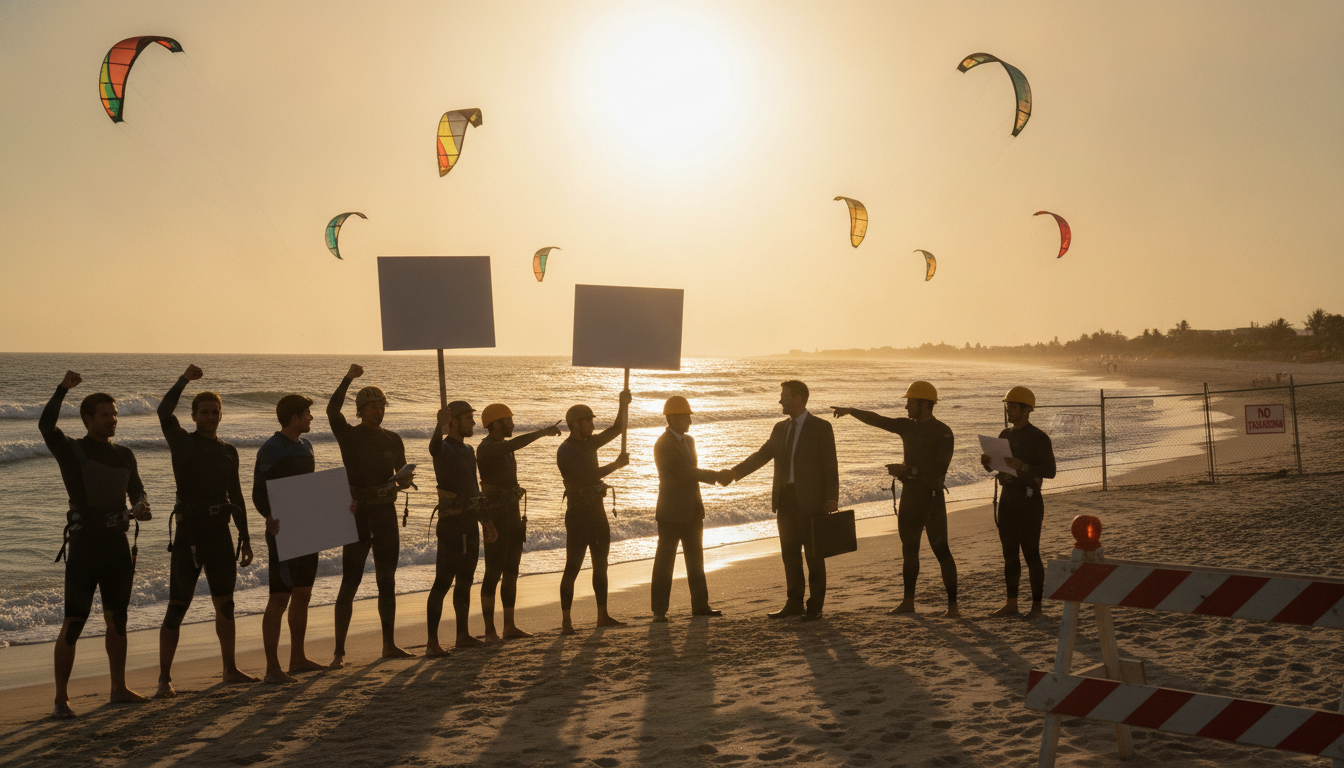
Kiteboarding's biggest threat may no longer be the wind or the waves—it may be access. As coastal communities impose stricter zoning and environmental protections, kiteboarders are increasingly forced to defend the beaches and launch points they depend on. But the solution isn't necessarily to fight regulation itself. The strongest strategy may be proving that responsible kiteboarding can coexist with environmental goals through designated zones, seasonal restrictions, safety standards, and cooperation with local authorities. The future of the sport could depend less on winning legal battles than on demonstrating that preserving access and protecting fragile coastlines don't have to be opposing goals.
Kiteboarding Spots Are Disappearing as Coastal Zoning Laws Catch Up With a Sport That Never Asked for Permission to Exist. The Athletes Are Fighting Back. The Lawyers Are Winning.
Does the thrill of kiteboarding come at the cost of the very spaces that make it possible?
Kiteboarding depends on something many other sports can take for granted: access.
You need wind, water, sufficient open space, and a safe place to launch and land.
Remove any one of those elements and the sport becomes considerably harder—or impossible.
That makes coastal regulation particularly consequential for kiteboarders. A new environmental restriction, beach-management rule, seasonal closure, or safety ordinance can effectively eliminate a location without ever explicitly banning the sport itself.
The resulting conflict isn't simply athletes versus regulators.
It's a negotiation over who gets to use increasingly valuable and environmentally sensitive public space.
The Access Problem
Coastal areas are under pressure from multiple directions.
They may need to accommodate:
- swimmers;
- surfers;
- fishermen;
- boaters;
- wildlife;
- tourism;
- conservation;
- commercial development;
- and local residents.
Kiteboarding introduces another consideration: large equipment, moving lines, powerful wind forces, and launch zones that require substantial clearance.
A beach that looks enormous from a distance can therefore have a surprisingly small usable area for kiteboarding.
When regulations divide the coastline into swimming areas, protected habitat, boating zones, and restricted access areas, the remaining space can become too small for safe operation.
Brian McCarthy: Regulation Doesn't Have to Mean Exclusion
The pro-access argument isn't necessarily that kiteboarders should be exempt from regulation.
It's that regulation should recognize how the sport actually operates.
A blanket prohibition may be easier to administer, but it isn't necessarily the most efficient solution.
A more sophisticated framework could establish:
- designated launch areas;
- seasonal operating windows;
- minimum-distance requirements;
- rider certification;
- equipment restrictions;
- environmental monitoring;
- and clear safety rules.
That approach treats kiteboarding as a legitimate recreational activity that needs to be managed rather than eliminated.
Susan Caldwell: The Environment Has to Come First
The environmental argument deserves equal weight.
Coastal ecosystems can be fragile.
A location that appears to be nothing more than a convenient stretch of beach may contain:
- nesting areas;
- sensitive vegetation;
- dunes;
- wildlife habitat;
- erosion-prone terrain;
- or protected marine environments.
From this perspective, restrictions aren't necessarily an attack on kiteboarding.
They're part of a broader attempt to manage finite environmental resources.
And that's where the argument becomes more complicated.
If scientific evidence shows that a particular launch area causes meaningful ecological damage, simply pointing to the sport's popularity isn't a sufficient response.
The relevant question becomes:
Can the activity be modified enough to coexist with the ecosystem?
Carlos Rivas: Losing Access Means Losing the Community
For athletes, however, a beach closure isn't an abstract regulatory decision.
It changes where people can practice, teach newcomers, compete, and socialize.
Once a popular location disappears, the consequences can extend beyond individual riders.
Local instructors may lose customers.
Equipment shops may lose business.
Tourism can shift elsewhere.
And communities built around the sport can fragment.
This is why Rivas's emphasis on athlete involvement is important.
If kiteboarders wait until a final regulation is already written, their options become much narrower.
The better strategy is to participate before the decision is finalized.
The Legal Battle Is Often Won Before Court
The dramatic version of this conflict is a lawsuit.
But litigation isn't necessarily the most effective first move.
A kiteboarding organization seeking to preserve access may have more leverage by establishing a factual record first.
That could include:
- Documenting existing use
- Collecting safety data
- Demonstrating economic benefits
- Identifying alternative launch areas
- Proposing specific operating restrictions
- Participating in public consultations
- Working with environmental organizations
This changes the argument from:
"Don't close our beach."
to:
"Here is a workable management plan that addresses your concerns while preserving responsible access."
That's a much stronger regulatory position.
Why "We've Always Used It" Isn't Enough
One of the weakest arguments in these disputes is historical use by itself.
A community may have used a beach for decades.
That doesn't automatically establish a permanent legal right to continue doing so under unchanged conditions.
Environmental conditions can change.
Population density can change.
Safety risks can change.
Land-use rules can change.
What worked when ten people used a location may not work when several hundred arrive on a busy weekend.
Historical use is useful evidence.
But it needs to be combined with a credible plan for the future.
The Economic Argument
Kiteboarding isn't just a recreational activity.
In suitable locations, it can generate economic activity through:
- instruction;
- equipment sales;
- equipment rentals;
- accommodation;
- restaurants;
- tourism;
- competitions;
- and related services.
That gives local governments another reason to consider managed access.
But economic arguments shouldn't be exaggerated.
Tourism revenue doesn't automatically override environmental restrictions.
The strongest economic case is therefore not:
"Kiteboarding makes money, so let us use the beach."
It's:
"Here is the measurable economic value of responsible kiteboarding, and here is a management model that minimizes its environmental and safety costs."
That is a more credible negotiation.
Designated Zones May Be the Middle Ground
The most promising solution may be spatial separation.
Instead of asking whether kiteboarding should be permitted across an entire coastline, authorities can identify specific areas where it is compatible with existing uses.
For example:
Zone A: swimming
Zone B: wildlife protection
Zone C: kiteboarding launch
Zone D: general recreation
This approach recognizes that different activities require different spatial conditions.
It also makes enforcement easier.
Seasonal Restrictions Could Work Too
Environmental sensitivity isn't always constant throughout the year.
If a particular location is problematic during nesting season, for example, a permanent closure may be unnecessarily broad.
A seasonal restriction could potentially preserve access during periods when ecological risk is lower.
The same principle can apply to crowded beaches.
If safety concerns peak during tourist season, authorities could establish restricted hours or designated launch windows.
The goal is precision.
Regulation works better when it targets the actual problem rather than simply eliminating the activity associated with it.
The Bigger Problem: Fragmentation
There is another issue that receives less attention.
Closing one location doesn't necessarily eliminate kiteboarding.
It can simply push riders somewhere else.
That can create a chain reaction.
Close Beach A.
Riders move to Beach B.
Beach B becomes overcrowded.
Residents complain.
Authorities impose restrictions.
Riders move to Beach C.
Eventually, the sport becomes concentrated in fewer and fewer locations.
This is why coastal planning needs to consider regional access, not just individual beaches.
What Both Sides Actually Want
Despite the adversarial language surrounding these disputes, the interests aren't necessarily incompatible.
Kiteboarders generally want:
- safe access;
- predictable rules;
- sustainable locations;
- and enough space to operate.
Environmental regulators generally want:
- ecosystem protection;
- compliance;
- predictable enforcement;
- and reduced ecological impact.
Local governments generally want:
- public safety;
- tourism;
- economic activity;
- and fewer conflicts between users.
There is considerable overlap.
The challenge is converting that overlap into policy.
Where the Experts Agree
The strongest consensus is straightforward:
- Coastal resources need management.
- Kiteboarding communities need to participate in that process.
- Environmental concerns cannot simply be dismissed.
- Blanket restrictions aren't necessarily the only solution.
- Cooperation can produce better outcomes than permanent conflict.
The disagreement is primarily about where the burden should fall.
Kiteboarders fear that regulation will gradually eliminate access.
Environmental advocates fear that recreational pressure will gradually degrade sensitive areas.
Both concerns can be legitimate.
What the Sport Should Do Next
If kiteboarding communities want to preserve access, the most effective strategy may be to become better organized before conflicts reach the courtroom.
That means developing:
1. Environmental standards
Show that riders understand and can comply with ecological requirements.
2. Safety protocols
Demonstrate responsible launch, landing, and operating practices.
3. Economic evidence
Document tourism and local-business contributions rather than relying on anecdotal claims.
4. Alternative-site proposals
Don't simply oppose closures. Present viable alternatives.
5. Community relationships
Residents who see kiteboarders as responsible neighbors are more likely to support continued access.
6. Legal preparedness
When negotiations fail, organized communities are in a much stronger position to challenge regulations.
Why This Matters
The fight over kiteboarding spots represents something larger than one sport.
Surfing, climbing, mountain biking, off-road recreation, boating, and other outdoor activities increasingly encounter the same fundamental problem:
public recreational space is limited, while demand for it is growing.
The answer cannot simply be that every recreational activity gets unrestricted access.
Nor can it be that environmental regulation automatically eliminates activities that were established before modern management frameworks existed.
The more sustainable answer is managed coexistence.
Kiteboarders need to demonstrate that they can operate responsibly.
Regulators need to demonstrate that restrictions are proportionate and evidence-based.
And lawyers need to ensure that both sides operate within a legitimate legal framework.
The future of kiteboarding may therefore depend less on defeating regulation than on becoming good enough at regulation to shape it.
Navigating the Currents of Change: Protecting Kiteboarding's Future
As kiteboarding continues to rise in popularity, it finds itself at a crucial crossroads where regulatory challenges threaten the very essence of the sport. Athletes and advocates are rightly raising alarms about escalating coastal zoning laws that jeopardize existing kiteboarding spots. However, the legal battles are not just about preserving access; they are also about fostering a deeper understanding of the sport’s broader economic and ecological impact. With strategic advocacy, there is hope for a future where kiteboarding can thrive in harmony with environmental goals. It is essential that lawmakers recognize the sport's value in promoting tourism and community engagement while ensuring sustainable practices. In the fight for preservation, kiteboarders are showing resilience, but collective efforts must be amplified to truly protect the spaces that allow this exhilarating sport to flourish.

Brian McCarthy
CEO, Kiteboarding Association
"McCarthy argues that kiteboarding is a legitimate sport deserving of access to coastal areas, emphasizing the need for updated zoning laws that recognize recreational activities."
𝕏 Brian McCarthy in Brian McCarthy
Susan Caldwell
Environmental Lawyer
"Caldwell believes that while sports like kiteboarding are essential, adherence to coastal zoning laws is crucial for environmental protection and sustainable development."
𝕏 Susan Caldwell in Susan Caldwell
Carlos Rivas
Kiteboarding Athlete and Advocate
"Rivas advocates for finding a middle ground between zoning regulations and kiteboarding access, highlighting the importance of collaboration between athletes and legal authorities."
𝕏 Carlos Rivas in Carlos RivasHow Does This Hit You?



No comments yet. Be the first to weigh in.