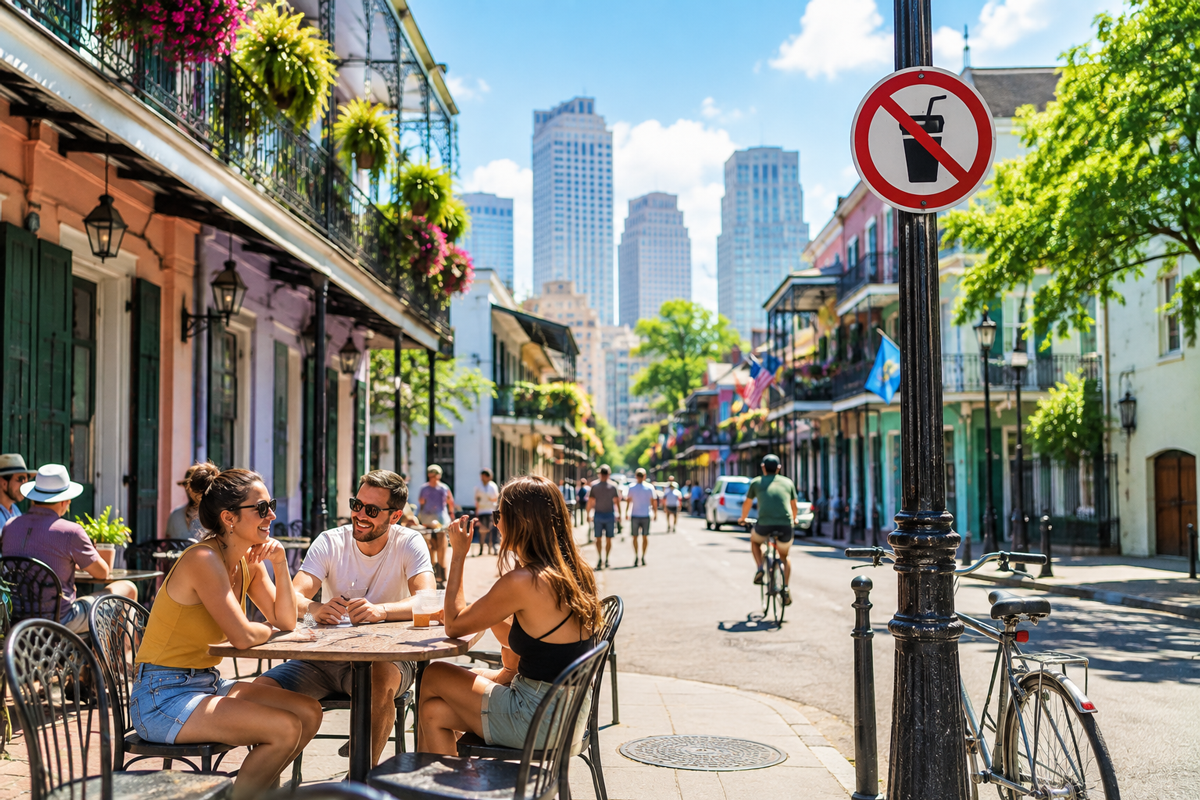
New Orleans exposes a basic truth about urban policy: a rule can be legally enforceable and still be economically and culturally misaligned with the city it governs. But the real lesson is not that cities should simply ignore inconvenient laws. It is that compliance has opportunity costs—and when regulation collides with a city’s identity, tourism economy, and public-space culture, policymakers should measure those costs against the benefits rather than assuming that stricter enforcement automatically produces a better city.
Few regulations reveal the tension between law, culture, and urban economics as clearly as rules governing alcohol in public.
The conventional argument is straightforward: open-container restrictions promote public order, reduce nuisance, and make streets easier to police.
New Orleans complicates that story.
The city's relationship with public drinking is unusually intertwined with festivals, tourism, nightlife, parades, and the use of streets as social spaces. But the premise that New Orleans simply "ignored" a single open-container law is too simplistic. Louisiana law, city ordinances, special-event rules, designated entertainment districts, and enforcement practices interact in more complicated ways.
That distinction matters.
The real question isn't whether New Orleans discovered that breaking the law is cheaper than obeying it.
It is whether a city can design a regulatory framework that recognizes that public space itself can be part of its economic and cultural product.
The Context: When Regulation Shapes Urban Identity
Open-container laws are often treated as relatively minor quality-of-life regulations.
They aren't necessarily minor.
A prohibition on consuming alcohol in public affects how people use sidewalks, plazas, streets, festivals, entertainment districts, and nightlife areas.
In a city where those spaces are central to tourism and cultural life, enforcement can change the underlying product that the city offers visitors.
Consider two hypothetical cities.
City A treats drinking on the street as a public-order problem.
City B treats controlled public drinking as part of a regulated entertainment ecosystem.
Neither is automatically superior.
The difference is that they have chosen different definitions of what public space is for.
New Orleans has historically leaned toward the second model in specific contexts, particularly around its entertainment culture and major events.
That does not mean there are no restrictions. Louisiana law generally prohibits possession of open alcoholic beverages in motor vehicles, for example, while local rules can govern consumption in particular public spaces and circumstances.
So the interesting case isn't lawlessness.
It's selective accommodation.
The Cultural Argument
The strongest argument for New Orleans's approach is not that alcohol is inherently good for cities.
It is that culture doesn't always fit neatly into standardized regulatory categories.
New Orleans's Mardi Gras, festivals, music culture, parades, and nightlife depend heavily on people occupying public space.
The street isn't merely transportation infrastructure.
It becomes:
- a gathering place;
- a performance space;
- a marketplace;
- a social environment;
- and, during major events, part of the city's entertainment infrastructure.
A regulation that treats every public alcoholic drink as equivalent to disorder can therefore miss an important distinction:
context matters.
A person carrying a drink while walking through a controlled entertainment district is not necessarily creating the same public-order problem as someone intoxicated and causing a disturbance.
That suggests a more sophisticated regulatory philosophy:
regulate behavior, not merely possession.
The Economic Argument
The economic case is even more interesting.
Suppose a city prohibits a behavior that tourists strongly associate with its entertainment culture.
The direct benefit of enforcement may be measurable:
- fewer violations;
- fewer enforcement interactions;
- potentially less public disorder.
But the opportunity cost is harder to calculate.
Would stricter enforcement reduce:
- visitor spending?
- time spent in entertainment districts?
- festival attendance?
- restaurant and bar revenue?
- demand for hotels?
- nightlife activity?
The answer is not automatically yes.
But the possibility means that a city should not compare fine revenue versus compliance costs in isolation.
It should compare the broader economic consequences.
That is where the original framing—"Did compliance cost more than the fine?"—is slightly misleading.
A fine is only one cost of noncompliance.
Likewise, compliance is not simply the cost of following a rule.
The real calculation is closer to:
Regulatory cost + lost economic activity + cultural effects vs. public-order benefits + enforcement savings.
That is a much harder equation.
The Hidden Cost of Compliance
Imagine New Orleans decided to enforce public-drinking restrictions far more aggressively across its entertainment districts.
The immediate result could look positive.
More citations.
Fewer open containers.
More visible enforcement.
But if the city's tourism economy depends partly on an informal street culture, the second-order effects could be different.
Visitors may spend less time outside.
Festivals could feel more restrictive.
Businesses could experience lower foot traffic.
The atmosphere that differentiates New Orleans from other American cities could become less distinctive.
And that creates an unusual policy problem:
You can successfully enforce a rule while simultaneously making the city less economically valuable.
That doesn't mean enforcement is wrong.
It means enforcement has an opportunity cost.
But New Orleans Doesn't Get a Free Pass
There is an equally important counterargument.
Cultural identity cannot be a universal exemption from public-safety regulation.
Open alcohol can contribute to:
- public intoxication;
- litter;
- violence;
- impaired driving;
- harassment;
- noise;
- disorder around residential areas.
A city that treats cultural tradition as an absolute defense can end up imposing costs on residents who do not participate in the culture.
That is the central weakness of the romantic version of the New Orleans argument.
Tourists may enjoy permissive public-space rules; residents still have to live with their consequences.
The best policy therefore isn't necessarily "let people drink wherever they want."
It is differentiated regulation.
Entertainment districts can have different rules from residential neighborhoods.
Festivals can operate under permits and temporary regulations.
Bars can be required to manage their immediate surroundings.
Police can prioritize dangerous behavior rather than harmless possession.
Cities can create rules that recognize cultural realities without abandoning public order.
What Other Cities Can Learn
The lesson from New Orleans isn't that every American city should copy New Orleans.
That would defeat the point.
The lesson is that cities should ask a more fundamental question:
What kind of city are our regulations producing?
Consider a hypothetical city with a thriving pedestrian nightlife district.
If the city adopts rules that make outdoor socializing extremely difficult, it may eventually produce a safer but quieter downtown.
Another city might choose more permissive rules and develop a vibrant entertainment district—but also accept greater enforcement and sanitation costs.
Neither outcome is inherently irrational.
The mistake is assuming that one regulatory model works everywhere.
Urban policy is partly about matching rules to the social and economic function of a place.
Editorial Synthesis
Where the Argument Is Strong
- Public-space regulation can influence a city's cultural identity.
- Enforcement has economic opportunity costs.
- Tourism and nightlife can depend on relatively permissive use of public space.
- Context-sensitive regulation can distinguish ordinary social behavior from genuine public disorder.
- Cities should measure second-order effects rather than looking only at citations or fines.
Where the Argument Gets Weaker
The claim that New Orleans simply "ignored" an open-container law overstates the case.
The city's approach is better understood as a patchwork of state law, municipal rules, special-event regulations, and enforcement practices rather than straightforward defiance.
And the economic claim that tourism benefits automatically outweigh regulatory costs requires evidence.
A city cannot simply declare that cultural authenticity is worth any amount of disorder.
Why This Matters
The deeper issue isn't alcohol.
It's who gets to define the function of urban space.
A city can be designed primarily around traffic movement, property protection, and risk minimization.
Or it can treat streets and public spaces as places where culture, commerce, and spontaneous social life occur.
Those choices have consequences.
New Orleans demonstrates that some cities derive economic value precisely from behaviors that more standardized urban regulation attempts to suppress.
But the answer isn't to romanticize noncompliance.
The better lesson is that good urban governance sometimes requires distinguishing between rules that prevent harm and rules that merely eliminate unconventional behavior.
If a regulation prevents violence, protects residents, or reduces dangerous intoxication, enforcement has an obvious justification.
If it merely prevents people from behaving in a culturally normal way in a carefully managed entertainment district, the policy deserves a harder economic and cultural examination.
So did compliance cost more than the fine?
Possibly—but that isn't really the right comparison.
The real cost of compliance may be the economic and cultural activity a city gives up when it forces public space to behave like private space.
And the real cost of noncompliance isn't the fine.
It's whatever happens when cultural tolerance crosses the line into public disorder.
The most successful cities won't necessarily be the ones with the fewest rules.
They'll be the ones that understand which rules protect the city—and which rules accidentally erase what makes the city worth visiting in the first place.
Defiance as a Tool for Urban Identity
The Open Container Law serves as a stark reminder of the ongoing struggle between regulatory compliance and the intrinsic cultural identity of a city. New Orleans's choice to largely ignore this law highlights a critical point: sometimes, strict adherence to regulations stifles the very essence that makes a city thrive. The economic benefits stemming from a vibrant street culture, fueled by a spirit of defiance, suggest that compliance could indeed cost more than simply facing occasional fines. This raises an essential debate: should cities like New Orleans prioritize bureaucratic governance over the organic development of their unique cultural landscapes? The path forward may require a re-evaluation of such laws, focusing on fostering environments where community and identity flourish rather than suffocate under the weight of compliance.

David Simon
Professor of Urban Studies, University of New Orleans
"The Open Container Law serves as a necessary tool for public safety and urban order. New Orleans' decision to ignore such laws raises questions about the long-term implications for civic compliance and the potential normalization of lawlessness."
in David Simon
Mary O'Connor
Cultural Anthropologist, Tulane University
"The open-container culture in New Orleans is a significant part of its identity and tourism. Compliance with strict laws could stifle the vibrancy of the city, ultimately costing more in lost revenue and cultural richness than the fines imposed."
in Mary O'Connor
Alex Romero
Urban Economist, University of California, Berkeley
"While the Open Container Law is meant to promote public safety, it's essential to evaluate the economic implications of compliance versus fines. A nuanced approach that considers both the regulatory intent and the local culture may provide a better solution for cities like New Orleans."
in Alex RomeroHow Does This Hit You?



No comments yet. Be the first to weigh in.