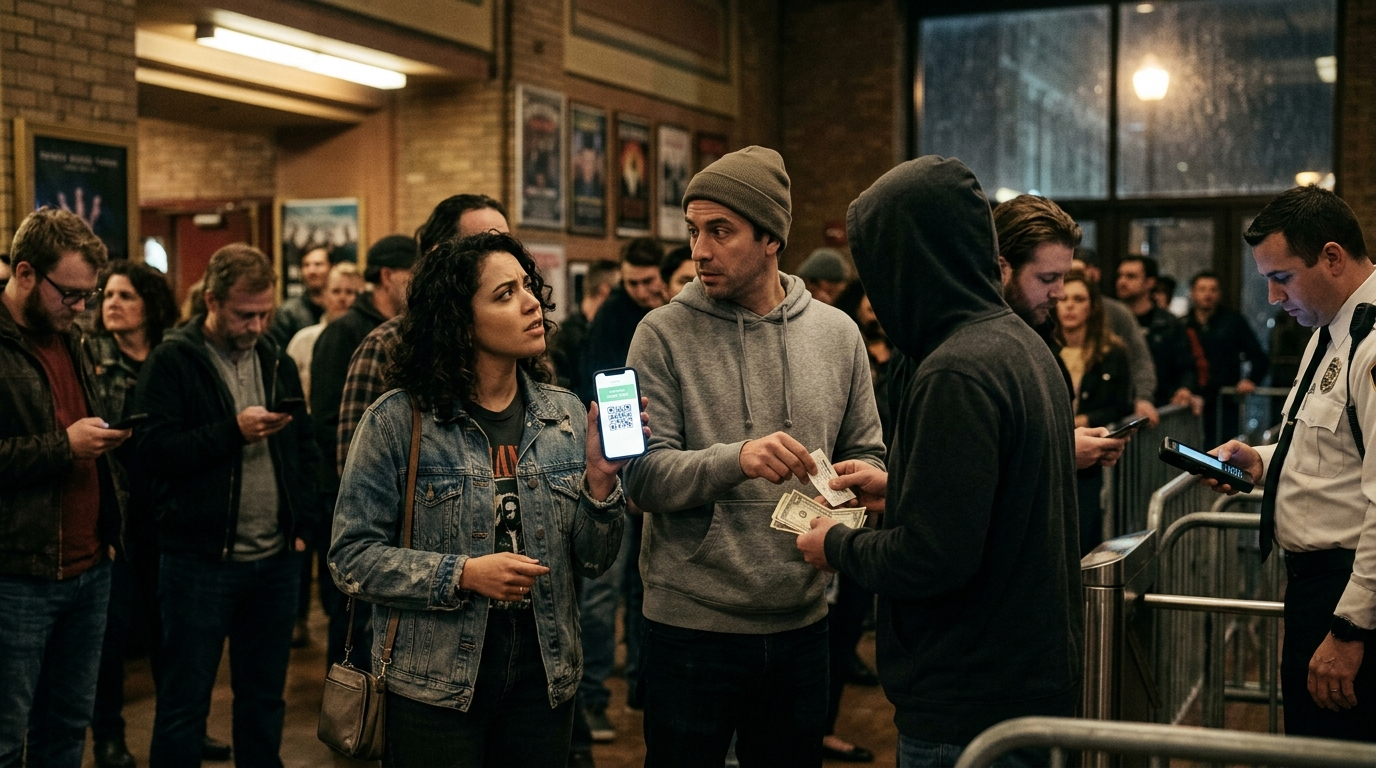
Blockchain ticketing was once heralded as the technology that would finally dismantle ticket scalping by introducing transparent ownership records, programmable resale rules, and direct artist control over secondary sales. Yet years after those promises captured the music industry's imagination, scalpers remain a persistent challenge. While blockchain has demonstrated technical potential, widespread adoption has been slowed by fragmented industry standards, regulatory uncertainty, and the reluctance of venues, promoters, and consumers to embrace new systems. Experts broadly agree that the technology can improve transparency, but they differ on whether innovation alone can solve a problem rooted in market incentives, governance, and industry coordination. The future of blockchain ticketing depends as much on collaboration as it does on code.
For years, blockchain ticketing promised to solve one of live entertainment's oldest frustrations.
Buy a ticket.
Own it securely.
Prevent counterfeiting.
Limit unfair resale.
Allow artists—not scalpers—to benefit when tickets change hands.
On paper, it sounded transformative.
Every ticket could be uniquely verified.
Every transfer permanently recorded.
Every resale governed by programmable rules.
Yet despite the excitement, ticket scalping remains a familiar part of buying concert tickets.
Fans still face inflated resale prices.
Artists still lose control of secondary markets.
Venues and promoters still rely largely on traditional ticketing systems.
That raises an important question:
If blockchain offers the technical tools to combat scalping, why hasn't it fundamentally changed the ticketing industry?
Why This Matters Now
Live entertainment continues to grow rapidly.
Concerts have become increasingly valuable experiences, driving intense demand for major events.
That demand creates opportunities for secondary marketplaces where tickets are frequently resold at substantial mark-ups.
Blockchain technology promises several advantages:
- Verifiable ticket ownership.
- Reduced fraud and counterfeiting.
- Programmable resale conditions.
- Greater transparency throughout the sales process.
- Opportunities for artists to receive royalties from secondary sales.
Yet technology alone cannot reshape an industry built on decades of established relationships between artists, venues, promoters, and ticketing companies.
The greatest obstacle may no longer be technological capability, but industry-wide adoption.
Expert Perspectives
Cathy Hackl: Innovation Requires Industry Adoption
Technology strategist Cathy Hackl believes blockchain ticketing possesses genuine potential, but its success depends on broad participation.
"We have the tools in place, but the ecosystem is still in its infancy."
Blockchain infrastructure requires significant investment from:
- Venues.
- Promoters.
- Ticketing platforms.
- Event organisers.
- Artists.
Without coordinated adoption across the entire ecosystem, isolated blockchain solutions struggle to achieve meaningful scale.
Hackl argues that technology can improve transparency, but widespread implementation remains the larger challenge.
Even transformative technology delivers limited results when only parts of an industry adopt it.
Dr. Primavera De Filippi: Governance Matters as Much as Technology
Researcher Dr. Primavera De Filippi argues that blockchain cannot solve ticketing challenges through technology alone.
"Technical solutions alone won't fix the problem."
Ticketing involves multiple stakeholders with competing incentives.
Artists seek fair compensation.
Fans want affordable access.
Venues require operational efficiency.
Promoters prioritise revenue.
Regulators focus on consumer protection.
According to De Filippi, successful blockchain ticketing requires governance structures that align these interests alongside technological innovation.
Without shared rules and industry cooperation, blockchain risks becoming another platform operating within the same flawed system.
Technology can improve processes, but governance determines how those processes ultimately function.
Matt Jones: Progress Is Happening—Just More Slowly Than Expected
Blockchain entrepreneur Matt Jones remains optimistic about the technology's future.
"We've seen a marked increase in artists choosing to use blockchain solutions that allow them to retain control over their tickets."
Rather than measuring success solely by eliminating scalpers, Jones points to gradual improvements.
Emerging blockchain platforms now enable:
- Artist-controlled resale policies.
- Royalties from secondary ticket sales.
- Improved ownership verification.
- Greater transparency in ticket transfers.
He believes broader adoption depends on better education for both consumers and industry stakeholders.
Meaningful innovation often arrives gradually before it becomes mainstream.
Editorial Synthesis
Where Experts Agree
Despite their differing outlooks, the experts identify several common themes:
- Blockchain can improve transparency in ticketing.
- Ticket scalping remains a significant challenge.
- Industry-wide adoption is necessary for meaningful change.
- The technology's full potential has not yet been realised.
Where Experts Disagree
How Close Is Blockchain to Delivering Its Promise?
Matt Jones believes meaningful progress is already underway through niche applications and growing artist adoption.
Cathy Hackl considers the industry to be at a much earlier stage, with infrastructure still developing.
Is Technology Enough?
Hackl and Jones focus primarily on technological implementation.
Dr. De Filippi argues that governance, regulation, and stakeholder cooperation are equally important to long-term success.
What Is the Biggest Barrier?
Hackl identifies slow adoption across the industry.
Jones highlights education and awareness.
De Filippi believes institutional coordination presents the greatest long-term challenge.
Why This Matters
Blockchain ticketing illustrates an important lesson about technological innovation.
Building a better tool is only part of solving a complex problem.
Real transformation depends on whether industries are willing—and able—to change how they operate.
Ticket scalping persists not because blockchain lacks useful features, but because the ticketing ecosystem involves competing commercial interests, entrenched business models, and millions of consumers accustomed to existing platforms.
If blockchain solutions become widely adopted, artists could gain greater control over pricing, fans could benefit from increased transparency, and secondary markets could become fairer.
If adoption remains fragmented, however, the technology may improve isolated parts of the industry without fundamentally changing the overall experience.
Ultimately, blockchain ticketing should not be judged solely on whether it eliminates scalpers. Its broader success will depend on whether it creates a more transparent, accountable, and equitable marketplace for everyone involved.
The future of ticketing will not be determined by blockchain alone. It will be shaped by whether technology, regulation, and industry cooperation evolve together. Until that alignment exists, blockchain will remain a promising solution still waiting for the ecosystem it was designed to transform.
The Hurdles of Blockchain Ticketing: Overcoming Obstacles to Fulfillment
The promise of blockchain ticketing, once hailed as the antidote to scalping, faces significant obstacles that continue to hinder its effectiveness. As Cathy Hackl points out, the technology exists, but its adoption is stunted by the industry’s reluctance to invest in a comprehensive infrastructure. Meanwhile, Dr. Primavera De Filippi reminds us that technology alone cannot resolve the deep-rooted complexities of the ticketing ecosystem involving multiple stakeholders. Without concerted efforts from artists, promoters, and venues to unite and fully embrace these innovative solutions, the persistent issue of scalping will likely endure. For blockchain ticketing to be a true game-changer, a collective endeavor towards a robust, transparent system is essential, or the dream of an equitable ticketing landscape will remain just that—a dream.

Cathy Hackl
CEO, Journey.ai
"Hackl argues that blockchain technology provides a transparent and secure means of tracking ticket sales, which, if properly implemented, could drastically reduce scalping and ensure artists receive their fair share of revenue."
𝕏 Cathy Hackl in Cathy Hackl
Dr. Primavera De Filippi
Researcher, CNRS & Berkman Klein Center
"De Filippi maintains that while blockchain has potential, its current applications in ticketing still face significant scalability and regulatory challenges that can undermine its effectiveness against scalping."
𝕏 Dr. Primavera De Filippi in Dr. Primavera De Filippi
Matt Jones
Founder, Ticketing Blockchain Solutions
"Jones argues that while blockchain has the potential to improve ticketing systems, the reality is that technological adoption in the music industry is slow and the scalper problem persists due to existing market dynamics and consumer behavior."
𝕏 Matt Jones in Matt JonesHow Does This Hit You?



No comments yet. Be the first to weigh in.