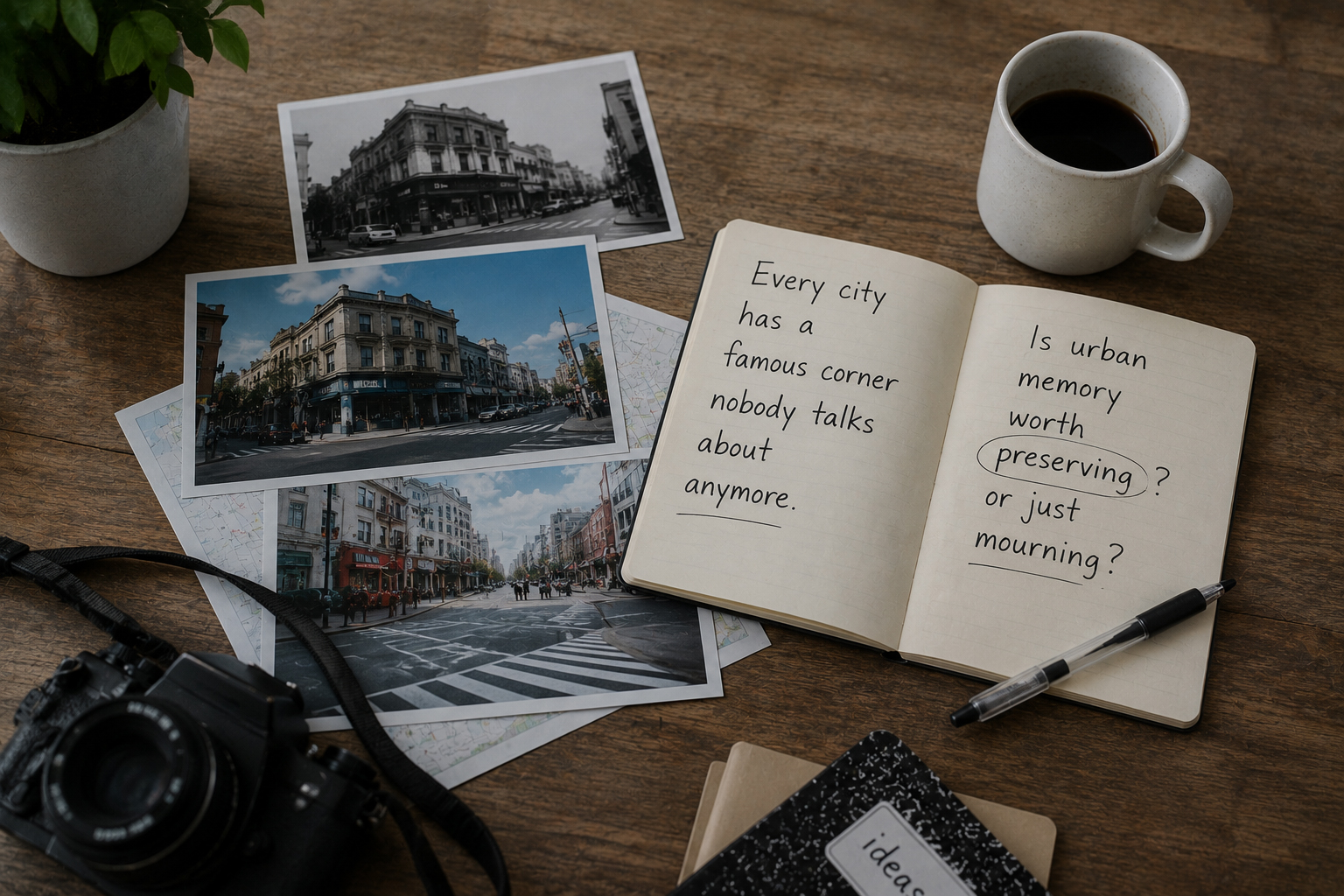
Every city has a corner that used to mean something — a jazz club, a diner, a gathering spot — that nobody talks about anymore. Edward Glaeser, Jan Gehl, and Rebecca Solnit debate whether urban memory is worth fighting to preserve or whether clinging to the past keeps cities from becoming something new.
Urban landscapes are dotted with forgotten corners — places once vibrant with cultural significance that now sit neglected, overshadowed by the pace of modern development. How should society engage with these spaces? Are they relics of the past worth preserving, or merely remnants better left to memory?
Context: The Present Need for Urban Memory
The discourse surrounding urban memory has gained traction in recent years, particularly as cities undergo rapid change fueled by globalization and technology. Historically significant locales often face the threat of being erased in favor of new developments that promise economic growth. Preserving urban memory is vital not just for nostalgia but for the identity it provides to communities. Yet in a world where space is at a premium, the question arises: Is valuing these corners a worthy pursuit, or are we merely mourning over what once was?
Perspective: For Preservation
Edward Glaeser: The Economic Argument for Memory
Edward Glaeser, a noted economist at Harvard University, argues that urban memory parallels economic vitality. He posits that cities thrive when they are able to foster both historical consciousness and innovation. "Place matters. In our increasingly anonymous world, these corners serve as anchors for community identity," Glaeser asserts. He highlights the economic development potential created by preserving historical sites, as they can draw tourists and stimulate local economies.
Additionally, Glaeser mentions research indicating that cities with a strong sense of history and identity often experience better social cohesion and lower rates of crime. "These historic corners offer lessons in resilience and adaptability," he explains.
Jan Gehl: The Human-Centric Perspective
Urban designer Jan Gehl emphasizes the impact of these spaces on human experience. "There is an emotional and social component tied to places we fondly remember. They serve as gathering spots, corners of conversation, and community connection," Gehl notes. In his view, preserving urban corners fosters public life and encourages micro-interactions among residents.
Gehl advocates for the creation of urban spaces conducive to social engagement. He sees the everyday corner as a vital piece in the mosaic of city life — a reflector of culture and community that speaks to larger issues of urban sustainability and livability. "If we abandon these areas, we risk losing what makes us human," he warns.
Perspective: The Case for Mourning
Rebecca Solnit: Recognizing the Ephemeral
While the arguments for preservation are compelling, author and activist Rebecca Solnit offers a different approach. Solnit acknowledges the inherent value of memory but raises a significant question: "What do we lose when we cling to these remnants of the past?" She suggests that focusing too much on preservation leads to a static understanding of urban spaces, stifling the fluid nature of cities as living entities.
In her view, each corner and street carries its own story, often tied to the dynamics of change. Solnit encourages a recognition of impermanence — "Cities breathe, transform, and evolve. Holding onto a particular memory often means refusing to acknowledge the richness of new ones." Rather than mourning what was lost, Solnit argues for embracing the transformations that bring communities to life anew.
She acknowledges the pain associated with loss but insists that mourning should be a catalyst for growth rather than a hindrance. "The nostalgia for a past corner can cloud judgment and inhibit progress," she notes, advocating a forward-thinking attitude that recognizes the potential for new memories to arise in transformed spaces.
Editorial Synthesis
Where Experts Agree
Both Glaeser and Gehl recognize that urban memory contributes to community identity. All experts agree that places — whether preserved or transformed — have a profound impact on social interactions. Glaeser and Gehl share concerns that losing historic corners might affect local economies negatively.
Where Experts Disagree
Glaeser and Gehl advocate for preservation as vital, while Solnit questions its relevance in the face of urban evolution. Solnit views nostalgia as potentially limiting, whereas Glaeser emphasizes its role in fostering economic and social benefits. Gehl supports human-centric designs maintaining historical memory, contrasting Solnit's call for acceptance of change.
Why This Matters
Urban memory serves as a tapestry woven into the fabric of everyday life, evoking profound implications for identity, economy, and social connectivity. However, the urban landscape is in perpetual flux — our challenge lies in balancing memory with progress.
The debate over preserving urban memory is not simply about erecting monuments to the past but engaging critically with the lived experiences of residents in an evolving urban context. As cities swell with new populations and technologies, the question remains: will we mourn the loss of these spaces, or will we take the time to recognize their stories while welcoming new narratives to unfold?
Cherishing Urban Memory: A Balance Between Past and Future
As cities continuously evolve, it is crucial to recognize the importance of urban memory in shaping community identity and fostering social cohesion. The argument for preserving these forgotten corners is compelling; they serve not just as a link to our past, but as catalysts for economic vitality and innovation. By maintaining a dialogue with our history, we enable future generations to find meaning in their spaces. While progress is necessary, it should not come at the cost of erasing our cultural heritage. Instead, a balance must be struck, integrating the old with the new to create vibrant, inclusive urban environments. In doing so, we honor our past while building a resilient future.
Edward Glaeser
Economist, Harvard University
"Glaeser argues that urban memory is essential for a city's identity and fosters community cohesion. He believes preserving historical corners can improve social connections and encourage civic engagement."
in Edward GlaeserJan Gehl
Urban Designer, Gehl Architects
"Gehl contends that urban memory can sometimes hinder progress by romanticizing the past. He advocates for adapting cities to current needs rather than clinging to former glory, emphasizing that functional environments should take priority over nostalgia."
Profile Jan GehlRebecca Solnit
Author, Activist
"Solnit believes that while it's essential to acknowledge and preserve urban memories, we must also recognize their limitations. She highlights the importance of integrating history with contemporary needs to create vibrant and adaptable urban spaces."
𝕏 Rebecca SolnitHow Does This Hit You?


No comments yet. Be the first to weigh in.