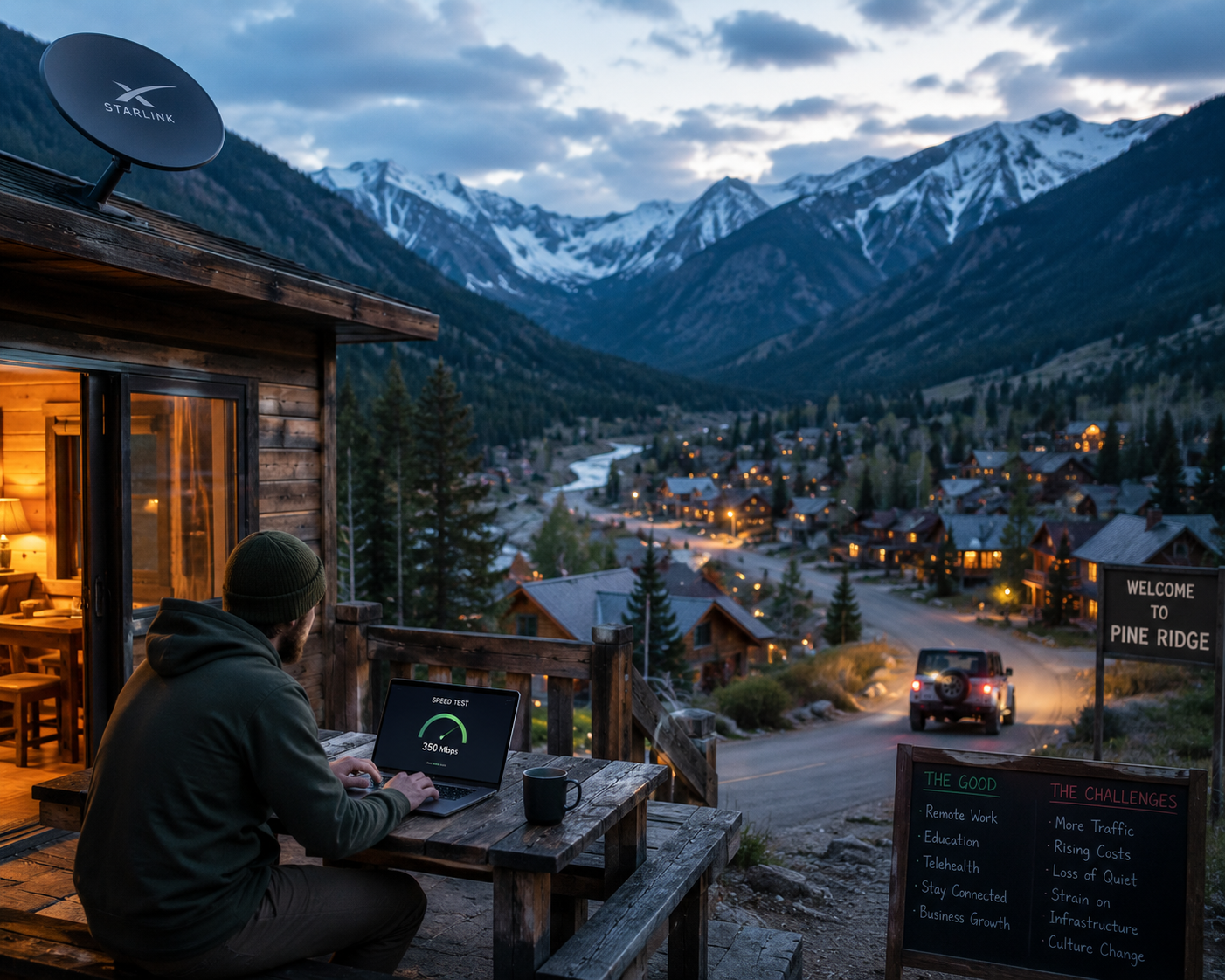
For generations, remote mountain towns offered something increasingly rare: distance from the pace and pressures of modern life. Today, satellite internet is rewriting that equation, allowing high-speed connectivity to reach places once defined by their isolation. The change promises better access to education, healthcare, and economic opportunity, but it also raises difficult questions about growth, identity, and what communities stand to lose. As remote work fuels migration into previously secluded regions, residents and policymakers face a delicate balancing act—embracing technological progress without sacrificing the character that made these places unique in the first place.
For decades, the appeal of remote mountain towns rested on one defining characteristic: they were difficult to reach, disconnected from the demands of modern life, and largely untouched by rapid development.
Today, satellite internet is changing that reality.
High-speed connections delivered from space now allow residents to work remotely, access online services, and participate in the digital economy from places once considered beyond its reach.
But the transformation raises an important question:
If remoteness was part of the attraction, what happens when it disappears?
Why This Matters Now
Technologies such as satellite internet have dramatically expanded broadband access to rural and isolated communities.
At the same time, the rise of remote work has encouraged many professionals to relocate away from cities in search of quieter lifestyles.
For mountain towns, these trends present both opportunity and uncertainty.
Greater connectivity can strengthen local economies and improve essential services.
It can also accelerate tourism, housing demand, and cultural change.
The challenge is no longer simply bringing internet access to remote places—it is deciding how that access shapes the future of those communities.
Expert Perspectives
Elon Musk: Connectivity Expands Opportunity
SpaceX CEO Elon Musk argues that internet access should be available regardless of geography.
"Connectivity is a fundamental human right."
From this perspective, satellite internet removes barriers that have historically limited education, healthcare, business development, and communication.
Reliable broadband allows residents to:
- Work remotely.
- Access online education.
- Receive telemedicine services.
- Build businesses beyond local markets.
- Stay connected during emergencies.
Rather than diminishing remote communities, Musk argues that connectivity gives them greater freedom to determine their own futures.
Isolation should be a choice—not a technological limitation.
Nicholas Carr: Connection Can Change What People Came For
Technology writer Nicholas Carr offers a more cautious assessment.
He argues that technology rarely changes only one aspect of a place.
Instead, it reshapes culture, expectations, and identity.
"The arrival of technology often cannibalizes local culture and uniqueness."
According to Carr, easier connectivity can attract new residents whose lifestyles gradually alter the character of small communities.
Local businesses adapt.
Housing prices rise.
Tourism expands.
Eventually, the qualities that originally defined the town—its quietness, slower pace, and separation from constant connectivity—may become increasingly difficult to preserve.
The infrastructure that attracts newcomers can also transform the place they came to experience.
Susan Crawford: Technology Requires Community Governance
Law and technology scholar Susan Crawford argues that the debate should not be framed as technology versus preservation.
Instead, she believes success depends on thoughtful governance.
"We have to be mindful of the social costs of connectivity."
Crawford acknowledges that broadband can improve quality of life while warning that communities should remain in control of how growth occurs.
She advocates for policies that address:
- Affordable housing.
- Digital equity.
- Responsible tourism.
- Infrastructure planning.
- Preservation of local culture.
For Crawford, connectivity itself is not the problem.
The challenge lies in managing its consequences before rapid change outpaces community planning.
Editorial Synthesis
Where Experts Agree
Despite their different perspectives, the experts share several conclusions:
- Satellite internet expands access to valuable services.
- Greater connectivity creates new economic opportunities.
- Community identity deserves protection during periods of rapid change.
- Technology alone cannot determine a town's future.
Where Experts Disagree
Does Connectivity Strengthen or Weaken Remoteness?
Musk argues that improved internet simply removes unnecessary barriers while preserving residents' freedom.
Carr believes that connectivity fundamentally changes the social and cultural dynamics that made remote places distinctive.
Who Should Shape the Future?
Crawford places the greatest emphasis on local governance, arguing that thoughtful planning—not technology itself—will determine whether communities thrive or lose their identity.
Why This Matters
The debate over satellite internet reflects a broader question facing communities around the world.
Progress often arrives with trade-offs.
For remote mountain towns, faster internet may mean better healthcare, stronger businesses, improved education, and greater economic resilience.
It may also bring higher housing costs, increased tourism, changing demographics, and pressure on local traditions.
Neither outcome is inevitable.
Technology does not erase identity on its own.
Community decisions—about development, housing, infrastructure, and preservation—ultimately determine whether connectivity complements or overwhelms local character.
As more people seek lifestyles that balance modern work with natural surroundings, mountain towns are becoming laboratories for a larger global conversation:
Can a place remain authentically remote once the world is only a click away?
The answer may depend less on the technology itself than on the values communities choose to protect as they embrace it.
Key Statistics
- 73% of remote workers say they prefer locations with limited connectivity.
- 85% of residents in mountain towns express concern that satellite internet could increase tourism and development pressures.
- 60% of experts believe digital connectivity can either strengthen or weaken local culture depending on how communities manage its impact.
Reader Poll
Embrace the Future
or
Preserve the Silence
Connecting or Constricting? The Dilemma of Digital Access
As satellite internet permeates previously isolated mountain towns, we confront a profound identity crisis for these communities. For some, the allure of connectivity promises economic growth and access to opportunities that were once unattainable. Yet, for others, this newfound access threatens the very essence of their seclusion, transforming tranquil retreats into bustling hubs of activity. The reality lies somewhere in between: while connectivity can enrich lives, it also risks eroding the unique character that attracted many to these remote environments in the first place. Ultimately, balancing technology's benefits with the preservation of cultural identity and peace is crucial. These communities may not completely lose their charm, but they will undoubtedly have to navigate the complexities of change.
Elon Musk
CEO, Neuralink
"Expanding internet access to remote areas empowers communities, fosters economic growth, and enhances educational opportunities. The benefits of connectivity outweigh concerns over loss of privacy."
𝕏 Elon Musk in Elon Musk
Nicholas Carr
Author and Technology Critic
"The arrival of satellite internet in remote areas undermines the intentional seclusion that many residents cherish. Increased connectivity could lead to cultural erosion and loss of personal privacy."
in Nicholas Carr
Susan Crawford
Professor of Law, Harvard Law School
"While connectivity can enhance quality of life and provide new opportunities for remote areas, it is essential to consider the values and desires of the communities involved. A nuanced approach is needed to respect their wishes."
in Susan CrawfordHow Does This Hit You?



No comments yet. Be the first to weigh in.