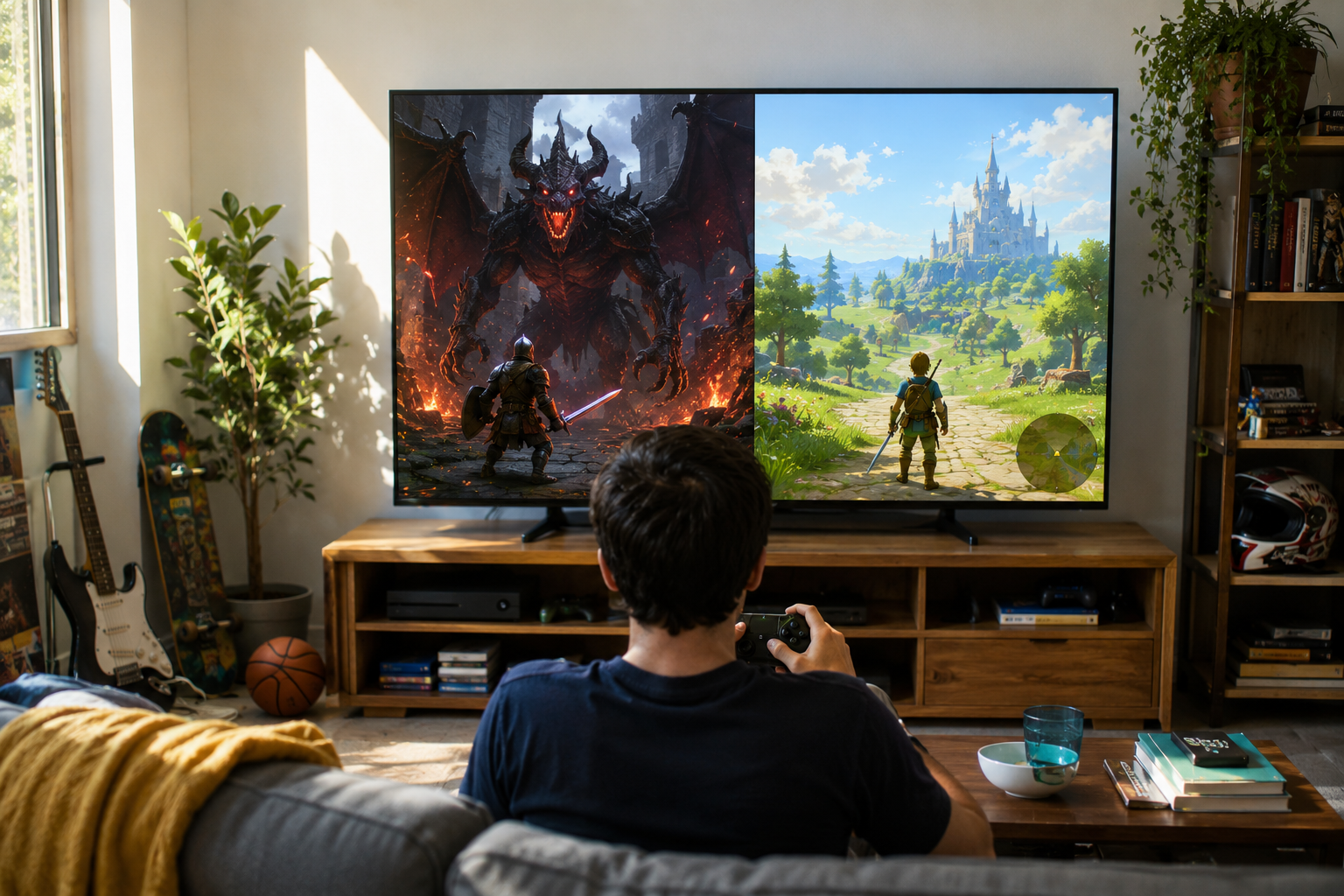
For decades, beating a game's final boss represented mastery earned through persistence, experimentation, and repeated failure. Today, difficulty sliders and accessibility options allow players to tailor that experience to their own abilities and goals. Some see this as expanding access without diminishing accomplishment, while others argue that removing mandatory obstacles changes the meaning of completion itself. The debate reflects a broader shift in game design: success is increasingly measured not by overcoming a universal challenge, but by whether players can experience a game's world, story, and mechanics on terms that suit them.
For years, finishing a video game meant overcoming the obstacle that stopped almost everyone.
The final boss.
The impossible platforming sequence.
The brutally difficult final mission.
Players failed repeatedly.
They learned patterns.
Improved mechanics.
Changed strategies.
Eventually, victory felt earned because failure had been unavoidable.
Today, many games offer adjustable difficulty settings, accessibility options, and gameplay assists that allow players to customize the experience from beginning to end.
The result raises an important question:
If every player can choose a different level of challenge, has the meaning of "finishing" a game fundamentally changed?
Why This Matters Now
Modern game development increasingly prioritizes accessibility alongside challenge.
Difficulty sliders, assist modes, customizable controls, and accessibility features allow more players—including those with disabilities, limited time, or varying skill levels—to experience games that might once have been inaccessible.
At the same time, some players worry that optional difficulty reduces the shared sense of accomplishment that once defined difficult games.
The debate is no longer simply about difficulty.
It is about what achievement actually represents.
Expert Perspectives
Gabe Newell: Games Should Welcome More Players
Valve co-founder Gabe Newell argues that accessibility strengthens gaming rather than weakening it.
"Games should be accessible to everyone, not just the hardcore players."
For Newell, difficulty settings do not remove achievement.
They remove unnecessary barriers.
Every player approaches games with different goals.
Some enjoy mastering mechanics.
Others value storytelling.
Others simply want to explore a game's world.
Allowing players to tailor difficulty expands the audience without changing the core experience.
Completion should reflect enjoyment, not exclusion.
Mark Brown: Challenge Is Most Meaningful When Players Choose It
Game designer and Game Maker's Toolkit creator Mark Brown believes player agency is central to good game design.
"Giving players the ability to dictate their challenges means they can engage with content that resonates with them."
Brown argues that frustration and challenge are not identical.
A difficult encounter can create memorable satisfaction.
An unfair barrier can simply cause players to quit.
Difficulty options allow players to balance challenge with enjoyment according to their own circumstances.
Rather than imposing a universal experience, games can become more personal.
The value of challenge increases when players actively choose it.
Anita Sarkeesian: Struggle Gives Achievement Its Meaning
Media critic Anita Sarkeesian offers a more cautious perspective.
While supporting accessibility, she questions whether reducing challenge changes the emotional experience of finishing a game.
"There is something to be said for the challenge and the satisfaction that comes from overcoming difficult gameplay."
According to Sarkeesian, overcoming repeated failure creates a unique emotional payoff.
Persistence becomes part of the narrative.
The player's story mirrors the character's journey.
If major obstacles can simply be lowered or removed, that relationship between effort and achievement may become less meaningful.
She also argues that this debate reflects broader cultural questions about convenience and delayed gratification.
Sometimes the obstacle is the experience.
Editorial Synthesis
Where Experts Agree
Although they disagree about difficulty itself, the experts share several conclusions:
- Accessibility allows more people to enjoy games.
- Player experience should remain central to game design.
- Games should accommodate diverse audiences.
- Challenge is an important component of engagement.
Where Experts Disagree
Does Optional Difficulty Reduce Achievement?
Newell and Brown argue that achievement becomes personal rather than universal.
Sarkeesian believes shared obstacles create a unique form of accomplishment that becomes harder to preserve when challenge is optional.
What Defines Success?
Brown views success as completing the experience in a personally meaningful way.
Sarkeesian argues that overcoming genuine resistance remains an essential part of many games' emotional impact.
Why This Matters
The debate over difficulty sliders reflects a broader evolution in how games are designed and experienced.
Earlier generations often assumed that every player should overcome identical challenges.
Modern design increasingly recognizes that players differ dramatically in ability, available time, physical needs, and reasons for playing.
Accessibility features have allowed millions more people to experience games they might otherwise never finish.
At the same time, difficult games continue to thrive because many players actively seek the satisfaction that comes from mastering demanding mechanics.
These goals are not necessarily incompatible.
Games can preserve meaningful challenge while also providing options that respect different players and circumstances.
Perhaps finishing a game has not become easier.
Perhaps it has become more personal.
Instead of asking whether someone defeated the final boss under identical conditions, today's conversation increasingly asks a different question:
Did the player experience the game in a way that felt meaningful to them?
The answer may vary from player to player, but that shift reflects an industry that increasingly values inclusion alongside mastery.
Completion is no longer defined solely by surviving the hardest obstacle.
It is defined by reaching the end of a journey that each player has shaped in their own way.
Redefining Completion: Embracing Inclusivity in Gaming
The evolution of difficulty sliders symbolizes a profound shift in gaming culture, enhancing accessibility while sparking robust debate regarding achievement. Traditionally, the final boss represented both skill and perseverance—a rite of passage that defined completion. However, as Gabe Newell and Mark Brown point out, the introduction of customizable difficulties doesn’t dilute the essence of gaming; rather, it allows a broader spectrum of players to engage with narratives that might otherwise be out of reach. By enabling everyone to tailor their challenges, we are not merely sidestepping obstacles, but redefining what it means to finish a game; it becomes less about the struggle and more about the journey. This shift invites us to embrace diverse player experiences, challenging the notion that true completion can only be achieved through hardship. Instead, we need to celebrate the varied ways players can arrive at conclusions, ultimately enriching the gaming landscape.
Gabe Newell
Co-founder, Valve Corporation
"Newell argues that games should challenge players, promoting exploration and problem-solving. Difficulty sliders may make games accessible, but they risk diluting the sense of achievement that comes from overcoming hard obstacles."
𝕏 Gabe Newell in Gabe Newell
Anita Sarkeesian
Media Critic and Feminist Gamer
"Sarkeesian advocates for difficulty sliders, emphasizing that they empower diverse players to engage with games on their own terms. Removing barriers enhances inclusivity and reevaluates what it means to 'finish' a game."
in Anita Sarkeesian
Mark Brown
Game Designer and Host of Game Maker's Toolkit
"Brown highlights the importance of both challenge and accessibility in games. He argues that difficulty sliders can coexist with traditional design philosophies, allowing developers to cater to varied player experiences while still retaining a sense of accomplishment."
𝕏 Mark Brown in Mark BrownHow Does This Hit You?



No comments yet. Be the first to weigh in.