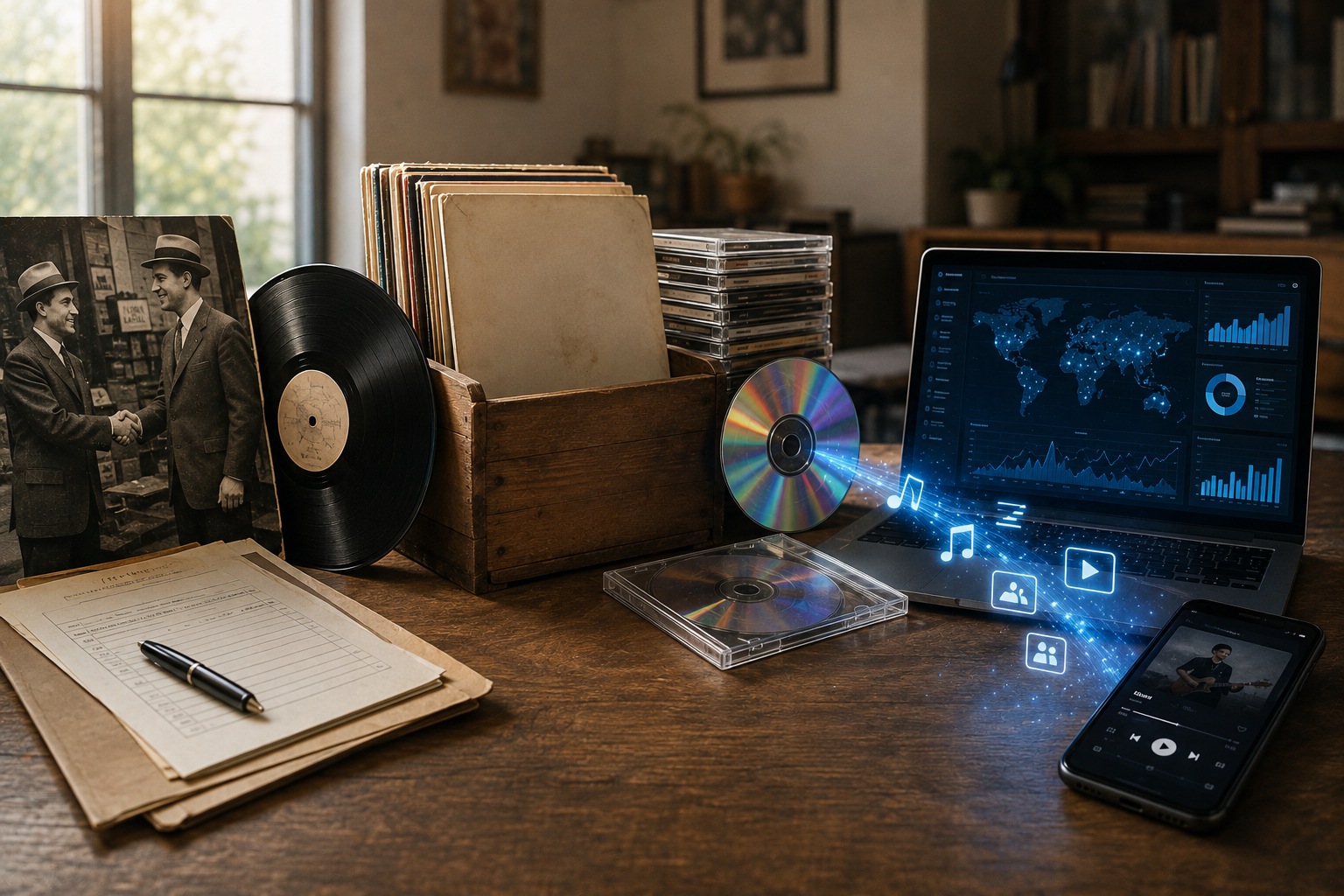
Digital platforms didn't eliminate music's gatekeepers—they changed what those gatekeepers look like. Independent artists can now bypass traditional labels and reach global audiences, but algorithms, playlists, and platform economics have created new barriers of their own. The central challenge is no longer simply getting music distributed; it's getting discovered, building a sustainable audience, and turning that attention into a viable career.
Opening Question
Did digital distribution truly democratize music, or did it simply replace record-label gatekeepers with algorithms that are harder to understand and even harder to negotiate with?
For decades, independent labels played a crucial role in discovering artists, developing careers, and connecting musicians with audiences. Their influence could be frustrating, but their decisions were often based on personal relationships, local knowledge, and an understanding of an artist's potential.
Streaming changed that equation.
Platforms such as Spotify made it dramatically easier for musicians to distribute their work without traditional industry infrastructure. But they also introduced a new system in which algorithms and playlist placement can determine which songs receive attention.
The gatekeeper didn't necessarily disappear.
It may have simply become less human.
Why This Matters Now
The digital transformation of the music industry has fundamentally changed how artists reach listeners.
An independent musician can now record a song, distribute it globally, build an audience through social media, and potentially reach listeners without signing with a traditional label.
That is an extraordinary increase in access.
But access isn't the same as visibility.
When millions of songs compete for attention, being available on a streaming platform doesn't guarantee that anyone will hear you. Recommendation systems, playlists, engagement metrics, and listener behavior increasingly determine which artists break through the noise.
This creates a new paradox: music distribution has become more democratic while music discovery may be increasingly concentrated.
Expert Perspectives
Steve Albini: Relationships Were More Than Gatekeeping
Producer and engineer Steve Albini viewed independent music communities as more than distribution networks.
Independent labels could function as mentors, helping artists develop their sound, build audiences, and navigate the business side of music.
That human relationship is difficult to reproduce through an algorithm.
Albini's concern is that algorithmic systems can reward measurable engagement rather than artistic experimentation.
When platforms prioritize signals such as listening behavior, retention, popularity, and audience response, musicians may feel pressure to create music that performs well within the system rather than music that challenges expectations.
The result could be a larger musical marketplace with fewer incentives for genuinely unconventional work to rise above the noise.
Billboard Chris: The Gatekeepers Changed
Music industry analyst Billboard Chris takes a more optimistic view.
From this perspective, streaming didn't eliminate gatekeepers—it democratized access to them.
Instead of convincing a small number of label executives, an independent artist can potentially find an audience directly.
If a song generates enough engagement, recommendation systems can amplify it.
That creates opportunities that were considerably harder to access under traditional industry structures.
But there is an important catch.
Artists still need to understand how discovery works. Marketing, audience development, social media, release strategy, and platform mechanics have become essential components of an independent musician's career.
The gatekeeper may be less visible, but learning how the system works can still determine who gets heard.
Amanda Palmer: Discoverability Isn't the Same as Sustainability
Musician and author Amanda Palmer offers a more complicated assessment.
Digital platforms can provide extraordinary reach while simultaneously making it difficult for artists to build sustainable incomes.
A musician can reach thousands—or millions—of listeners without necessarily earning enough money to support a career.
Palmer therefore advocates combining digital distribution with direct relationships.
Streaming can introduce someone to an artist, but concerts, merchandise, direct fan support, community engagement, and personal relationships can create a deeper economic connection.
The lesson is that visibility and sustainability are different problems.
An artist can succeed at one without succeeding at the other.
Editorial Synthesis
Where Experts Agree
The experts share several important conclusions:
- Music distribution has fundamentally changed.
- Digital platforms have lowered barriers to entry for independent artists.
- Algorithms now play a major role in determining what gets discovered.
- Personal relationships and community remain important even in a digital marketplace.
- Getting music onto a platform is not the same as building a sustainable career.
Where Experts Disagree
The biggest disagreement concerns whether algorithms represent democratization or simply a new form of gatekeeping.
Albini sees algorithmic systems as potentially hostile to artistic experimentation because measurable engagement can favor commercially predictable material.
Billboard Chris sees the same systems as an opportunity for independent musicians to reach audiences without relying entirely on traditional industry connections.
Palmer occupies the middle ground. She recognizes the enormous reach offered by digital platforms but argues that artists still need direct relationships with their audiences to build sustainable careers.
The New Music Gatekeeper
The most interesting lesson may be that gatekeepers didn't disappear.
They multiplied.
Artists now have to navigate:
- Streaming recommendation algorithms
- Editorial playlists
- Social media feeds
- Search rankings
- Influencer culture
- Audience engagement metrics
- Digital advertising
- Fan communities
The difference is that these gatekeepers are often less transparent than the executives and radio programmers they replaced.
A label executive could reject a song and tell you why.
An algorithm simply doesn't recommend it.
That makes today's system simultaneously more accessible and more opaque.
Why This Matters
Digital distribution has undeniably expanded access.
An artist no longer needs permission from a traditional record label simply to make their music available to listeners around the world.
But the problem has shifted from distribution to discovery.
And discovery has its own gatekeepers.
The strongest path forward may therefore involve combining both worlds: using digital platforms for reach while maintaining the human relationships that independent music has historically depended on.
Streaming can help an artist get discovered.
A community can give that artist a career.
The future of independent music may ultimately belong not to artists who reject algorithms or those who surrender completely to them, but to musicians who understand how to use digital systems without allowing those systems to define what their art becomes.
Navigating the New Landscape of Music Distribution
The debate over the impact of algorithms on independent music distribution reveals a profound tension between accessibility and artistry. While platforms like Spotify have democratized access to music, they have also created a new hierarchy based on data-driven decisions. Artists often find themselves at the mercy of algorithms that prioritize viral potential over unique expression. As we recognize the loss of mentorship and community inherent in traditional label models, it’s crucial to seek a balance that allows for artistic integrity amidst algorithmic influence. We must advocate for systems that not only promote emerging talent but also honor the diverse voices that define the art form. The future could blend the best of both worlds—leveraging technology without sacrificing creativity. In an era where accessibility is important, we must remember that art requires space for individuality to flourish beyond mere numbers.
Steve Albini
Producer and Engineer
"Albini argues that independent labels foster a genuine music culture that can be overshadowed by algorithm-based platforms like Spotify. He believes that the artistry and personal touch of small labels can't be replicated by automated systems."
in Steve Albini
Billboard Chris
Music Industry Analyst
"Chris contends that while distribution has shifted, algorithms democratize music discovery by exposing emerging artists to broader audiences. He sees this as a necessary evolution that can empower musicians in new ways."
in Billboard ChrisAmanda Palmer
Musician and Author
"Palmer recognizes the significant role of both independent labels and streaming algorithms in shaping the music landscape. She advocates for a balance where artists can leverage both old and new methods of distribution."
𝕏 Amanda Palmer in Amanda PalmerHow Does This Hit You?

No comments yet. Be the first to weigh in.