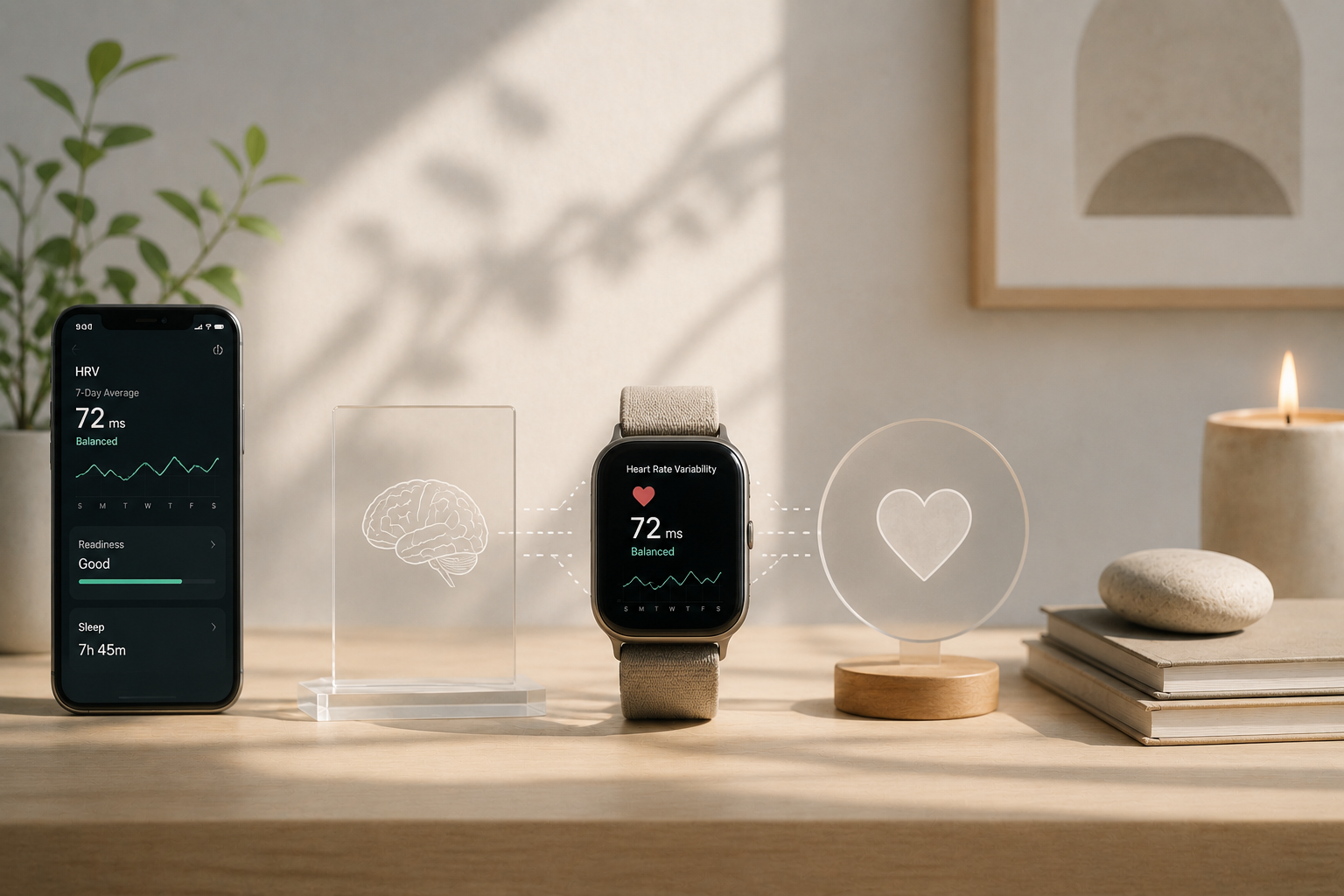
Athletes now check a wristband before deciding whether to train hard or rest — but is HRV tracking genuine body awareness, or just outsourcing intuition to an algorithm? Dr. Matthew Walker, Dr. Dan Cox, and Drew Harrisberg debate what these devices can actually tell us, and what they can't.
In a world increasingly driven by technology, the rise of heart rate variability (HRV) trackers raises pressing questions: Are athletes becoming more attuned to their bodies, or are they simply outsourcing their decision-making to wearable devices?
Context: Why This Matters Now
In recent years, wearable technology has revolutionized the way athletes monitor their performance and recovery. By measuring the variation in time between heartbeats, HRV devices provide insights into an athlete's autonomic nervous system, heart health, and overall recovery status.
As reliance on technology grows, a question arises: Are we genuinely in tune with our bodies, or are we delegating our intuition to algorithms?
Perspective: Dr. Matthew Walker
Dr. Matthew Walker, renowned sleep scientist and author of Why We Sleep, asserts that while HRV trackers can provide useful data, they should not replace introspection and personal awareness. "The body's natural rhythms are profoundly complex," he says. "Relying entirely on a device may lead athletes to ignore crucial signs that only their body can communicate."
He emphasizes the integral relationship between recovery and sleep, calling into question the implications of blindly following HRV data. "If you don't understand how sleep impacts recovery," he suggests, "you might misinterpret high readiness scores merely as an invitation to train harder."
Perspective: Dr. Dan Cox
Dr. Dan Cox, a sport scientist and university professor, engages with the topic from a more analytical angle. He acknowledges that while HRV data can inform training decisions, it should be contextualized and not used as a standalone indicator of readiness. "HRV is influenced by numerous factors, including stress and hydration levels, which may not be fully accounted for by the device."
Cox also raises the issue of data literacy, believing that athletes must be equipped with the knowledge to interpret their data correctly. "Outsourcing decisions to technology can become problematic if an athlete does not comprehend the underlying physiological factors at play," he warns.
Perspective: Drew Harrisberg
Contrasting with both Walker and Cox, Drew Harrisberg, a performance coach, advocates for the effective use of HRV trackers as part of an athlete's wider training regimen. "These devices can be integral to fine-tuning training loads and recovery protocols," argues Harrisberg, citing success stories of athletes who use HRV data to progressively adapt their training cycles.
However, Harrisberg also underscores the necessity of listening to one's body. "I'd never suggest that athletes rely exclusively on technology," he clarifies. "HRV trackers are tools that, when used correctly, can provide valuable insights."
Editorial Synthesis
Where Experts Agree
All experts recognize that HRV data must be contextualized within broader lifestyle factors, such as stress, sleep, and hydration. There is consensus that athletes should not completely relinquish control to technology, maintaining a balance between intuition and data. Providing athletes with knowledge to interpret the data is seen as crucial for better decision-making.
Where Experts Disagree
Walker takes a more cautious stance on over-reliance on technology, whereas Harrisberg sees it as an instrumental part of training regimes. Cox emphasizes the need for athletes to develop strong data literacy, while Harrisberg focuses more on integration rather than critical separation of data. Walker argues that the nuanced human experience cannot be fully captured by trackers, while Harrisberg believes technology can complement these experiences if engaged with wisely.
Why This Matters
As athletes navigate their training paths in an era dominated by technology, the balance between monitoring performance and attuning to one's own body becomes increasingly pivotal. HRV trackers, while informative, should serve as adjunctive tools rather than replacements for innate intuition.
Ultimately, the challenge lies not in the technology itself, but in how athletes engage with these tools to enhance their understanding and decision-making — a reminder that no device can replicate the subtleties of human experience.
Balancing Technology and Intuition in Athletic Training
As athletes increasingly turn to heart rate variability trackers to gauge their readiness to train, we must remember that technology is a tool, not a crutch. While these devices offer valuable insights into recovery and performance, they should complement, rather than replace, an athlete's intrinsic understanding of their body. Relying solely on algorithms risks fostering a disconnection from our natural rhythms and signals. Experts like Dr. Matthew Walker remind us of the importance of introspection and the holistic view of well-being, including sleep and mental state. Therefore, the optimal approach combines data-driven insights with personal intuition, empowering athletes to make informed decisions about their training regimens while remaining attuned to their own physiological cues.

Dr. Matthew Walker
Author, Sleep Scientist
"Dr. Walker argues that heart rate variability trackers empower athletes to listen to their bodies more effectively, encouraging a nuanced understanding of their physical and mental readiness to train."
in Dr. Matthew Walker
Dr. Dan Cox
Sport Scientist, University Professor
"While acknowledging the benefits of heart rate variability trackers, Dr. Cox emphasizes the need for athletes to remain aware of their own bodily signals and not solely rely on technology for decision-making."
in Dr. Dan CoxDrew Harrisberg
Performance Coach
"Harrisberg argues that wearable technology like heart rate variability trackers provide critical data that can enhance an athlete's training program, making informed decisions based on precise metrics rather than intuition alone."
in Drew HarrisbergHow Does This Hit You?



No comments yet. Be the first to weigh in.