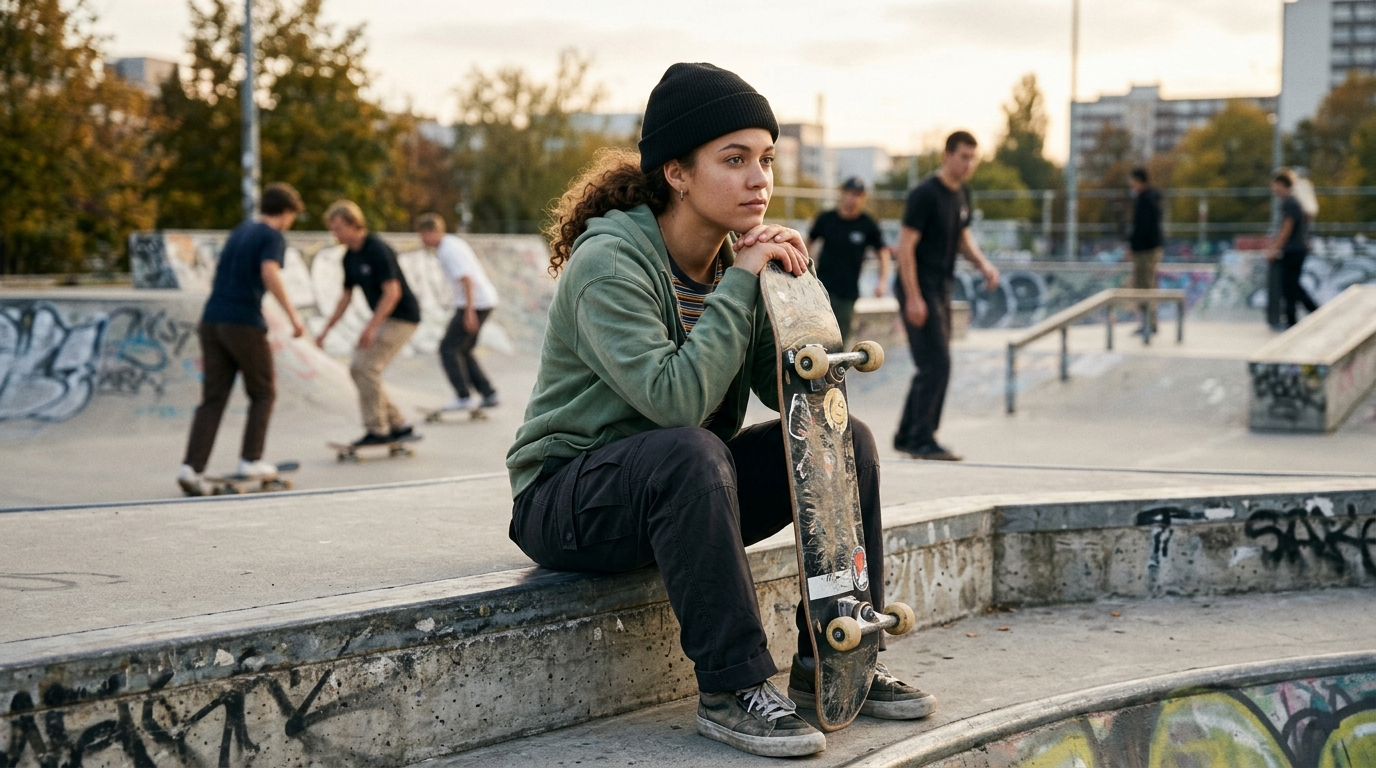
For years, many girls who entered skateparks found themselves skating alone—not because they lacked passion, but because they lacked company. Being the only female skater in a male-dominated environment could be both empowering and exhausting, demanding resilience while exposing the limits of inclusivity within skateboarding culture. As women's skateboarding gains unprecedented visibility through professional competitions and the Olympics, these early experiences deserve renewed attention. The debate is no longer simply about participation, but about belonging. How can skateboarding preserve its rebellious, welcoming spirit while ensuring that future generations of girls never have to feel like outsiders simply for showing up with a skateboard?
For six years, the local skatepark felt like two places at once.
It was a place of freedom.
And a place of isolation.
As the only girl skating there, every session came with an unspoken awareness that I stood out—not because of how I skated, but because of who I was.
That experience shaped confidence, resilience, and identity.
It also raised a question that continues to resonate as skateboarding becomes more inclusive:
Why did being the only girl have to feel normal in the first place?
As women's skateboarding reaches new audiences through professional competitions and the Olympics, the sport is beginning to confront a long-overlooked reality: talent has never been limited by gender, but opportunity and belonging often have.
Why This Matters Now
Women's skateboarding has experienced remarkable growth over the past decade.
Professional tours, sponsorships, and Olympic competition have introduced millions of people to female skateboarders performing at the highest level.
Yet visibility at the elite level does not always reflect everyday experiences.
In many local skateparks, girls still report feeling:
- Outnumbered
- Closely watched
- Underestimated
- Less welcome than their male peers
Representation matters because it changes expectations.
When girls regularly see other girls skating, simply showing up becomes less intimidating.
Creating inclusive skateparks is not only about increasing participation—it's about ensuring everyone feels they belong.
Expert Perspectives
Marginally Mad: Adversity Can Build Confidence
Skateboarding advocate and influencer Marginally Mad argues that being the only girl at a skatepark is an experience many women unfortunately recognize.
"Too many young women have faced the same barriers."
While acknowledging those challenges, they also believe adversity can cultivate valuable personal qualities.
Skateboarding naturally rewards:
- Creativity
- Persistence
- Independence
- Problem-solving
Being the lone female skater can amplify those lessons by requiring athletes to push through discomfort and self-doubt.
At the same time, Marginally Mad stresses that greater visibility is essential.
Every girl who feels comfortable skating publicly makes it easier for the next one to do the same.
Dr. Alison Smith: Confidence and Emotional Fatigue
Sports psychologist Dr. Alison Smith examines the experience through the lens of mental health and identity.
She believes being the only girl can have both empowering and challenging psychological effects.
"Being the only girl can create feelings of isolation, but it can also forge strong identity and self-efficacy."
Overcoming repeated obstacles often builds confidence.
However, constantly feeling different or unwelcome carries emotional costs.
If a skatepark environment becomes dismissive or hostile, that stress can accumulate over time.
Resilience should be celebrated—but it should not become a requirement for participation.
According to Smith, supportive environments allow confidence to develop without unnecessary emotional strain.
Shawn Green: Inclusion Requires Allies
Professional skateboarder and activist Shawn Green believes skateboarding culture has improved significantly, but meaningful work remains.
"The skatepark should be a sanctuary for everyone, regardless of gender."
Historically, many skateparks have reflected broader social inequalities rather than escaping them.
Green argues that creating inclusive communities is not solely the responsibility of women entering the sport.
Male skateboarders also have an important role to play.
That includes:
- Challenging exclusionary behavior
- Encouraging newcomers
- Creating welcoming environments
- Recognizing unconscious bias
True inclusivity is built collectively, not individually.
Editorial Synthesis
Where Experts Agree
Despite approaching the issue from different perspectives, all three experts share several common conclusions:
- Skateboarding can build resilience and confidence.
- Women deserve greater representation within the sport.
- Inclusive skateparks benefit the entire community.
- The culture of skateboarding continues to evolve.
Where Experts Disagree
Is Adversity a Benefit or a Burden?
Marginally Mad views many of these challenges as opportunities for growth.
Dr. Smith cautions that the emotional impact varies greatly depending on the environment and the individual.
Who Is Responsible for Change?
Marginally Mad emphasizes women's visibility and self-advocacy.
Shawn Green argues that lasting progress also requires active allyship from male skateboarders and the broader skateboarding community.
Why This Matters
The story of being the only girl at a skatepark is about far more than skateboarding.
It reflects a broader question about who feels welcome in public spaces—and who is expected to prove they belong.
For years, countless female skateboarders developed remarkable resilience simply because they had little alternative.
That resilience deserves recognition.
But it should never have been a prerequisite.
The healthiest skate communities are not those that force newcomers to overcome exclusion.
They are the ones that remove unnecessary barriers before they appear.
As skateboarding continues to grow worldwide, its greatest opportunity is not simply producing more champions.
It is ensuring that every young person who arrives at a skatepark—regardless of gender—feels that the space already belongs to them.
The goal isn't to celebrate girls for surviving exclusion. It's to build a skateboarding culture where exclusion is no longer part of the experience.
Beyond the Barrier: Embracing Female Skateboarders
The journey of being the only girl at the skatepark is emblematic of the broader struggles and triumphs faced by women in male-dominated spaces. As outlined in the experiences shared, these narratives are not merely individual anecdotes; they reflect a call for change and acknowledgment within skateboarding culture. The empowerment derived from overcoming adversity stands alongside the need for systemic improvements in representation and inclusivity. Organizations, sponsors, and the community at large must recognize and support female skateboarders to ensure that the sport is a space where all genders can thrive equally. By amplifying diverse voices and experiences, we can create an environment where future generations of female skateboarders feel empowered to not only carve their paths but to also reshape the sport itself. Each story shared is both a reflection of the past and a beacon for the future, enabling a culture that embraces resilience, creativity, and equality.

Marginally Mad
Skateboarding Advocate & Influencer
"Having been one of the few female skateboarders in her area, Marginally Mad emphasizes the importance of creating welcoming environments for women in skateboarding. She believes that greater representation can inspire more girls to engage in sports conventionally viewed as male-dominated."
𝕏 Marginally Mad in Marginally Mad
Dr. Alison Smith
Sports Psychologist & Researcher
"Dr. Smith discusses the complex emotional impacts on women navigating predominantly male environments like skateparks, suggesting that while it can build resilience, it also presents significant psychological challenges that need addressing for holistic development."
in Dr. Alison Smith
Shawn Green
Professional Skateboarder & Activist
"Shawn emphasizes the urgent need for systemic change within skateparks to foster and support female participation. He argues that the culture needs to evolve to remove barriers and create opportunities for girls and women, enabling them to thrive in the sport."
in Shawn GreenHow Does This Hit You?

No comments yet. Be the first to weigh in.