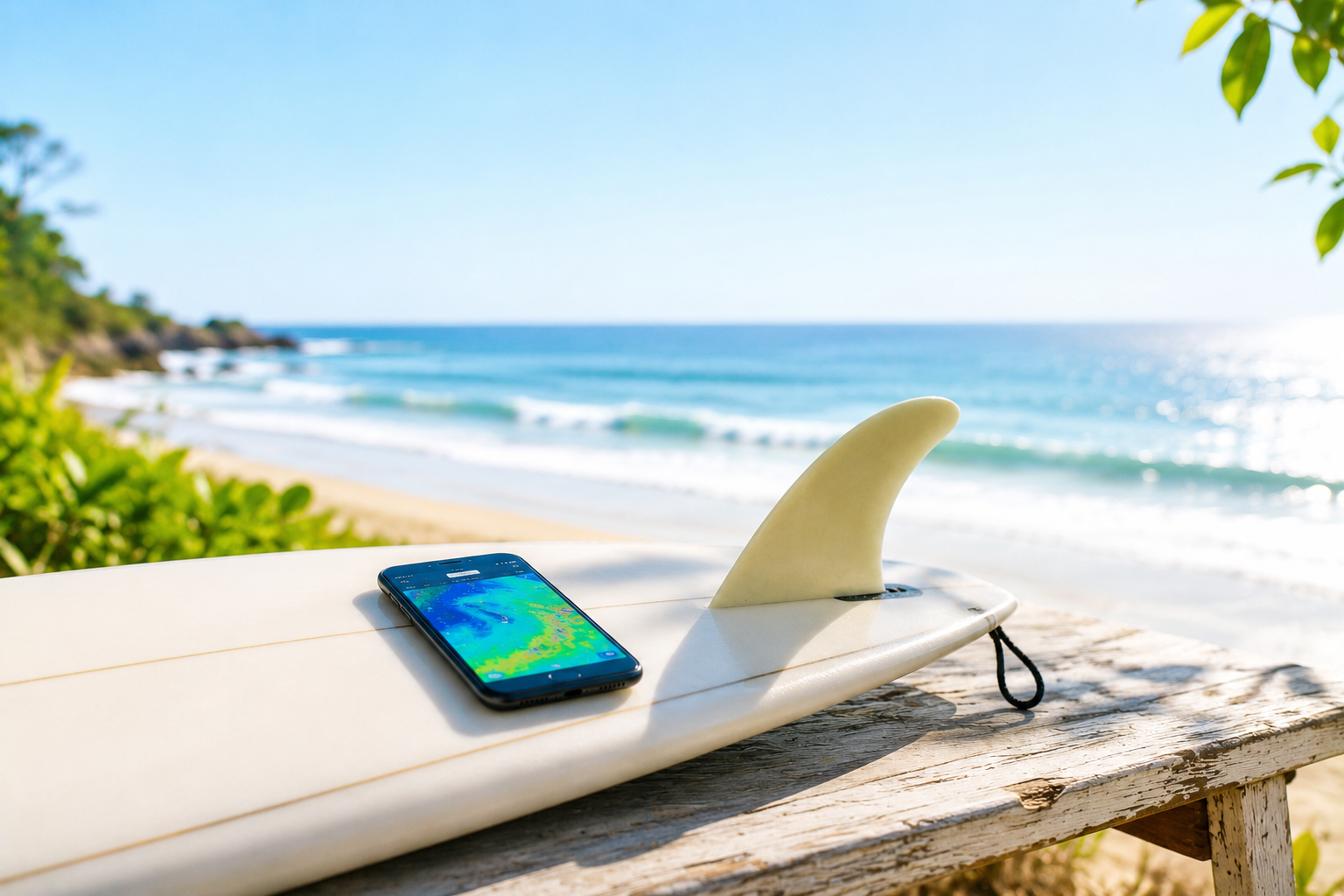
Ocean forecasting is entering a new era: satellites, high-resolution current maps, wave models, and AI can increasingly predict how swell will travel and transform before it reaches a break. But “predictable” does not mean “guaranteed.” The next frontier for surfers is likely not knowing exactly where every perfect wave will appear, but knowing the probability, timing, size, direction, and local conditions well enough to make dramatically better decisions.
For decades, surfers have relied on a mixture of instinct, local knowledge, weather charts, buoys, tides, and increasingly sophisticated forecasting tools.
That system is changing.
Ocean science can now combine satellite observations, atmospheric models, wave spectra, bathymetry, current estimates, buoy measurements, cameras, and machine learning to build increasingly detailed forecasts of what the ocean is doing—and what it is likely to do next.
In 2026, that evolution is accelerating. ECMWF has introduced data-driven wave forecasting into its operational forecasting system, while new research is producing much higher-resolution maps of surface currents from geostationary satellites. (ECMWF)
The implication for surfing is significant.
But the headline needs one important qualification:
We are not at the point where every big wave on Earth is perfectly predictable.
The ocean remains chaotic, observations remain incomplete, and the final transformation of offshore swell into a breaking wave depends on extremely local conditions.
The more interesting question is therefore:
What happens when surf forecasting becomes good enough that uncertainty—not lack of information—is the main limitation?
Why This Matters Now
Surf forecasting has already come a long way.
Satellite observations have been used to identify major swells for decades. NASA documented how satellite measurements could help forecasters track swell generated by distant storms and determine when it might reach famous big-wave locations. (Jet Propulsion Laboratory)
Modern systems go considerably further.
Surfline's LOTUS model, for example, combines satellite data, high-resolution bathymetry, nearshore wave models, historical observations, camera data, and machine learning. Its system is specifically designed to take offshore swell information and model what happens closer to the beach. (Surfline)
Meanwhile, ocean-current mapping is improving rapidly.
A 2026 study using geostationary satellite observations demonstrated high-resolution reconstructions of surface currents and their spatial gradients, with hourly updates in the study framework—far more frequent than some existing global products. (Nature)
That matters because currents don't simply move water around.
They can alter how waves propagate.
And that means better current information can potentially improve predictions of how a swell changes before reaching a surf break.
The Missing Piece: Currents
Traditional surf forecasts tend to emphasize familiar variables:
- swell height
- swell period
- swell direction
- wind
- tide
- bathymetry
But currents add another layer.
A wave moving through a current can change speed, direction, wavelength, and energy distribution. Strong opposing currents can interact with incoming swell in ways that affect the eventual shape and behavior of waves.
Researchers have already demonstrated computational methods that simultaneously estimate ocean currents and wave states, improving wave prediction when current information is incorporated. (arXiv)
This is important because surfers don't ultimately care about the offshore wave model.
They care about what the wave will do at the reef, point, beach, or slab.
That's a much harder prediction problem.
The Prediction Stack
The future of surf forecasting is likely to look less like a single weather app and more like a layered ocean simulation.
Layer 1: Storms
Atmospheric models determine where strong winds are developing and how long they will blow.
That establishes the raw energy available to generate swell.
Layer 2: Swell
Wave models then track the resulting wave systems as they travel across the ocean.
Modern systems represent the ocean surface statistically using wave spectra rather than attempting to track every individual wave. ECMWF explains that this approach captures the distribution of wave energy across different frequencies and directions. (ECMWF)
Layer 3: Currents
High-resolution current maps increasingly allow models to account for the moving ocean through which the swell travels.
This is where new satellite technology becomes particularly interesting.
Layer 4: Bathymetry
Eventually, the swell encounters the seafloor.
The shape and depth of the bottom determine how the wave transforms as it approaches shore.
A reef, point break, beach, canyon, or submarine ridge can produce radically different outcomes from the same offshore swell.
Layer 5: Local Conditions
Wind, tide, currents, water level, and rapidly changing nearshore conditions determine whether the theoretical swell actually produces the wave surfers want.
Layer 6: Machine Learning
AI can then compare the physical forecast with enormous quantities of historical observations.
That can help identify patterns that conventional models struggle to capture.
Modern research is already combining machine learning with physics-based ocean forecasting. One 2026 system, for example, produces global probabilistic forecasts of ocean currents and other variables, illustrating how AI is moving from pattern recognition toward operational ocean prediction. (arXiv)
But Can You Really Predict Every Big Wave?
No.
And this distinction is crucial.
Forecasting wave conditions is not the same as predicting individual waves.
ECMWF explicitly notes that global models cannot track every individual wave. Instead, they represent the sea statistically through wave spectra. (ECMWF)
So a forecast might become extremely good at saying:
A powerful west swell will arrive between 8 and 11 a.m., with a certain period and direction, producing exceptional conditions at this particular break.
That does not mean the system can tell you:
The 17th wave in the set at 9:42:13 will be the best wave of the session.
Those are fundamentally different prediction problems.
The first is increasingly tractable.
The second remains extraordinarily difficult.
What Happens to Surfing When Forecasts Become Extremely Good?
This is where the technological story becomes cultural.
1. Surf Trips Become More Efficient
The most obvious effect is logistical.
Instead of traveling somewhere because the long-range forecast merely looks promising, surfers could increasingly wait until the probability of exceptional conditions becomes very high.
A trip to a remote big-wave destination becomes less of a gamble.
The result could be fewer wasted trips—and potentially more surfers arriving simultaneously when the forecast confirms the opportunity.
That creates a paradox.
Better information could make surfing more efficient while making famous breaks more crowded.
2. Big-Wave Surfing Becomes More Professionalized
Big-wave surfing already depends heavily on forecasting.
When enormous swell is approaching, surfers, photographers, safety teams, boats, and media organizations need to coordinate.
More accurate forecasting could turn this into something resembling a highly optimized competitive operation.
The forecast doesn't just tell the surfer when to paddle out.
It tells an entire ecosystem when to mobilize.
3. Local Knowledge Becomes Less Exclusive
Historically, a local surfer's advantage has partly come from understanding subtle patterns:
- which swell direction works;
- which tide is best;
- where currents run;
- how the wind interacts with the coastline;
- how a particular storm behaves;
- which neighboring break starts working first.
Advanced forecasting systems can encode some of that knowledge into software.
That creates a difficult cultural question:
What happens when decades of accumulated local forecasting knowledge become an algorithm?
The knowledge doesn't disappear.
But its scarcity does.
4. The Crowding Problem Could Get Worse
This may be the biggest unintended consequence.
If everyone receives the same highly accurate forecast, everyone knows when the best conditions are coming.
The information advantage disappears.
A perfect forecast could therefore produce an imperfect surfing experience.
Instead of a few knowledgeable surfers recognizing that tomorrow morning could be exceptional, thousands of people receive the same notification.
The better the prediction becomes, the more valuable the physical space itself may become.
The Next Frontier Isn't Prediction. It's Personalization.
Once forecasts become sufficiently accurate, simply knowing that a break will be good isn't particularly differentiated.
The next question becomes:
Good for whom?
A beginner might want:
- smaller waves;
- lighter currents;
- forgiving wind;
- fewer crowds.
An experienced shortboarder might want:
- powerful offshore conditions;
- a specific swell direction;
- steep faces;
- a particular tide.
A big-wave surfer may want an entirely different combination.
The future forecast could therefore become personalized around the surfer rather than the location.
Instead of:
"Mavericks: 12 feet."
you could receive:
"Your preferred conditions at Mavericks have an 82% probability between 7:20 and 9:10 a.m."
That is a fundamentally different product.
And Then Comes the Hardest Problem: Uncertainty
Better forecasting doesn't eliminate uncertainty.
It makes uncertainty measurable.
Modern forecasting systems increasingly use ensembles, which provide ranges of possible outcomes rather than pretending there is one guaranteed future. ECMWF already provides both deterministic and ensemble wave forecasts to represent the likelihood of different scenarios. (ECMWF)
That may ultimately be more useful to surfers than false precision.
Instead of saying:
"8-foot waves at 9 a.m."
the system might say:
"There is a 75% probability of 7–9-foot surf between 8 and 10 a.m.; wind deterioration becomes increasingly likely afterward."
That's decision support.
And that's arguably the real technological breakthrough.
Editorial Synthesis
What Technology Is Already Doing
- Satellites can observe enormous portions of the ocean.
- Wave models can track swell across thousands of kilometers.
- Current models increasingly incorporate ocean circulation.
- High-resolution bathymetry can model how swell interacts with specific coastlines.
- Cameras and buoy data provide real-world observations.
- Machine learning can accelerate forecasting and identify patterns across huge datasets. (ECMWF)
What It Still Can't Do Perfectly
- Predict every individual wave.
- Fully capture constantly changing sandbars.
- Eliminate uncertainty in storm forecasts.
- Observe every part of the ocean continuously.
- Guarantee exactly how a particular wave will break.
The ocean is simply too complex.
Even ECMWF notes that the scarcity of observations remains an important constraint on global AI wave forecasting. (ECMWF)
Why This Matters
Surfing has always contained an element of prediction.
A good surfer reads clouds, wind, tide, swell direction, water movement, and the behavior of the waves themselves.
Technology doesn't eliminate that skill.
It moves the starting line.
The surfer who once spent years learning how a distant storm would translate into local surf may increasingly receive that information instantly from a model.
That creates a strange trade-off.
The ocean becomes more predictable while surfing itself may become less predictable as a cultural experience.
More accurate forecasts could mean better trips, safer big-wave sessions, fewer wasted journeys, and more sophisticated competition.
They could also mean more crowds, less informational advantage for locals, and a growing dependence on algorithms.
The ultimate irony is that technology may eventually make it possible to know almost exactly when the ocean is going to produce exceptional waves—without making those waves any easier to ride.
And that may be the point.
Forecasting can tell you where to be and when to paddle out.
It cannot replace the judgment required once the wave is actually moving beneath you.
The future of surfing may therefore not be about conquering uncertainty altogether.
It may be about reducing everything that can be predicted—so that the remaining uncertainty is the part that still belongs to the surfer.
Navigating the New Wave: Embracing Technology While Preserving Tradition
The integration of ocean current mapping technology represents a watershed moment for surfing, blending innovation with the rich traditions of the sport. Surfers now stand at a crossroads: while the ability to predict wave conditions weeks in advance can enhance their planning and safety, it also challenges the deep, intuitive connection they have honed with the ocean over years of practice. This technology should not eclipse the skill and experience that define the art of surfing; instead, it should be embraced as a tool that empowers surfers to deepen their understanding of the ocean and its rhythms. By finding a balance between technology and traditional surfing wisdom, we can expand our appreciation for the waves while safeguarding the culture that celebrates them. The key lies in striking a harmonious relationship between these two worlds, ensuring that surfers continue to thrive both on and off the waves.

Dr. Kevin Trenberth
Senior Scientist, NCAR
"The ability to predict ocean currents two weeks in advance offers an unprecedented advantage for surfers, allowing them to make calculated decisions about when and where to surf. This technology can enhance safety and performance, opening up opportunities for optimal wave riding."
in Dr. Kevin Trenberth
Dr. Ben F. T. G. Lentz
Surf Scientist, Surfing Australia
"While the predictability of waves can enhance surfing experiences, it may also disrupt the traditional surfing ethos where understanding the ocean comes from years of experience. There's a fine line between leveraging technology and losing the art of reading the sea."
in Dr. Ben F. T. G. Lentz
Mark Occhilupo
World Champion Surfer
"Surfers have spent years learning the nuances of the waves and ocean currents, which is part of the sport's allure. While technology can help predict conditions, it shouldn't override the skills and instincts developed through experience."
in Mark OcchilupoHow Does This Hit You?


No comments yet. Be the first to weigh in.