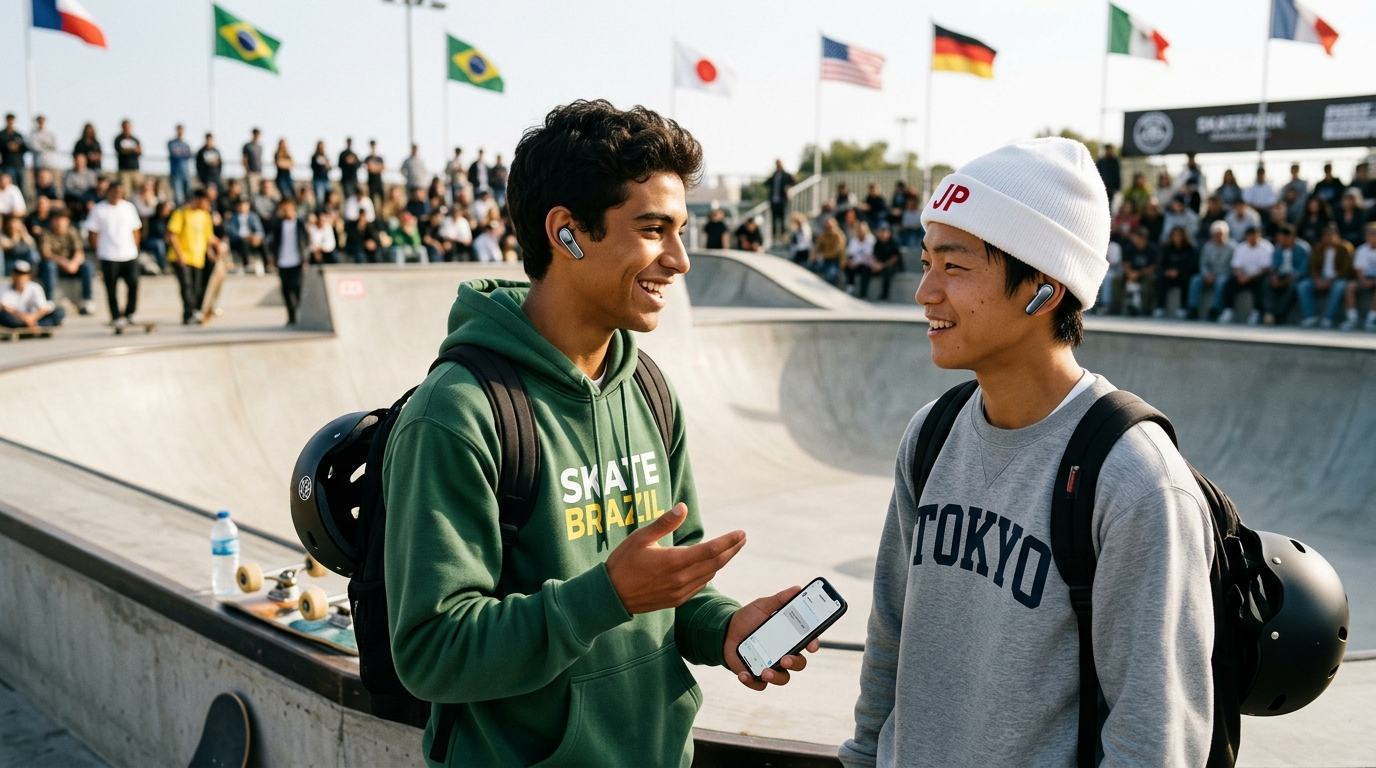
International skateboarding has always been united by creativity rather than language, but new real-time translation earbuds are changing how riders, coaches, and fans communicate across borders. Conversations that once relied on gestures, shared sessions, and fragmented phrases can now unfold instantly in dozens of languages. Supporters see this as a breakthrough that deepens friendships, broadens audiences, and gives athletes the opportunity to tell their own stories without interpreters. Others worry that frictionless communication may gradually smooth over the regional slang, local identities, and cultural nuances that have long defined skateboarding's character. The debate asks whether removing language barriers enriches the culture—or quietly erases some of what made it unique in the first place.
For decades, skateboarding spoke its own language.
Not English.
Not Japanese.
Not Portuguese.
Not Spanish.
The language of shared sessions.
Head nods.
Hand gestures.
Laughter after failed tricks.
Respect earned without needing many words.
Today, technology is changing that.
Real-time translation earbuds allow riders from opposite sides of the world to hold natural conversations almost instantly.
For the first time, athletes can exchange stories, coaching advice, and ideas without waiting for an interpreter.
It's an extraordinary leap in communication.
But it also raises an unexpected question:
Did the language barrier accidentally preserve something that made skateboarding culture special?
Why This Matters Now
Skateboarding has become one of the world's most international sports.
Olympic competition has accelerated its global growth.
Professional tours now bring together athletes from every continent.
Fans follow riders from countries they may never visit.
As the sport expands, communication becomes increasingly important.
Real-time translation technology promises immediate benefits:
- Easier conversations between athletes.
- Better collaboration among coaches and teams.
- Richer interviews for global audiences.
- More accessible broadcasts for fans worldwide.
Yet skateboarding has always been shaped by local identity.
Every city developed its own style.
Its own vocabulary.
Its own traditions.
The question is not whether technology connects people—it clearly does. The question is whether effortless communication changes the culture that grew from learning to understand one another without it.
Expert Perspectives
Dr. Emily Carter: Translation Expands the Community
Linguistics professor Dr. Emily Carter believes real-time translation strengthens one of skateboarding's greatest qualities—its ability to unite people across cultures.
"Technology that fosters communication can only enhance the sport."
Removing language barriers allows athletes to explain their ideas, motivations, and experiences in their own words rather than relying on simplified translations or interpreters.
That creates opportunities for:
- Deeper friendships.
- Better collaboration.
- More inclusive competitions.
- Richer storytelling.
Carter argues that understanding an athlete's voice also helps fans appreciate the cultural backgrounds that shape their skating.
Translation doesn't replace identity—it gives identity a wider audience.
Carlos Mendoza: Culture Lives Inside Language
Cultural anthropologist Carlos Mendoza urges greater caution.
"Language is not merely a tool for communication; it's a vessel of cultural expression."
Every language carries meanings that extend beyond literal translation.
Local slang.
Humour.
Shared references.
Unspoken cultural assumptions.
These subtle elements have long given regional skate scenes their distinctive personalities.
Mendoza argues that removing communication barriers may unintentionally flatten those differences.
When conversations become standardised through technology, unique expressions risk becoming simplified for broader understanding.
Sometimes what gets lost in translation is precisely what makes a culture memorable.
Jennifer Yu: Global Communication Is Also Big Business
Technology analyst Jennifer Yu approaches the issue through the lens of commercial growth.
Real-time translation represents more than a communication tool.
It also creates opportunities for:
- Global sponsorships.
- International media coverage.
- Cross-border brand partnerships.
- Expanded fan engagement.
Translation technology makes athletes more accessible to worldwide audiences, increasing both visibility and commercial value.
At the same time, Yu recognises a familiar challenge.
As financial investment grows, so does the pressure to package sports for mass audiences.
Commercial success and cultural authenticity are not always in conflict—but they rarely evolve independently of one another.
Editorial Synthesis
Where Experts Agree
Despite their differing priorities, the experts identify several areas of consensus:
- Real-time translation significantly improves communication across international skateboarding.
- Athletes and fans benefit from greater cultural exchange.
- Technology will continue shaping the future of the sport.
- Commercial growth influences how skateboarding is presented to global audiences.
Where Experts Disagree
Does Translation Strengthen or Dilute Culture?
Dr. Carter believes removing language barriers makes skateboarding more inclusive while allowing athletes to tell their own stories.
Mendoza argues that language itself carries cultural meaning that technology cannot fully preserve.
Is Commercialisation a Threat?
Yu views expanding global markets as a natural consequence of improved communication.
Mendoza remains concerned that commercial incentives may gradually replace local traditions with more universally marketable narratives.
What Makes Skateboarding Authentic?
For Carter, authenticity grows through greater understanding between cultures.
For Mendoza, authenticity depends on preserving the unique linguistic and cultural identities that developed organically within local skate communities.
Why This Matters
The debate surrounding translation technology reaches beyond skateboarding.
It reflects a broader question about what happens when technology removes barriers that once shaped human interaction.
Misunderstandings can disappear.
Friendships become easier.
Knowledge travels faster.
Those are meaningful gains.
Yet barriers sometimes preserve diversity.
Local dialects.
Regional humour.
Shared rituals.
Ways of communicating that exist because communities developed independently.
Technology does not erase those traditions on its own.
But it can encourage a more universal style of communication that gradually becomes the default.
For skateboarding, whose identity has always celebrated individuality over conformity, maintaining that balance matters.
The future of the sport should not require choosing between connection and authenticity.
Instead, the challenge is ensuring that technology helps people understand one another without encouraging every conversation—and every culture—to sound the same.
Real-time translation earbuds may allow every skater to speak to anyone in the world. Their greatest success, however, will be measured not by how many languages they translate, but by how well they preserve the unique voices that made skateboarding a global culture in the first place.
The Fine Line Between Unity and Authenticity
As real-time translation earbuds bridge communication gaps in international skate contests, we must consider the balance between embracing inclusivity and preserving the essence of skate culture. While technology empowers skaters to share their unique stories and experiences, one must ponder whether the loss of that rich, localized dialogue diminishes the authenticity that has long defined the sport. It’s crucial to celebrate diverse voices while remaining mindful of the cultural nuances that give skateboarding its distinct flavor. Moving forward, we must harness technology not just to connect, but to enhance and respect the heritage of skateboarding, ensuring that every voice adds to a narrative steeped in authenticity and camaraderie.

Dr. Emily Carter
Linguistics Professor, Stanford University
"Dr. Carter argues that real-time translation earbuds can foster inclusivity and understanding among diverse participants, enhancing the collaborative spirit of international skate contests. She believes breaking down language barriers facilitates greater cultural exchange and camaraderie."
in Dr. Emily Carter
Carlos Mendoza
Cultural Anthropologist, Freelance Consultant
"Carlos Mendoza suggests that language barriers can preserve unique cultural expressions and authenticity within skate communities. He warns that universal translation may dilute local identities and the richness of individual voices, essential to the sport's character."
in Carlos MendozaJennifer Yu
Tech Analyst, Market Research Firm
"Jennifer Yu maintains that while translation technology has potential benefits for communication, it also raises questions about the preservation of cultural integrity in sports. She emphasizes the importance of finding a balance between inclusivity and cultural authenticity."
in Jennifer YuHow Does This Hit You?

No comments yet. Be the first to weigh in.