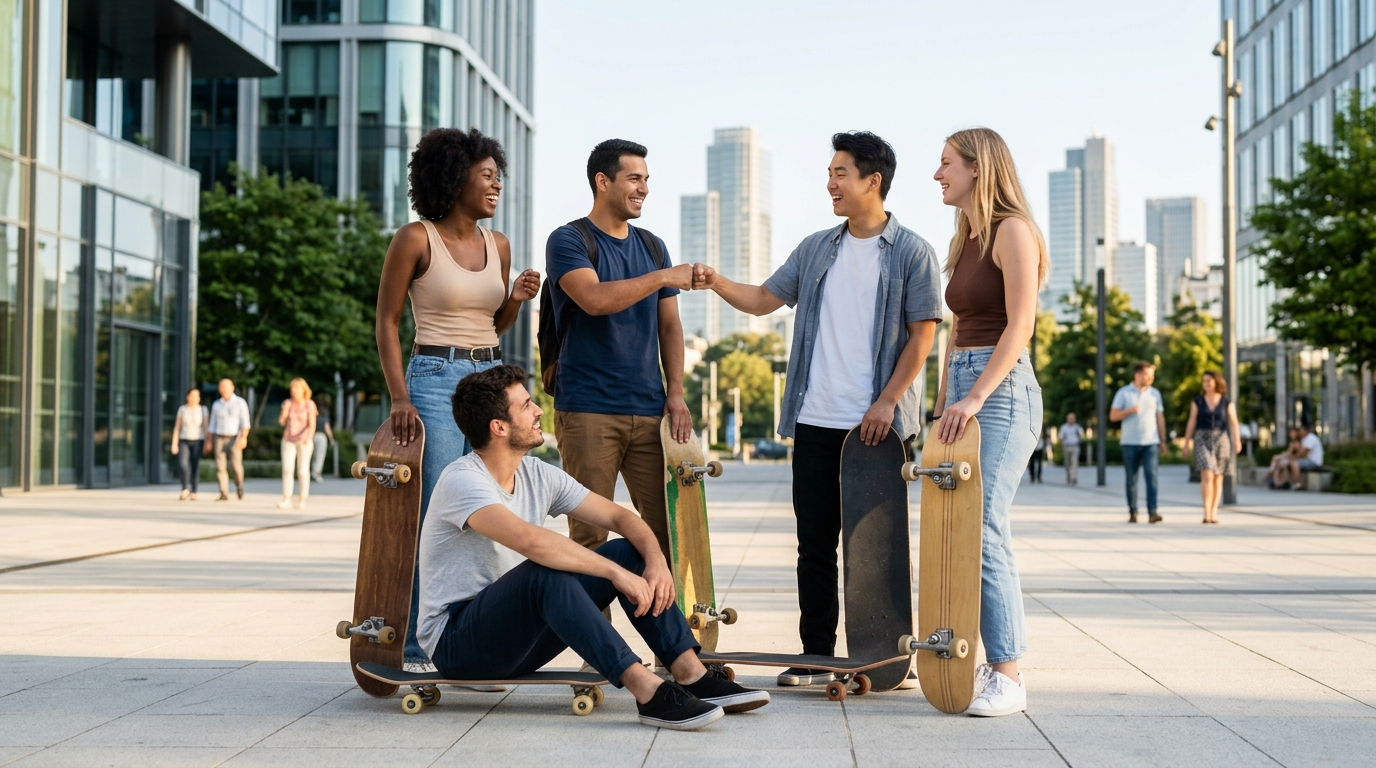
Moving to a new city can be one of life's most isolating experiences, especially in an age where online connections often outnumber meaningful face-to-face relationships. Yet for many people, shared passions provide a shortcut to belonging. Skateboarding, with its open parks, collaborative culture, and unwritten code of encouragement, has long served as more than a sport—it has been a social gateway. Experts argue that while common interests create opportunities for connection, lasting friendships require consistent effort, vulnerability, and time. The story of arriving in an unfamiliar city armed with nothing but a skateboard explores a broader truth: community is rarely found by accident. More often, it is built one conversation, one shared session, and one return visit at a time.
When I arrived, I knew exactly three things.
My new address.
The nearest supermarket.
And where the local skatepark was.
I didn't know anyone.
No friends.
No family.
No familiar faces waiting to welcome me.
Just a skateboard under one arm and the hope that showing up might be enough.
It sounds overly simple.
But that's often how communities begin.
Not with introductions.
With shared spaces.
A nod.
A conversation about a trick.
A borrowed tool.
A laugh after a failed attempt.
The skateboard wasn't just a hobby.
It became a passport into a community.
And it raises a question that extends far beyond skateboarding:
How do complete strangers become lifelong friends in a world where genuine connection often feels harder to find?
Why This Matters Now
Modern life makes starting over increasingly common.
People relocate for work, education, relationships, or opportunity.
Yet while moving has become easier, building meaningful friendships often hasn't.
Social media offers constant connection, but many people still experience profound loneliness after arriving somewhere new.
The challenge isn't simply meeting people.
It's finding places where repeated interaction happens naturally.
Communities built around shared interests—whether sport, music, volunteering, or creative pursuits—provide exactly that.
Friendship rarely begins with perfect chemistry. It begins with showing up often enough for familiarity to become trust.
Expert Perspectives
Tony Hawk: Shared Passion Creates Instant Common Ground
Professional skateboarder Tony Hawk believes skateboarding possesses a unique ability to dissolve social barriers.
"Skateboarding provides an almost immediate sense of belonging."
Unlike many organised activities, skateparks rarely require formal introductions.
A shared appreciation for the sport becomes its own language.
Advice is exchanged.
Equipment is shared.
Progress is celebrated regardless of experience.
Hawk argues that simply arriving with a skateboard communicates openness.
"The act of sharing space, tricks, and stories creates bonds that can solidify quickly."
In many skate communities, participation matters more than background.
A shared passion often becomes the first conversation before names are even exchanged.
Robert Putnam: Community Grows Beyond the Activity
Sociologist Robert Putnam views hobbies as gateways into something larger.
In Bowling Alone, he argues that shared activities help generate what he calls social capital—the networks of trust and cooperation that strengthen communities.
"The connections we forge through recreational activities can lead us to more profound interactions beyond the sport itself."
A skatepark may provide the introduction.
But lasting friendships often develop elsewhere.
Coffee after a session.
Helping someone move.
Supporting one another through life's challenges.
Putnam encourages newcomers to expand beyond one activity by participating in local events, clubs, and community organisations.
Shared interests open the door. Consistent participation keeps it open.
Angela Duckworth: Friendship Is Built Through Persistence
Psychologist Angela Duckworth approaches friendship through the lens of perseverance.
"Building meaningful relationships takes time and effort."
Many people expect friendships to happen naturally.
Duckworth argues they are more often the result of repeated choices.
Returning after awkward first meetings.
Starting conversations despite discomfort.
Continuing to invest even when connections develop slowly.
Moving to a new city demands resilience as much as confidence.
Belonging is rarely immediate. It grows through small acts of consistency repeated over time.
Editorial Synthesis
Where Experts Agree
Although they emphasise different aspects of community, the experts converge on several important ideas:
- Shared activities create natural opportunities for meaningful social interaction.
- Strong friendships require continued effort and engagement.
- Communities contribute significantly to wellbeing and a sense of belonging.
- Showing up consistently matters more than making a perfect first impression.
Where Experts Disagree
Can One Hobby Build Lasting Community?
Tony Hawk believes skateboarding itself often provides everything needed to begin enduring friendships.
Robert Putnam argues that recreational activities are only the starting point for broader social networks.
Organic Connection or Intentional Effort?
Putnam emphasises the importance of participating in multiple community spaces.
Duckworth focuses on the personal persistence required to transform acquaintances into genuine friends.
Why This Matters
The story of arriving in a new city with nothing but a skateboard resonates because it reflects something deeply human.
Everyone wants somewhere to belong.
A place where faces become familiar.
Where conversations become routines.
Where strangers gradually become the people you call when life becomes difficult.
Skateboarding succeeds as a community not because everyone shares identical backgrounds, but because everyone shares a willingness to occupy the same space, learn from one another, and celebrate progress together.
That principle extends far beyond the skatepark.
Book clubs.
Running groups.
Volunteer organisations.
Music scenes.
Local cafés.
Communities form wherever people repeatedly choose presence over isolation.
In an era often defined by digital interactions, genuine friendship still follows surprisingly traditional rules.
It asks us to leave the house.
To risk awkwardness.
To return after the first visit.
And to keep showing up long enough for familiarity to become trust.
A skateboard didn't create lifelong friendships on its own. It simply provided the first reason to say hello. The friendships that followed were built the old-fashioned way—through time, shared experiences, and the quiet courage to keep coming back.
Building Bonds on Wheels
The journey of moving to a new city armed only with a skateboard illuminates the profound impact of shared passions in fostering friendships. In an age where many feel isolated despite the abundance of digital connections, engaging in community-driven activities like skateboarding provides a tangible pathway to connection. Both Tony Hawk's insights on the universal language of skateboarding and Robert Putnam's analysis of social capital emphasize the need for real interactions. By immersing oneself in local culture and embracing vulnerability, the individual not only finds a sense of belonging but also cultivates lasting friendships. As this experience suggests, embodying an open heart and adventurous spirit can transform anonymity into camaraderie—one ollie at a time.

Tony Hawk
Professional Skateboarder, Entrepreneur
"Skateboarding naturally fosters community as it brings together individuals who share a common passion, creating bonds through shared experiences and challenges. By pursuing this passion in a new city, one can quickly forge meaningful connections with like-minded individuals."
𝕏 Tony Hawk in Tony HawkRobert Putnam
Political Scientist, Author
"While movements to new environments often create opportunities for social interaction, the depth and sustainability of these connections depend significantly on various factors, including local culture and existing community structures. Understanding these dynamics is crucial for successfully integrating and forming relationships."
in Robert Putnam
Angela Duckworth
Psychologist, Author
"Moving to a new city alone can catalyze personal growth and resilience. Engaging in local activities, such as skateboarding, invites chances to meet new people while also developing valuable life skills like adaptability and determination."
in Angela DuckworthHow Does This Hit You?

No comments yet. Be the first to weigh in.