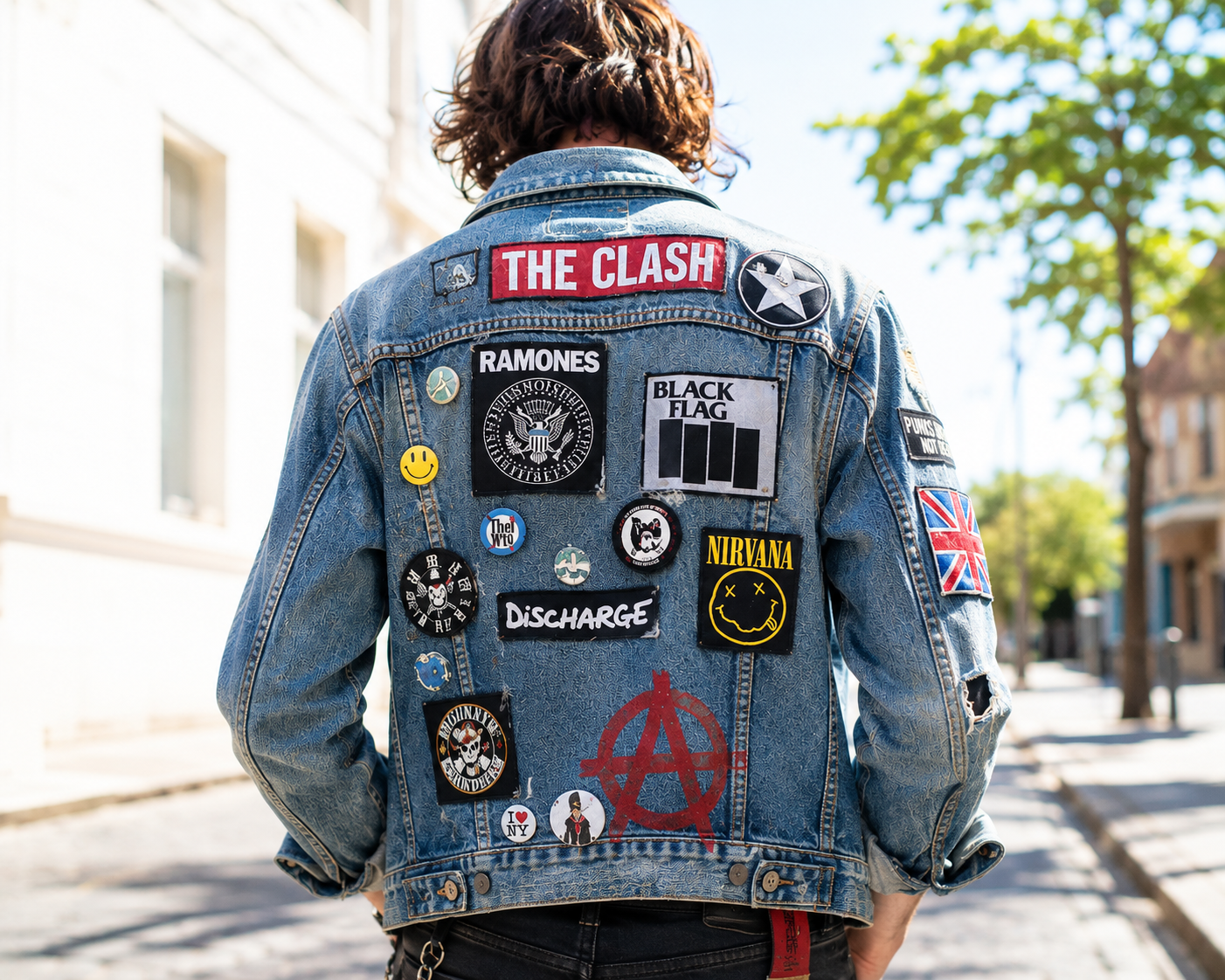
The denim jacket was once more than a piece of clothing: it was a physical record of identity, belonging, and personal history. Patches, pins, repairs, and stains accumulated over time, creating a narrative that could not simply be replicated by mass production. Today, as social media turns identity into something instantly curated and fast fashion reproduces the look of individuality at scale, the denim jacket raises a larger question: what happens when we preserve the aesthetic of self-expression but lose the story behind it?
The Denim Jacket Was the First Social Media Profile
Every patch was a post, every pin a like, and every stain a story unknown.
The classic denim jacket is more than just clothing; it can function as a physical expression of identity and personal history. In a world saturated with instantaneous digital validation, it is worth asking whether we still recognize the enduring narrative embedded in the fabric of a denim jacket.
And as fast fashion increasingly replicates its aesthetic, another question emerges: are we losing the deeper meanings these garments once carried?
Why This Matters Now
As social media continues to dominate personal and public identities, the denim jacket provides a useful metaphor for individual branding and expression.
Once associated with rebellion, creativity, music, subcultures, and working-class identity, the denim jacket has also become a highly reproducible fashion object. Its visual language can now be copied almost instantly, potentially separating the appearance of individuality from the lived experiences that originally gave the garment meaning.
This transformation matters in an era increasingly concerned with fast fashion, sustainability, consumerism, and the construction of identity.
The question is no longer simply what we wear.
It is what our clothes are allowed to say about us—and whether they still carry a story of their own.
Dr. Virginia Postrel: Clothing as Personal History
Dr. Virginia Postrel, an author and cultural economist, argues that the evolution of the denim jacket reflects broader changes in society.
Historically, denim jackets were often customized with patches, pins, embroidery, alterations, and other details. These modifications could represent personal beliefs, experiences, affiliations, or particular moments in someone's life.
In that sense, the jacket became a record of the person wearing it.
Postrel's comparison with social media is particularly revealing. Just as people curate photographs, posts, interests, and opinions online, they once curated physical identities through the clothing they wore.
A jacket accumulated meaning over time.
A new patch could mark a concert. A pin could communicate a political belief. A repair could reveal years of use. A stain might remain as an accidental reminder of a particular moment.
The result was an object that became increasingly personal through use.
The more history it accumulated, the less replaceable it became.
Professor Elizabeth Cline: When Individuality Becomes a Product
Professor Elizabeth Cline takes a more critical view of what happens when this aesthetic becomes absorbed by fast fashion.
For Cline, the problem is not that denim jackets are being produced on a large scale. The deeper issue is that the visual appearance of individuality can be mass-produced without the personal history that originally made it meaningful.
A factory can reproduce a faded finish.
It can reproduce patches.
It can manufacture artificial wear.
It can make a jacket look as though it has already lived a life.
But it cannot manufacture the actual experiences that produced that history.
This creates an interesting paradox.
Consumers can purchase a jacket designed to look unique, while thousands of other people can purchase essentially the same version.
The aesthetic survives.
The individuality becomes standardized.
Cline connects this phenomenon to a broader cycle of consumption in which novelty is valued over longevity. When clothing is continually replaced to follow new trends, garments have less opportunity to accumulate the personal histories that once made them culturally significant.
Dr. Michael H. Stone: Clothing as Cultural Storytelling
Dr. Michael H. Stone approaches the denim jacket from a sociological perspective.
For him, the garment represents much more than individual fashion. Its history connects different communities and generations, from working-class origins to punk, music, youth culture, and other countercultural movements.
The denim jacket became meaningful partly because people used it to communicate belonging while simultaneously making it their own.
That distinction is important.
A uniform communicates identity through standardization.
A personalized denim jacket communicates identity through modification.
Stone argues that when clothing is separated from its cultural context, something important can be lost. The garment may continue to exist physically, but the stories surrounding it become less visible.
He also draws a parallel with social media.
Both clothing and digital platforms can function as tools for self-presentation. Both allow people to communicate who they are—or who they want others to believe they are.
But both can also encourage an obsession with appearance.
The profile and the jacket can become surfaces that communicate identity without necessarily revealing the deeper story underneath.
Where the Experts Agree
The experts converge around several central ideas.
Denim jackets can function as forms of storytelling. Their customization and accumulated wear can communicate personal identity, cultural affiliation, and lived experience.
Fast fashion changes that relationship. Mass production makes the aesthetic easier to reproduce, but potentially separates appearance from history.
And commodification can weaken cultural meaning when an object becomes primarily a trend rather than a medium for personal expression.
Where the Experts Disagree
The disagreement concerns what this transformation ultimately means.
Postrel is more interested in the continuing evolution of personal expression. From this perspective, people will always find new ways to use clothing to construct identity, even as cultural practices change.
Cline is more critical of mass-produced versions of individuality, arguing that replication can dilute authenticity and encourage disposable consumption.
Stone takes the broadest sociological view, focusing on what happens to collective storytelling when cultural symbols are detached from their historical context.
Their differences ultimately come down to one question:
Does changing the medium change the meaning?
The Denim Jacket as a Physical Profile
The social-media comparison becomes especially interesting when we consider how differently the two mediums preserve identity.
A social-media profile can be edited instantly.
Posts can be deleted.
Photos can be filtered.
A bio can be rewritten.
A denim jacket is much less forgiving.
Its history remains visible.
A faded sleeve records wear. A repaired tear shows damage. A patch covers a particular place. A pin leaves a small mark. Over years, the garment becomes increasingly difficult to separate from the person who owned it.
The jacket doesn't just present an identity. It accumulates evidence of one.
That may be one reason vintage and heavily worn denim can feel more authentic than a brand-new garment designed to look old.
The difference isn't necessarily the material.
It's the history.
Why This Matters
In a world where clothing can be produced, photographed, posted, and discarded at extraordinary speed, the denim jacket represents a different relationship with personal style.
It suggests that identity doesn't have to be created instantly.
It can accumulate.
It can change.
It can become messy.
It can carry contradictions.
And, importantly, it can become more meaningful through time.
That is precisely what fast fashion struggles to reproduce. It can imitate the visual language of experience, but it cannot manufacture the experience itself.
The challenge for consumers is therefore not simply to buy "authentic" clothing.
It is to create a relationship with what they own that extends beyond the moment of purchase.
A jacket that remains in someone's life for ten years, collecting memories and modifications, may ultimately say more about that person than ten jackets purchased to follow ten different trends.
The Story We Wear
The denim jacket's enduring appeal may come from this unusual combination of durability and adaptability.
It can belong to different generations.
It can move between social groups.
It can communicate rebellion, nostalgia, creativity, belonging, or simply personal taste.
But its most powerful characteristic may be its ability to become more personal with age.
That makes the comparison with social media particularly striking.
Social platforms encourage us to document our lives digitally. The denim jacket represents a much older form of documentation—one in which the evidence is physical, imperfect, and difficult to curate.
Every patch was a post.
Every pin was a signal.
Every repair was an edit.
And every stain was a story.
Reviving Meaning in Denim: A Call to Action
The denim jacket, once a canvas of individuality and personal storytelling, now faces the threat of becoming a mere fashion commodity in the fast fashion sphere. As society grapples with the implications of rapid consumerism, it’s vital to reclaim the narrative woven into the fabric of these jackets. We must elevate our understanding of clothing not just as items but as reflections of our identities and histories. Moving forward, brands and consumers alike should prioritize sustainability and authenticity, ensuring that each patch and pin retains its significance rather than being lost in a sea of disposable trends. The denim jacket can once again be a medium of expression, but only if we choose to invest in its story, not just its style.

Dr. Virginia Postrel
Author and Cultural Economist
"Postrel argues that denim jackets, adorned with patches and personal stains, are culturally significant artifacts that reflect individual identity and social connections, unlike fast fashion imitations that strip away these meanings."
𝕏 Dr. Virginia Postrel in Dr. Virginia Postrel
Professor Elizabeth Cline
Fashion Academic and Author
"Cline emphasizes that while denim jackets may represent personal stories, the fast fashion industry commodifies these symbols without understanding their backstory, leading to a dilution of their authentic value."
𝕏 Professor Elizabeth Cline in Professor Elizabeth Cline
Dr. Michael H. Stone
Sociologist and Fashion Analyst
"Stone presents a balanced view, acknowledging the cultural significance of denim jackets while highlighting the complexities introduced by fast fashion, suggesting that both have roles in contemporary society that can coexist."
𝕏 Dr. Michael H. Stone in Dr. Michael H. StoneHow Does This Hit You?



No comments yet. Be the first to weigh in.