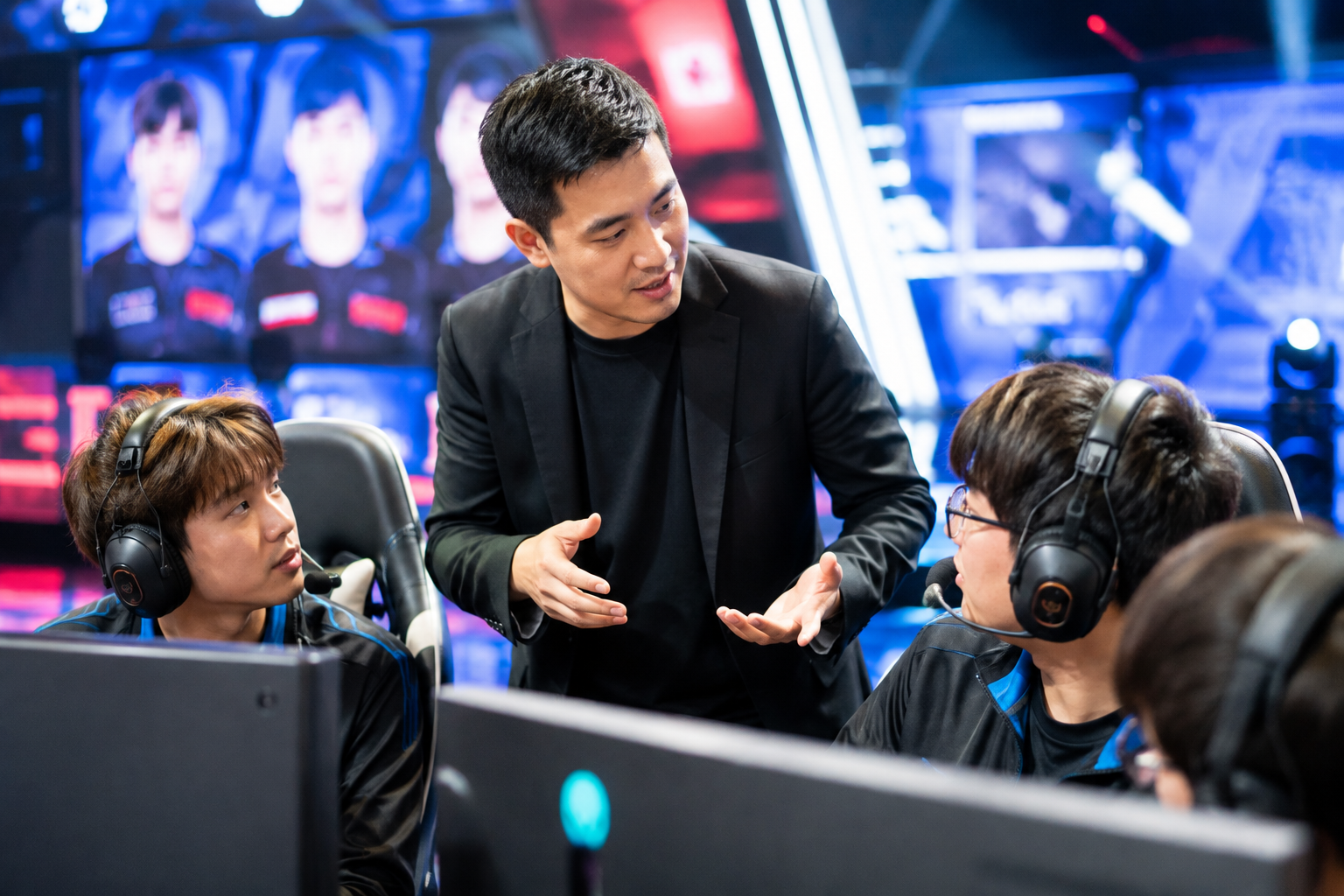
Esports coaching salaries can demonstrate that the industry places substantial economic value on specialized expertise, but a paycheck cannot determine whether something qualifies as a sport. High salaries reflect audience size, sponsorships, commercial models, and demand—not necessarily athletic legitimacy. The more interesting question is whether esports should be evaluated using the same criteria as traditional sports or recognized on its own terms.
The Highest-Paid Esports Coach in the World Earns More Than Most Olympic Head Coaches. The Sport That Pays Them Still Can't Agree on Whether It's a Sport. Does the Salary Settle the Argument?
As esports continues to clash with traditional sports over legitimacy, the rising salaries of its coaches—particularly the highest-paid among them—raise a provocative question:
Can a coach's salary actually tell us whether a discipline is a sport?
At first glance, the argument seems compelling. If organizations are willing to pay esports coaches six-figure salaries, surely that reflects the value of the expertise involved.
But financial value and athletic legitimacy are not necessarily the same thing.
A high salary can tell us that an industry has money, audiences, sponsors, and demand. It doesn't necessarily tell us how that activity should be classified.
Why This Matters
Esports has evolved into a major entertainment and competitive industry, with professional teams, coaches, analysts, training systems, sponsorships, broadcasting, and enormous online audiences.
The role of the coach has evolved alongside it.
Modern esports coaches may be responsible for strategy, player development, opponent analysis, team dynamics, preparation, and performance management. In some competitive environments, the role can resemble traditional sports coaching more closely than casual observers might expect.
Yet one question continues to generate disagreement:
Is esports actually a sport?
The emergence of highly compensated coaches makes the debate more visible, but it doesn't necessarily resolve it.
Adam Apicella: The Market Is Sending a Signal
Adam Apicella, CEO of Esports Engine, views coaching salaries primarily through the lens of market demand.
High compensation indicates that organizations recognize the value of specialized expertise.
In a rapidly changing competitive environment, coaches aren't simply managing players. They are helping teams understand evolving game mechanics, develop strategies, analyze opponents, and maintain competitive advantages.
From this perspective, a six-figure salary represents something meaningful.
Someone is willing to pay that much because the expertise produces value.
Apicella also emphasizes the distinctive economics of esports.
Unlike many traditional sports, esports is inherently digital. Its competitions can reach global audiences without requiring viewers to be physically present in a stadium, and players can develop communities around games that transcend national boundaries.
That creates commercial opportunities that don't necessarily map neatly onto traditional sports economics.
But it also raises an important distinction.
Commercial success can establish that esports is valuable. It cannot, by itself, establish that esports is a sport.
Dr. Rachel Kowert: Salary Doesn't Define a Sport
Dr. Rachel Kowert approaches the question from a different direction.
The definition of sport typically involves some combination of competition, skill, rules, organized participation, and—depending on the definition—physical exertion.
Esports complicates that framework.
Competitive gaming unquestionably requires significant cognitive abilities, coordination, reaction speed, teamwork, strategic thinking, and sustained concentration.
But whether those characteristics satisfy a particular definition of "sport" is ultimately a conceptual and institutional question.
Kowert therefore rejects the idea that salaries can settle the debate.
A coach can earn an enormous salary in an activity that society doesn't classify as a sport. Conversely, something can clearly qualify as a sport without generating enormous salaries.
Price is not a classification system.
If esports is going to be evaluated seriously, Kowert argues that the conversation needs to include competition structures, regulation, player health, cognitive demands, physical engagement, and the broader characteristics of organized sport.
Kurtis "T1" Cummings: Coaching Is Coaching
Kurtis "T1" Cummings, a professional esports coach, focuses on the practical reality of the job.
From inside the competitive environment, coaching requires preparation, strategy, communication, psychological management, and an enormous amount of performance analysis.
The players may be sitting at computers rather than running across a field, but that doesn't make the coaching process trivial.
Coaches still have to prepare teams to perform under pressure.
They have to understand opponents, identify weaknesses, manage team dynamics, and develop strategies that can produce results.
Cummings therefore sees high compensation as recognition of the expertise required.
For him, the argument isn't necessarily about whether esports looks like traditional sports.
It's about whether the competitive demands and professional structures are real.
And from his perspective, they clearly are.
The Problem With Using Salary as Proof
There is a fundamental flaw in the salary argument.
Consider what a salary actually measures.
It can reflect:
- Revenue generated by the industry
- Scarcity of specialized expertise
- Sponsorship money
- Audience size
- Broadcasting rights
- Investor expectations
- Commercial competition between organizations
None of these factors directly measure athleticism.
A professional esports coach earning $500,000 isn't necessarily evidence that esports requires the same physical attributes as Olympic competition.
It is evidence that someone believes the coach's expertise is worth $500,000 in that particular market.
That distinction is crucial.
What Esports Does Have in Common With Traditional Sports
Rejecting the salary argument doesn't mean rejecting esports as a legitimate competitive activity.
There are substantial similarities.
Professional esports involves structured competition, specialized skills, preparation, coaching, teamwork, tactical planning, performance analysis, and high-pressure execution.
Players train repeatedly to improve.
Teams develop systems.
Coaches analyze opponents.
Organizations invest heavily in talent.
Audiences follow competitions and identify with teams and players.
In that sense, esports clearly shares many institutional characteristics with traditional sports.
The disagreement is primarily about which characteristics should be considered essential.
Where the Experts Agree
Despite their different perspectives, the experts share several conclusions.
Esports has developed into a serious professional industry. Its coaching salaries reflect significant economic activity and demand for specialized expertise.
Traditional definitions of sport may not fully capture esports. Competitive gaming introduces a combination of cognitive, technical, and strategic skills that complicates conventional definitions.
And coaching in esports involves substantial expertise, regardless of whether one ultimately chooses to classify the activity as a sport.
Where They Disagree
The central disagreement concerns what should determine esports' legitimacy.
Apicella places greater emphasis on the economic signals created by professional investment and high compensation.
Kowert argues that financial metrics are insufficient and that esports needs to be evaluated through broader conceptual and institutional criteria.
Cummings focuses on the practical experience of competition and coaching, arguing that the complexity of the work itself demonstrates its legitimacy.
These aren't necessarily mutually exclusive arguments.
They simply answer different questions.
So, Does the Salary Settle the Argument?
No.
A six-figure coaching salary doesn't prove that esports is a sport any more than a low salary would prove that it isn't.
What the salary does demonstrate is that esports has become valuable enough to sustain a sophisticated professional ecosystem around competitive performance.
That's significant.
But the sport-versus-non-sport debate isn't really an economic question. It's a question about definitions.
If sport requires substantial physical exertion, some forms of esports may struggle to satisfy traditional criteria.
If sport is defined more broadly around organized competition, specialized skill, training, rules, teamwork, and performance under pressure, esports fits much more comfortably.
Why This Matters
The debate over esports isn't really about whether gamers deserve to be paid.
The market has already answered that question.
The more interesting question is what we mean when we call something a sport.
As technology changes the way people compete, traditional categories become less straightforward. Esports challenges assumptions about what training looks like, where competition happens, what skills matter, and how physical and cognitive performance interact.
The salaries of esports coaches don't settle that debate.
But they do reveal something important: whatever we decide to call esports, it has become a serious professional competitive ecosystem with real economic value and specialized expertise.
The argument, therefore, shouldn't stop at the size of a paycheck.
The Financial Divide: Is It Enough to Claim Sport Status?
The escalating salaries of esports coaches challenge the narrative that the sector lacks legitimacy as a sport. While some argue that financial compensation is a mere reflection of market demands rather than athletic merit, the reality is that the figures speak volumes about societal recognition and acceptance. High salaries can indeed pave the way for legitimacy, forcing traditional sport institutions to reconsider their definitions and boundaries. However, monetary success alone cannot settle the argument; it must be accompanied by tangible standards of competition, skill, and cultural acceptance. As esports continues to evolve, it will take more than financial clout to integrate fully into the realm of recognized sports. The debate over classification may persist, but the financial landscape is shifting, signaling that the conversation is far from over.

Adam Apicella
CEO, Esports Engine
"The substantial salaries of esports coaches reflect the level of professionalism and dedication within the industry, positioning esports similarly to traditional sports. This financial success necessitates recognition as a legitimate sport, impacting public perception and investment."
𝕏 Adam Apicella in Adam Apicella
Dr. Rachel Kowert
Research Director, Take This
"While salaries in esports may rival those in traditional sports, the debate over whether esports constitutes a sport reveals deeper issues. Recognition involves more than financial success and requires consensus on factors like competition, skills, and community."
𝕏 Dr. Rachel Kowert in Dr. Rachel Kowert
Kurtis 'T1' Cummings
Professional Esports Coach
"Despite high earnings, some argue that esports lacks the physical components inherent to traditional sports, complicating its classification. The differing views on what constitutes a sport should not be overshadowed by financial success alone."
𝕏 Kurtis 'T1' Cummings in Kurtis 'T1' CummingsHow Does This Hit You?



No comments yet. Be the first to weigh in.