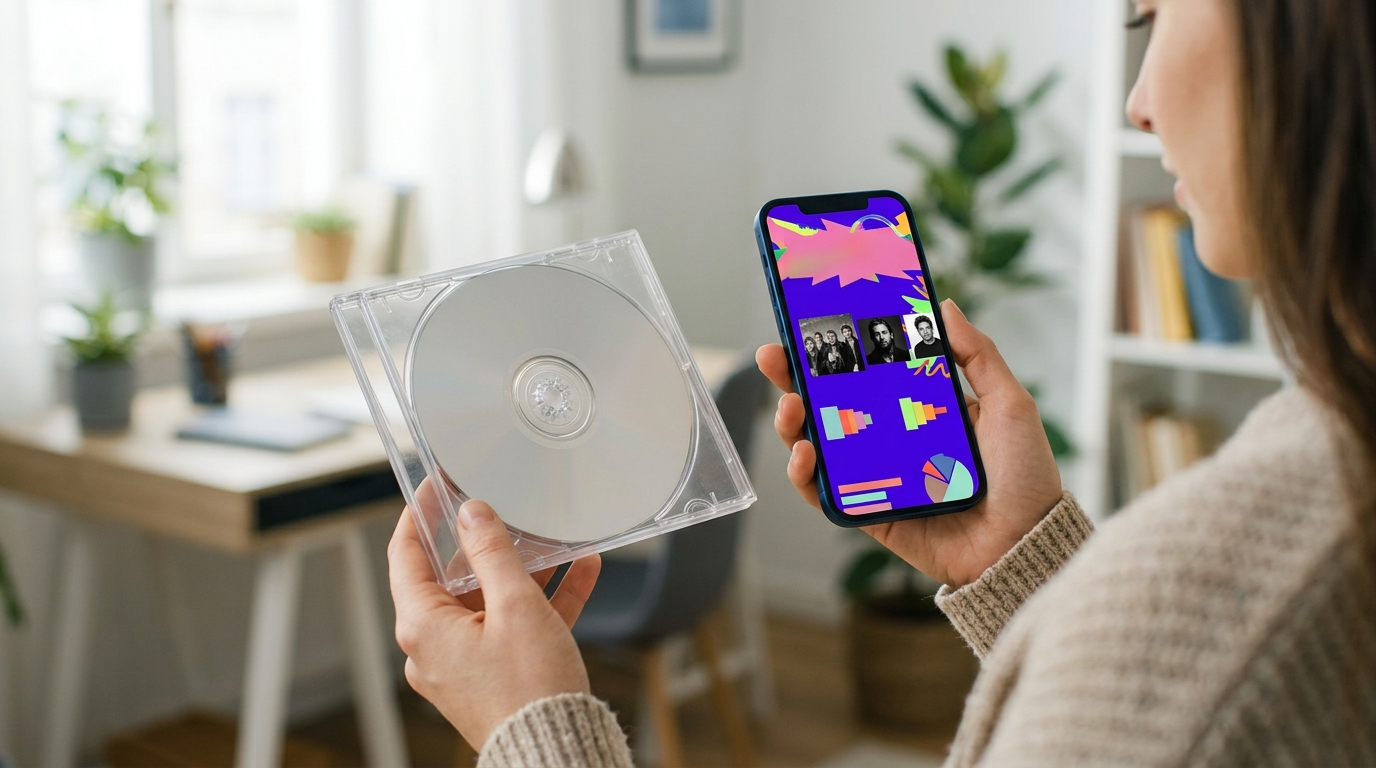
Long before streaming platforms analyzed every song we played, music fans expressed themselves through carefully crafted mix CDs. Every track was chosen deliberately, often for a specific person, creating playlists that functioned as love letters, friendships, apologies, or personal manifestos. Today, Spotify Wrapped offers a polished, data-driven snapshot of our listening habits, transforming a year's worth of plays into colorful graphics designed for sharing. While both celebrate our relationship with music, they represent fundamentally different ideas: one is an act of intentional creation, the other an act of reflection. As algorithms increasingly shape how we discover and share music, the debate asks whether convenience can ever replace the emotional meaning behind human curation.
There was a time when giving someone music required effort.
You spent hours choosing songs.
You worried about the order.
You debated whether Track 7 was too obvious or Track 12 said too much.
You burned the CD, decorated the cover, and handed it to someone knowing they would hear not just the music—but your intention.
Today, music tells a different story.
Every December, Spotify Wrapped arrives with colorful graphics, listening statistics, and personalized playlists generated automatically from months of streaming history.
Millions proudly share the results.
But the comparison invites a deeper question:
Can an algorithmic summary of what you listened to ever carry the same emotional meaning as a playlist someone deliberately created for you?
Why This Matters Now
Streaming platforms have fundamentally changed our relationship with music.
Discovery has become faster.
Libraries have become virtually limitless.
Recommendations are increasingly personalized through machine learning.
At the same time, many of the rituals surrounding music have disappeared.
The mix CD—and before it, the cassette mixtape—required time, intention, and emotional investment.
Spotify Wrapped requires only listening.
One reflects your habits. The other reflects someone else's thoughtfulness.
Understanding that distinction reveals how technology has reshaped not just music consumption, but emotional expression itself.
Expert Perspectives
Jason Tanz: Algorithms Understand Patterns
WIRED editor Jason Tanz believes algorithmic platforms have transformed music discovery for the better.
Spotify Wrapped does more than summarize individual listening habits.
It also captures larger cultural trends.
"The algorithm effectively captures the zeitgeist of each user."
Through massive datasets, streaming platforms can reveal listening behaviors that would otherwise remain invisible.
Users discover:
- Favorite artists
- Hidden listening patterns
- Emerging genres
- Unexpected habits
Spotify also introduces listeners to artists they may never have found independently.
Yet Tanz recognizes an important limitation.
"It lacks the intimate intention that comes with a hand-crafted mix."
Data can describe listening.
It cannot explain affection.
Knowing what someone played is different from knowing why someone chose it for another person.
Tiffany Shlain: Music as Human Communication
Filmmaker and Webby Awards founder Tiffany Shlain argues that the emotional value of mixtapes cannot be replicated by algorithms.
For Shlain, creating a mix was itself an act of storytelling.
Every decision carried meaning.
Song selection.
Track order.
Cover art.
Timing.
Each element communicated something personal.
"Music is not just data; it's a form of communication."
Unlike Spotify Wrapped, a mixtape was intentionally directed toward another person.
It wasn't simply about musical taste.
It expressed identity, affection, memory, or emotion.
"The algorithm might tell you what you listened to, but it can't communicate what those songs meant to you."
Algorithms organize information. Humans assign meaning.
Rob Sheffield: Nostalgia and Convenience Can Coexist
Rolling Stone music critic Rob Sheffield takes a more balanced position.
He acknowledges the emotional significance of mixtapes while recognizing the value of modern streaming platforms.
"Mix CDs were love letters, yes, but they could also be a curated experience that encouraged listeners to explore outside their comfort zones."
Spotify continues that spirit of discovery, albeit through different methods.
Streaming offers unprecedented convenience.
Millions of songs are immediately available.
Recommendations evolve continuously.
However, Sheffield argues that abundance changes the emotional experience of curation.
"The convenience seems to overshadow the sentiment."
The ease of creating playlists today may reduce the sense of intention that once accompanied every musical gift.
When music becomes infinitely available, choosing it can sometimes feel less meaningful—even when the songs remain just as powerful.
Editorial Synthesis
Where Experts Agree
Although they differ in emphasis, all three experts recognize several common themes:
- Music remains a powerful form of emotional expression.
- Technology has fundamentally changed how people discover music.
- Human-curated playlists communicate something algorithms cannot.
- Streaming has expanded access while changing musical rituals.
Where Experts Disagree
Can Algorithms Replace Human Curation?
Tanz believes algorithms provide valuable insight into personal taste and cultural trends.
Shlain argues they cannot reproduce the emotional intention behind a handcrafted mix.
Discovery vs. Meaning
Streaming excels at helping listeners discover new music.
Mixtapes excelled at expressing relationships through carefully chosen songs.
The two serve different purposes.
Convenience vs. Connection
Sheffield suggests modern platforms offer undeniable advantages but may unintentionally diminish the emotional significance once attached to sharing music.
Why This Matters
The debate over mixtapes and Spotify Wrapped reflects a larger question about life in the algorithmic age.
Should technology simply help us consume culture—or should it preserve the rituals that give culture emotional meaning?
Spotify Wrapped is remarkably good at telling us who we've been over the past year.
It can identify favorite artists, forgotten obsessions, and surprising listening habits.
But it cannot answer deeper questions.
Why did that song matter?
Who introduced it to you?
What memory does it carry?
A mixtape rarely contained the perfect songs.
It contained the right songs—for one specific person, at one specific moment.
That intention transformed music into conversation.
Spotify Wrapped performs a different function.
It is less a love letter than a mirror.
It reflects our habits back to us with extraordinary accuracy, but reflection is not the same as expression.
Perhaps the future of music doesn't require choosing between algorithms and human curation.
The best listening experiences may come from combining both: discovering music through technology while continuing to share it with the thoughtfulness that no algorithm can automate.
A mixtape said, "I made this for you." Spotify Wrapped says, "This is who you've been." Both tell stories—but only one begins with another person in mind.
Embracing Both: The Personal and the Algorithmic
As we celebrate both the mixtape and Spotify Wrapped, it becomes clear that each speaks to different facets of our musical experiences. The mixtape, crafted with intention and thoughtfulness, represents a personal connection that is deeply meaningful, akin to a love letter that encapsulates one’s feelings and shared memories. On the other hand, Spotify Wrapped serves as a snapshot of our listening habits, informed by data that reflects trends and preferences we may not even fully recognize. Although these formats diverge in their emotional weight and origins, they coexist as vital expressions of our relationship with music in the digital age. Together, they remind us that both personal curation and algorithm-driven insights contribute to our understanding and enjoyment of music, creating a more nuanced dialogue between nostalgia and innovation.

Jason Tanz
Editor, Wired
"Tanz argues that mix CDs served as a deeply personal form of communication, crafting a narrative through song selection, while Spotify Wrapped is primarily an algorithmic reflection of data. This distinction highlights the emotional versus mechanical nature of musical sharing."
in Jason Tanz
Tiffany Shlain
Filmmaker & Founder, The Webby Awards
"Shlain contends that Spotify Wrapped democratizes music sharing, allowing users to celebrate and connect over data-driven insights. She believes it serves a modern purpose by fostering community engagement, even if it lacks the personal touch of a mix CD."
in Tiffany Shlain
Rob Sheffield
Music Critic, Rolling Stone
"Sheffield believes both mix CDs and Spotify Wrapped have their own merits in musical expression. While mix CDs encapsulate a thoughtful curation of emotions, Wrapped reflects a modern interpretation of our listening habits, showcasing different dimensions of how we celebrate music."
in Rob SheffieldHow Does This Hit You?



No comments yet. Be the first to weigh in.