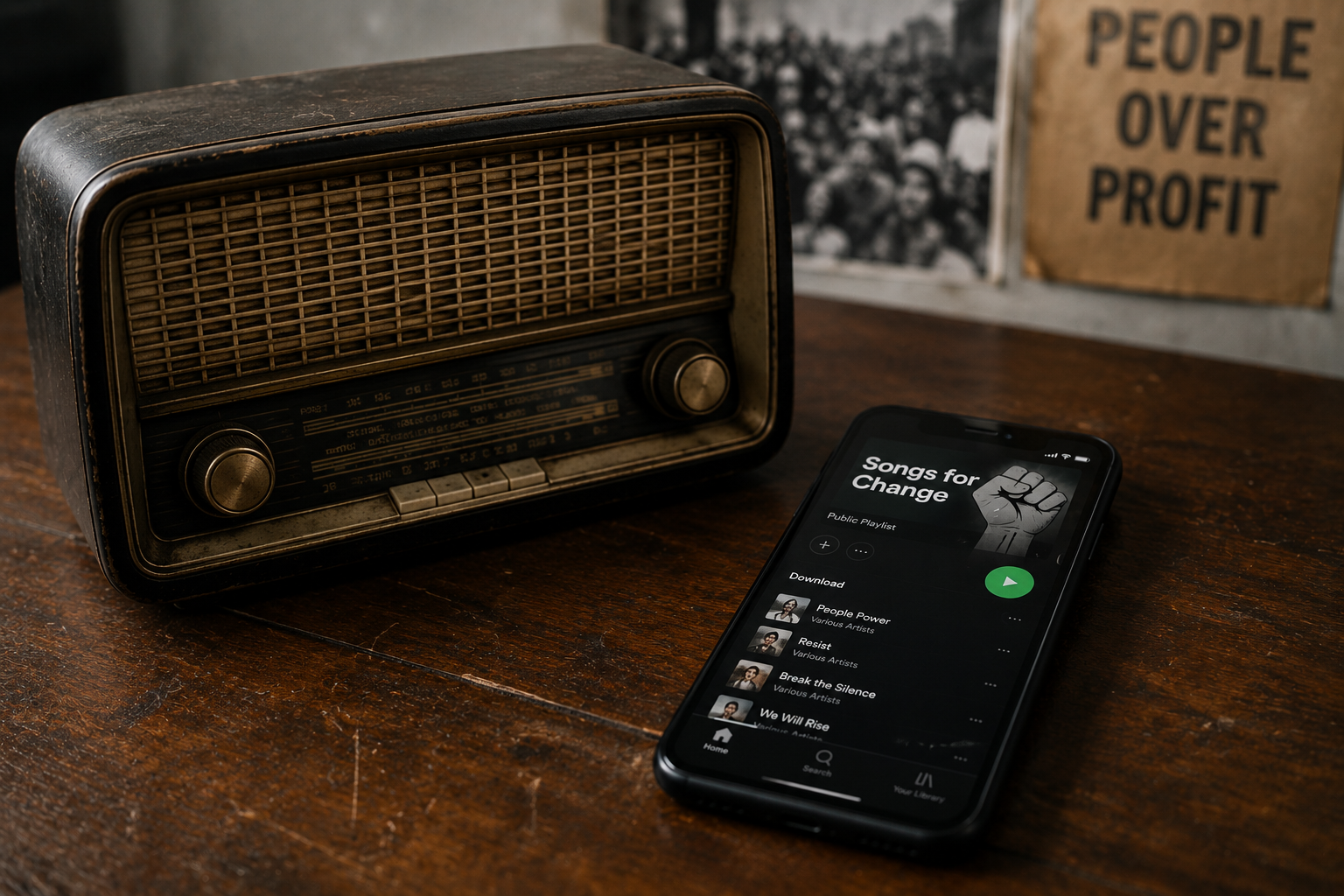
Protest music has always carried risks, but the nature of those risks has evolved. Where artists once faced censorship, imprisonment, blacklisting, or financial ruin, today's musicians often navigate algorithmic visibility, commercial partnerships, social media backlash, and political polarization. The question is no longer whether protest songs require sacrifice—it is whether today's costs are less visible, differently distributed, and easier to absorb within an increasingly commercialized digital culture.
Opening Question
A protest song was once more than a recording.
It was often a gamble.
Artists risked radio bans, cancelled concerts, government surveillance, imprisonment, corporate blacklisting, or the loss of an audience. The message frequently carried consequences beyond poor reviews or online criticism.
Today, protest music reaches millions within hours through streaming platforms and social media.
But it also appears in curated playlists between advertisements, recommendation algorithms, and branded campaigns.
Has protest music become more powerful because of its accessibility—or has the very cost that once gave it urgency quietly disappeared?
Why This Matters Now
Music has long served as one of society's most effective forms of political expression.
From labor movements and civil rights campaigns to anti-war demonstrations and democratic uprisings, songs have documented resistance while helping to organize it.
Digital platforms have transformed that relationship.
Artists no longer depend solely on record labels, radio stations, or television exposure.
A song can reach listeners across continents overnight.
Yet greater access has introduced new pressures.
Instead of censorship by governments alone, musicians increasingly navigate:
- Algorithmic visibility
- Brand partnerships
- Platform moderation
- Online harassment
- Political polarization
- Commercial expectations
The barriers have changed, but questions surrounding artistic independence remain.
Expert Perspectives
Mimi Parker: Visibility Can Dilute Urgency
Musician Mimi Parker argues that protest music remains essential but exists within a fundamentally different ecosystem.
"Artists today have a platform to reach millions instantly, but that also means they are competing with a flood of content."
She worries that activism itself has become a marketable category.
Streaming services can package socially conscious music into playlists that make political expression feel like another consumer preference.
According to Parker, this risks separating protest from its disruptive purpose.
If activism becomes simply another genre, its capacity to challenge institutions may weaken.
Jay-Z: The Audience Has Never Been Larger
Jay-Z views digital distribution more optimistically.
"Streaming gives artists the chance to speak their truth to a broader audience than ever before."
He argues that technology has dramatically lowered barriers to entry.
Artists who might once have struggled to secure radio play can now reach global audiences directly.
At the same time, he rejects the idea that modern protest is consequence-free.
Corporate relationships, sponsorships, and public scrutiny create different—but still meaningful—forms of pressure.
The risks have evolved rather than disappeared.
Sharon Jones: Authenticity Cannot Be Manufactured
Sharon Jones consistently emphasized that effective protest music begins with lived experience.
"The message had to be shared."
For Jones, sincerity mattered more than popularity.
She believed audiences recognize the difference between conviction and performance.
When protest becomes fashionable rather than deeply felt, music risks losing the emotional force that makes it memorable.
Her perspective reminds us that authenticity cannot be generated through marketing strategy alone.
Editorial Synthesis
Where Experts Agree
Although they emphasize different aspects of modern music, several points unite these perspectives.
All agree that:
- Protest music continues to play an important cultural role.
- Authenticity remains essential.
- Digital platforms have expanded audience reach.
- Artists still encounter professional and personal risks when engaging with controversial issues.
Where Experts Disagree
Has Technology Strengthened Protest?
Parker worries commercialization weakens political messages.
Jay-Z believes technology expands the potential impact by reaching audiences that traditional media never could.
What Defines Risk?
Jones focuses on personal commitment.
Parker emphasizes commercial pressures.
Jay-Z highlights evolving institutional consequences rather than outright censorship.
The Changing Cost of Speaking Out
Historically, protest music often carried immediate consequences.
Artists in different countries have faced:
- Government censorship
- Arrest or imprisonment
- Performance bans
- Radio blacklisting
- Loss of employment
- Political persecution
Those risks remain very real in many parts of the world.
Elsewhere, however, the pressures often look different.
Today's artists may instead face:
- Organized online harassment
- Consumer boycotts
- Sponsorship losses
- Platform demonetization
- Algorithmic invisibility
- Intense public polarization
These consequences are generally less visible than imprisonment, but they can still influence artistic decisions.
The economics of digital media often reward broad appeal over confrontation.
Can Protest Survive Commercial Success?
One of the central tensions facing modern musicians is whether commercial success necessarily softens political expression.
Some argue that corporate partnerships inevitably discourage controversial messages.
Others point out that financial success can provide artists with greater independence from traditional gatekeepers.
History offers examples supporting both views.
Commercial popularity has sometimes amplified social movements.
In other cases, political messages have been repackaged into lifestyle branding with little lasting impact.
The outcome depends less on distribution platforms than on artistic intent and audience engagement.
Why This Matters
The debate surrounding protest music ultimately concerns more than music itself.
It reflects broader questions about culture, technology, and political participation.
Digital platforms have unquestionably expanded access to audiences.
They have also transformed how attention is earned, measured, and monetized.
Whether that transformation strengthens or weakens protest depends on how artists, listeners, and institutions respond.
Songs continue to inspire movements, preserve historical memory, and challenge injustice.
What has changed is the environment in which they compete for attention.
The protest song may no longer always demand the same visible sacrifices it once did.
But meaningful artistic expression still carries costs—whether financial, reputational, political, or personal.
The form of risk has evolved.
The need for courage has not.
The enduring power of protest music has never rested solely on how many people hear it.
It has always depended on whether the artist is willing to say something worth hearing—and whether listeners are willing to act once the music ends.
Navigating the Fine Line of Activism in Music
The evolution of protest music in the streaming era poses a complex dilemma for artists: while the accessibility of platforms offers unprecedented reach, it also risks diluting the very essence of activism. Mimi Parker's observation highlights the tension artists face between genuine expression and commodified activism, where the message might become secondary to its marketability. As society grapples with urgent issues, the need for impactful protest songs remains vital; however, artists must navigate an environment where their contributions can easily be lost among the noise of countless playlists and commercial interruptions. The challenge lies not just in voicing dissent but in ensuring that such expressions resonate authentically and meaningfully. Thus, it is crucial for both artists and audiences to engage with protest music thoughtfully, recognizing its potential to inspire change amidst a backdrop of commercialization.
Mimi Parker
Musician and Activist
"Mimi Parker believes that the true impact of protest songs comes from the personal sacrifices artists make. She argues that losing something tangible adds authenticity to the message, while curated playlists dilute the urgency of activism."
𝕏 Mimi Parker in Mimi ParkerJay-Z
Music Mogul and Philanthropist
"Jay-Z contends that the landscape of protest music is evolving and that streaming platforms provide crucial visibility for activists. While there may be reduced risks, the ability to reach wider audiences compensates for that, fostering new avenues for change."
𝕏 Jay-Z in Jay-ZSharon Jones
Soul Singer and Activist
"Sharon Jones' perspective suggests that while the stakes may have shifted, music will always be a reflection of societal struggles. She emphasizes the importance of context in understanding activism in music, regardless of the platform."
in Sharon JonesHow Does This Hit You?

No comments yet. Be the first to weigh in.