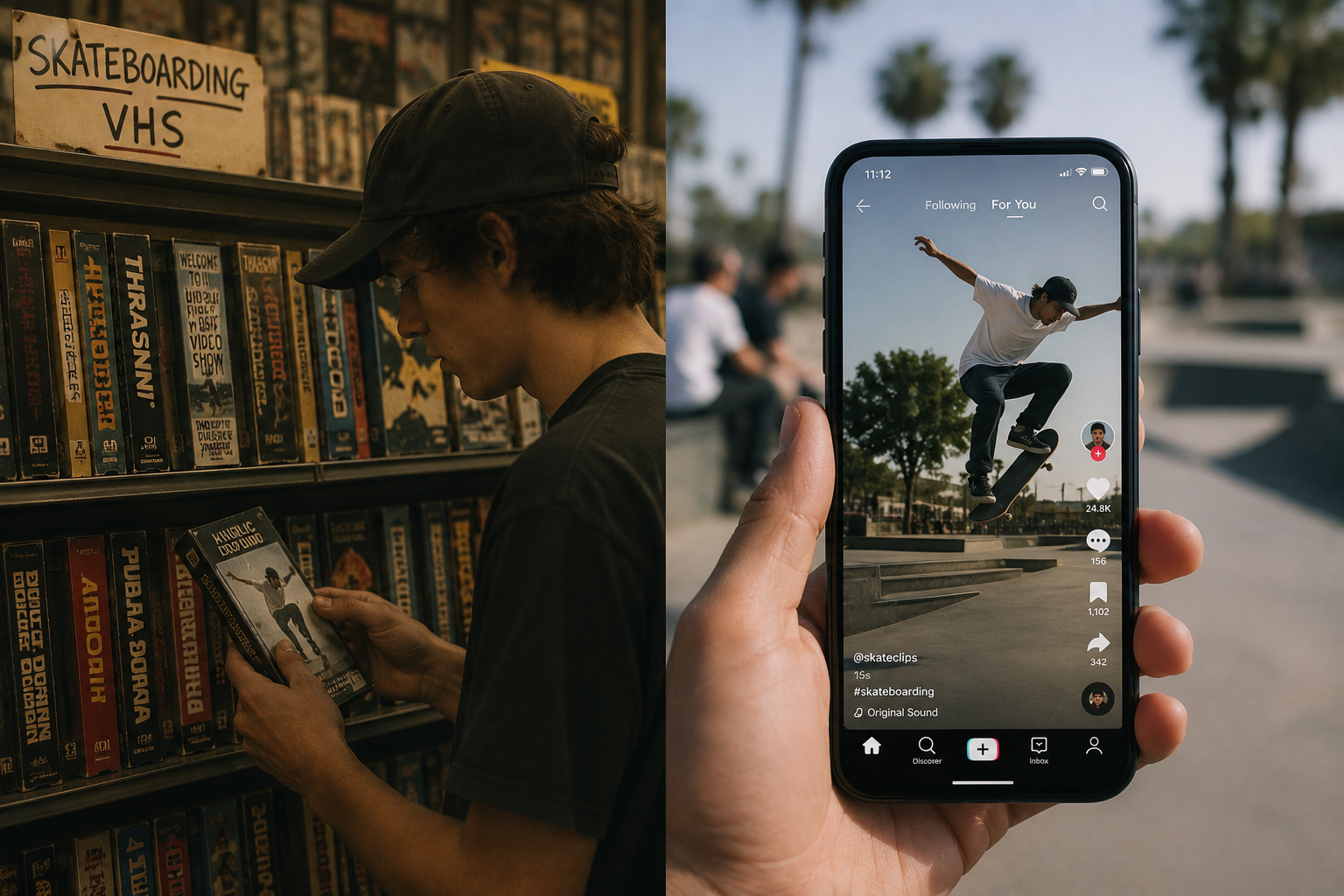
Skateboarding once revolved around full-length videos that documented style, community, and personal journeys. Today, much of that storytelling has been compressed into fifteen-second clips optimized for social media feeds. Supporters argue that short-form content has democratized skateboarding, giving talented skaters instant visibility and unprecedented reach. Critics counter that the shift prioritizes engagement over authenticity, reducing a rich cultural tradition into isolated highlights. As platforms like TikTok and Instagram reshape how skateboarding is consumed, the debate reflects a broader question facing modern media: are we gaining accessibility at the expense of depth, or simply witnessing the next evolution of creative expression?
In the world of skateboarding, the release of a new skate video used to be a landmark event.
Skaters gathered around VHS players, later DVDs and online premieres, to celebrate creativity, progression, filmmaking, and the culture surrounding the sport.
Today, skate videos have largely been replaced by short-form clips optimized for social media feeds.
Have we sacrificed depth for speed in the pursuit of fleeting moments?
Why This Matters Now
The transformation mirrors broader shifts in media consumption driven by technology and the rise of short-form content.
In an era where attention spans are increasingly fragmented, the skate video—a format once revered for storytelling and artistry—faces a new challenge.
Can skateboarding maintain its cultural richness when its stories are compressed into fifteen-second highlights?
The answer has implications not only for skaters but for the future of creative communities built around shared experiences.
Perspectives on the Evolution of Skate Videos
Tony Hawk: Celebrating Speed and Accessibility
Tony Hawk sees the rise of short-form content as an opportunity rather than a threat.
In his view, social media has fundamentally expanded access to skateboarding culture.
"In a world dominated by social media, it's all about engagement."
Hawk argues that short clips allow skaters to reach broader audiences quickly, creating opportunities that didn't exist in the era of traditional skate videos.
"You can go from obscurity to a million followers overnight."
For Hawk, social platforms democratize visibility.
Talented skaters no longer need sponsorships, video premieres, or industry gatekeepers to build an audience.
The trick itself becomes the story.
Rather than diminishing skateboarding, Hawk believes social media has simply created a new artistic language built around immediacy and impact.
Wendy Rhoades: The Risk of Losing Authenticity
Media scholar Wendy Rhoades offers a more cautious perspective.
She argues that while social media increases exposure, it may simultaneously erode the cultural depth that once defined skateboarding.
"In the age of the fifteen-second clip, we risk losing the narratives that once defined skate culture."
Traditional skate videos captured far more than tricks.
They documented friendships, road trips, local scenes, personal struggles, and the unique character of places.
According to Rhoades, those contextual elements helped viewers form deeper emotional connections with both the skaters and the culture.
When content is reduced to isolated moments, the surrounding story often disappears.
Her concern is not about technology itself, but about what may be lost when engagement metrics become the dominant creative priority.
Jason Lee: The Filmmaker's Perspective
Filmmaker and skateboarder Jason Lee occupies a middle ground.
He acknowledges the appeal and utility of short-form content while defending the value of longer storytelling formats.
"We used to create entire films that encapsulated the spirit of the skateboarder, their style, and our narrative."
Lee argues that traditional skate films allowed creators to explore themes, emotions, pacing, and personality in ways that short clips simply cannot.
Longer formats helped audiences appreciate not only what a skater could do, but who they were.
Storytelling created connection.
While Lee appreciates the reach and efficiency of social media, he worries that filmmaking itself may become secondary to algorithm-friendly content.
"We should embrace the new forms while still championing the roots of skate culture."
Editorial Synthesis
Where Experts Agree
Despite their differences, all perspectives acknowledge several realities:
- Social media has fundamentally changed skateboarding media.
- Short-form content increases visibility and audience reach.
- Technology has lowered barriers to participation and exposure.
- The evolution of skate videos reflects larger shifts across digital media.
Where Experts Disagree
Speed vs. Storytelling
Tony Hawk views rapid content as empowering and accessible.
Rhoades and Lee argue that storytelling, context, and cultural meaning are harder to preserve in extremely short formats.
Engagement vs. Depth
Supporters believe short clips maximize attention and participation.
Critics worry that engagement metrics may encourage increasingly superficial interactions with skateboarding culture.
The Future of Skateboarding Media
Some see short-form video as the next logical evolution.
Others fear it may gradually replace the creative traditions that helped define the sport for decades.
Why This Matters
The debate surrounding skate videos is ultimately about more than skateboarding.
It reflects a larger cultural question facing nearly every creative medium today:
What happens when attention becomes the most valuable currency?
Platforms like Instagram, TikTok, and YouTube Shorts have given skaters unprecedented opportunities to showcase their talent.
At the same time, those platforms reward speed, frequency, and instant impact over slow-building narratives.
Neither side of the debate is entirely wrong.
Short-form content has undeniably expanded access and visibility.
Yet traditional skate films offered something that algorithms struggle to replicate: context, atmosphere, and emotional connection.
The future of skateboarding media may not be a choice between one format and the other.
Instead, the challenge will be finding a balance where quick clips drive discovery while longer stories continue to preserve the culture's identity.
The question isn't whether skate videos are disappearing. It's whether the next generation will still have reasons to watch something longer than a scroll.
Depth Versus Speed: Reflecting on Skate Culture's Evolution
The rapid transition from extensive skate videos to concise social media clips presents both opportunities and challenges for the skateboarding community. While figures like Tony Hawk praise the instant exposure and democratization that these short formats provide, we must consider the potential loss of storytelling and artistry that characterized the skate videos of the past. As skaters trade lengthy narratives for fleeting moments, there's a risk that the rich culture surrounding skateboarding could be diluted into mere trends. Navigating this digital landscape requires a balance; embracing the immediacy of social media while preserving the depth and creativity that inspire communities. Ultimately, this evolution should invite a dialogue about the value of both formats in shaping the future of skateboarding. Shall we celebrate speed, or seek to reclaim depth? The answer lies in how we choose to engage with the culture we love.

Tony Hawk
Professional Skateboarder, Entrepreneur
"As a longtime advocate for skate culture, I believe that longer-format skate videos cultivate a deeper appreciation for the sport, allowing viewers to connect with the skaters' journeys and creativity. The quick clips might be engaging but often lack the emotional depth and storytelling found in traditional skate videos."
𝕏 Tony Hawk in Tony Hawk
Wendy Rhoades
Director of Media Studies, NYU
"In today's fast-paced digital landscape, 15-second clips can foster immediate engagement and excitement within the skate community. While depth is valuable, the brevity of these clips allows for greater accessibility and sharing, reaching a wider audience and keeping the culture alive."
in Wendy RhoadesJason Lee
Filmmaker and Skateboarder
"While I appreciate the artistry behind long-form skate videos, I recognize that the rapid consumption of short clips reflects changing audience habits. Both formats hold merit; it's about finding how they can coexist and complement each other in evolving the culture."
in Jason LeeHow Does This Hit You?


No comments yet. Be the first to weigh in.