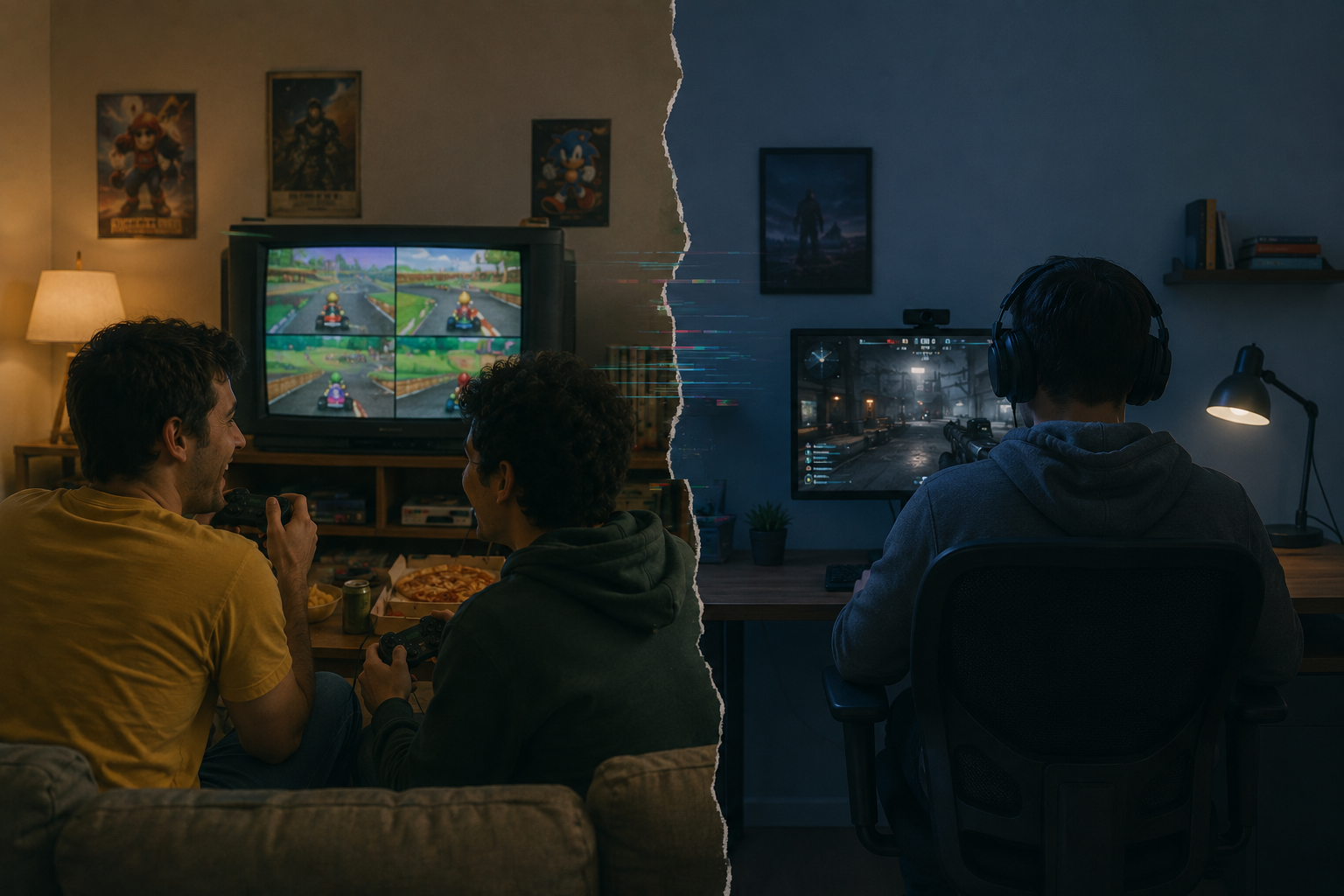
For decades, couch co-op gaming was as much about friendship as it was about the games themselves. Friends gathered in the same room, shared a screen, celebrated victories, and traded insults that were equal parts competitive and affectionate. Today, online multiplayer has largely replaced that experience, making it easier than ever to play together from anywhere in the world. While some argue that online gaming has preserved friendships that distance might otherwise destroy, others worry that convenience has come at the cost of genuine human connection. The debate raises a broader question: did online co-op simply replace the couch, or did it fundamentally change the way friendships are formed and maintained?
For many gamers, some of the most memorable gaming experiences didn't happen online.
They happened on a couch.
Friends crowded around a television, sharing controllers, arguing over strategies, celebrating victories, and engaging in the kind of playful trash talk that only works when everyone is in the same room.
Today, that experience has become increasingly rare.
Online multiplayer has largely replaced couch co-op, allowing players to connect instantly regardless of geography.
The convenience is undeniable.
But it raises a deeper question:
Did online co-op simply eliminate the couch—or did it weaken the friendships that once formed around it?
As gaming becomes increasingly digital, the answer says a great deal about how technology is reshaping social connection.
Why This Matters Now
Gaming has become one of the world's largest forms of entertainment.
At the same time, concerns about loneliness and social isolation have grown across many societies.
The decline of couch co-op reflects a broader cultural shift.
Activities once experienced in shared physical spaces are increasingly taking place online.
For gamers, this evolution presents both opportunities and challenges.
Technology has made connection easier than ever, yet many people wonder whether those connections feel as meaningful as they once did.
The debate over couch co-op is ultimately a debate about friendship itself.
Expert Perspectives
Dr. Jamie Madigan: The Value of Physical Presence
Psychologist and game researcher Dr. Jamie Madigan argues that something important is lost when gaming moves entirely online.
While online multiplayer enables connection, he believes it cannot fully replicate the social dynamics of sharing physical space.
"The dopamine rush from shared laughter and the thrill of competitive trash-talking in the same room fosters deeper connections."
According to Madigan, face-to-face interaction creates stronger emotional bonds because it incorporates body language, spontaneous reactions, and shared environmental experiences.
Gaming together becomes more than gameplay.
It becomes a social event.
The friendship often grows in the moments between the matches.
Madigan worries that online gaming can sometimes create an illusion of social connection while reducing opportunities for deeper interpersonal engagement.
"Players may think they're socializing, but lack of physical presence might result in less meaningful interactions."
Anita Sarkeesian: Community Beyond Convenience
Media critic Anita Sarkeesian approaches the issue from a cultural perspective.
She acknowledges that online gaming has expanded access dramatically.
People who once struggled to find local gaming communities can now connect with others around the world.
However, she questions whether accessibility alone can replace the community-building aspects of couch co-op.
"Couch co-op has historically been a space for relationship-building, including the forging of identity and cultural conversation."
Shared physical spaces often encourage conversations that extend beyond the game itself.
Friendships develop through the rituals surrounding gaming:
- Hanging out before playing
- Sharing food
- Watching others play
- Talking between matches
- Experiencing victories and defeats together
The game was often just the excuse to gather.
Sarkeesian worries that as gaming becomes increasingly individualized and remote, some of those cultural and social experiences may disappear.
Geoff Keighley: Friendship Adapts
Video game journalist Geoff Keighley takes a more optimistic view.
He agrees that couch co-op offers a unique kind of connection, but he rejects the idea that online gaming is inherently inferior.
"People are busier than ever, and online co-op allows friends to connect without logistics becoming a barrier."
For Keighley, online multiplayer has preserved friendships that might otherwise fade due to distance, careers, family responsibilities, or changing lifestyles.
Technology has allowed gaming communities to remain connected across cities, countries, and even continents.
Without online gaming, many friendships simply wouldn't survive adulthood.
Keighley cautions against romanticizing the past.
While couch co-op created memorable experiences, it was also limited by geography and schedules.
Modern technology offers flexibility that previous generations never had.
"It's not either/or; it's about how we can integrate both experiences."
Editorial Synthesis
Where Experts Agree
Despite their differing conclusions, all three experts acknowledge several realities:
- Gaming is fundamentally a social activity.
- The format of interaction influences relationship quality.
- Technology has dramatically changed how friendships are maintained.
- Community remains a central part of gaming culture.
Where Experts Disagree
Can Online Gaming Replicate In-Person Friendship?
Madigan and Sarkeesian believe physical presence creates richer social experiences.
Keighley argues that online interactions can still produce meaningful and lasting friendships.
Accessibility vs. Intimacy
Online gaming offers convenience and broader access.
Couch co-op offers deeper immersion in shared social experiences.
The debate centers on whether one benefit compensates for the loss of the other.
The Future of Gaming Communities
Some see online gaming as weakening traditional social rituals.
Others see it as expanding opportunities for connection in a more mobile and geographically dispersed world.
Why This Matters
The discussion surrounding couch co-op extends far beyond gaming.
It reflects a larger question confronting modern society:
What happens when convenience replaces physical presence?
Many technologies promise greater connection.
Yet they often change the nature of that connection in subtle ways.
Online gaming has undoubtedly brought people together across enormous distances.
It has allowed friendships to survive life changes that might once have ended them.
At the same time, the decline of couch co-op represents the loss of a unique social experience—one built on proximity, spontaneity, and shared physical space.
Perhaps the real issue is not whether online gaming killed friendship.
It is whether society has become too willing to substitute digital interaction for in-person connection whenever possible.
The healthiest future may not involve choosing between the couch and the internet.
It may involve recognizing the value of both.
Online gaming keeps friendships alive across distance. Couch co-op reminds us why those friendships mattered in the first place.
The couch may no longer be the center of gaming culture, but the need for genuine human connection remains exactly where it has always been.
The Couch is Not Dead—Yet
The shift from couch co-op to online gaming brings undeniable conveniences, but the value of face-to-face interaction cannot be overlooked. As highlighted by Dr. Jamie Madigan, the deep bonds formed through shared experiences in the same physical space are crucial for sustaining friendships. While online co-op has democratized access to multiplayer experiences, it risks creating a more superficial social fabric. Let's not abandon couch co-op completely; instead, we should strive to blend both worlds. Hosting game nights and reviving the couch experience, while complementing it with online play, can enrich our gaming lives and keep our friendships strong. After all, laughter and friendly banter are best enjoyed in person, and the couch should remain a vital part of our gaming culture.
Dr. Jamie Madigan
Psychologist and Game Researcher
"Dr. Madigan believes that couch co-op fosters closer interpersonal connections, encouraging face-to-face interactions and shared experiences that are integral to maintaining friendships. He argues that online co-op cannot fully replicate the laughter and camaraderie of in-person play."
𝕏 Dr. Jamie Madigan in Dr. Jamie Madigan
Anita Sarkeesian
Media Critic and Feminist Gamer
"Anita argues that online co-op has democratized gaming, allowing friends to connect regardless of location, thus fostering new types of friendships and collaboration. She believes that while couch co-op has its charm, the accessibility of online play is pivotal in expanding relationships in a global context."
in Anita SarkeesianGeoff Keighley
Video Game Journalist and Host
"Geoff acknowledges the nostalgia and community spirit of couch co-op while recognizing that online modes have made gaming more inclusive and diverse. He suggests that both forms of play can coexist, each catering to different social needs in the gaming experience."
𝕏 Geoff KeighleyHow Does This Hit You?



No comments yet. Be the first to weigh in.