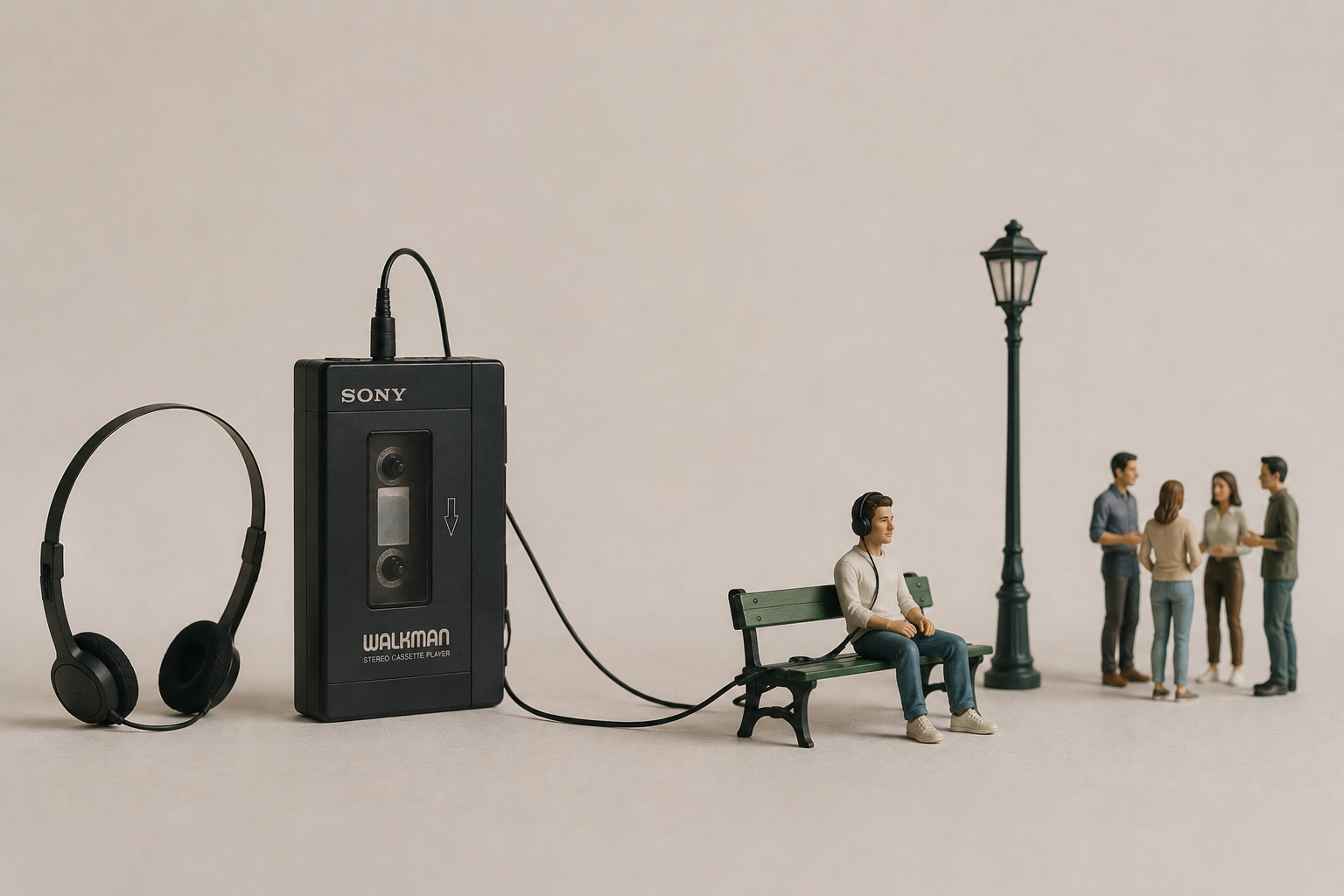
When Sony introduced the Walkman in 1979, it transformed music from a shared activity into a deeply personal experience. For the first time, listeners could carry their favorite songs wherever they went, creating private soundtracks for everyday life. Supporters argue that this shift allowed for deeper emotional connections with music, self-reflection, and individual expression. Critics contend that it also normalized a culture of isolation, replacing communal listening with personalized audio bubbles. As earbuds and streaming services become increasingly ubiquitous, the debate raises a timely question: did portable music liberate listeners—or quietly reshape society's relationship with one another?
When Sony launched the Walkman in 1979, it did more than revolutionize music technology.
It changed the way people experienced music itself.
For the first time, listeners could carry their favorite songs through city streets, train rides, parks, and everyday routines.
Music was no longer tied to a living room stereo, a concert venue, or a shared social setting.
It became personal.
But in making music portable, did the Walkman also normalize listening alone—and fundamentally alter how people connect with one another?
More than four decades later, that question feels increasingly relevant in a world dominated by earbuds, streaming services, and personalized algorithms.
Why This Matters Now
The Walkman's influence extends far beyond cassette tapes.
It established the foundation for nearly every personal audio device that followed:
- Portable CD players
- MP3 players
- Smartphones
- Wireless earbuds
- Streaming platforms
Today, millions of people move through daily life accompanied by personalized soundtracks.
The ability to curate individual listening experiences is often celebrated as a triumph of personal freedom.
Yet it has also contributed to a broader cultural shift.
Music, once frequently experienced as a shared activity, has increasingly become a solitary one.
Understanding that shift offers insight into larger questions about technology, community, and human connection.
Expert Perspectives
David Bowie: Music as a Personal Soundtrack
Few artists embraced technological change as enthusiastically as David Bowie.
For Bowie, the Walkman represented a new form of intimacy between listener and music.
"It's like having your soundtrack playing all the time, which lets you navigate your own life in a way that feels uniquely yours."
The device allowed people to shape their emotional environment in real time.
A commute could feel cinematic.
A walk could become reflective.
An ordinary moment could become meaningful through music.
The Walkman transformed listeners from passive consumers into active curators of their own experiences.
From this perspective, solitary listening is not isolation.
It is empowerment.
David Byrne: The Value of Listening Alone
David Byrne, former frontman of Talking Heads, similarly sees value in individualized listening.
While known for exploring the social dimensions of music, Byrne argues that listening alone offers something uniquely important.
"When you listen to music alone, you're not just engaged with the artist; you're involved in a dialogue with your inner self."
For Byrne, music can function as a tool for:
- Reflection
- Creativity
- Emotional processing
- Personal discovery
The Walkman expanded access to those experiences by allowing listeners to carry music wherever they went.
Listening alone became less an act of withdrawal and more an opportunity for self-exploration.
Sherry Turkle: The Hidden Cost of Solitude
Sociologist and MIT professor Sherry Turkle offers a more critical perspective.
While acknowledging the benefits of personal listening, she argues that the Walkman also accelerated a broader trend toward social isolation.
"People have become more disconnected from each other, even as they listen to music tailored to their tastes."
Turkle believes personal technologies often encourage individuals to retreat into private experiences rather than engage with those around them.
The result may be fewer spontaneous conversations, fewer shared cultural moments, and weaker social connections.
When everyone inhabits a personalized soundscape, opportunities for communal experiences can diminish.
For Turkle, the issue is not music itself but the way technology mediates social interaction.
She warns that excessive personalization can contribute to emotional distance and reduced empathy.
Editorial Synthesis
Where Experts Agree
Despite their different conclusions, all perspectives recognize several important realities:
- The Walkman fundamentally changed how people consume music.
- Portable listening created experiences that were previously impossible.
- Technology continues to shape cultural relationships with music.
- Music remains a powerful tool for emotional engagement and identity formation.
Where Experts Disagree
Empowerment vs. Isolation
Bowie and Byrne view solitary listening as liberating and enriching.
Turkle sees potential risks in the normalization of private listening experiences.
Personal Growth vs. Social Connection
Supporters argue that listening alone encourages introspection and self-discovery.
Critics worry that it may come at the expense of shared cultural experiences.
The Legacy of Personal Technology
Some celebrate the Walkman as the beginning of greater individual freedom.
Others see it as an early step toward increasingly fragmented social interactions.
Why This Matters
The debate surrounding the Walkman is ultimately about more than music.
It is about how technology changes the way people relate to one another.
Before portable audio, music was often experienced collectively:
- Around home stereos
- At parties
- In public spaces
- Through shared albums and radio broadcasts
The Walkman shifted that dynamic by placing the listener at the center of a private experience.
That transformation brought undeniable benefits.
People gained control over how, when, and where they listened.
Music became more personal, more intimate, and more integrated into daily life.
Yet every technological gain involves tradeoffs.
As personalized media experiences continue to expand, society faces a recurring question:
What do we gain when technology personalizes culture—and what do we lose when those experiences are no longer shared?
The answer may not be choosing between solitude and community.
It may be recognizing that both serve important roles.
Music can connect us to ourselves, and it can connect us to each other.
The challenge is ensuring that one does not entirely replace the other.
The Walkman didn't simply make music portable. It redefined where the experience of music happens: inside a community, inside a room, or increasingly, inside a single pair of headphones.
Solo Soundscapes: A Double-Edged Sword
The Walkman undeniably changed our listening habits, allowing for a deeply personal relationship with music. While artists like Bowie and Byrne celebrate the nuanced dialogues that solitary listening fosters, we must also consider the societal consequences of this shift towards individualism. The ability to curate our own soundtracks can lead to emotional introspection, but it risks creating a barrier between us and communal experiences. As we move further into an age of personalized audio, it is essential to strike a balance between enjoying music in solitude and nurturing shared listening experiences that bond us. Ultimately, the Walkman paved the way for a revolution in music consumption, one that calls for reflection on the value of connection in both our personal and collective lives.
David Bowie
Musician and Icon
"The Walkman facilitated a personal relationship with music, allowing individuals to curate their own soundtracks for life, which was vital for self-expression and individuality."
𝕏 David Bowie in David BowieSherry Turkle
Professor of Social Studies of Science and Technology, MIT
"While the Walkman allowed for personal music experiences, it also normalized solitude in public spaces, which could detract from genuine social interactions and communal experiences."
𝕏 Sherry Turkle in Sherry TurkleDavid Byrne
Musician and Author
"The Walkman revolutionized music listening, but its impact on social interaction is complex; it depends on individual use. Music can both connect and isolate, shaping cultural experiences uniquely for each user."
in David ByrneHow Does This Hit You?



No comments yet. Be the first to weigh in.